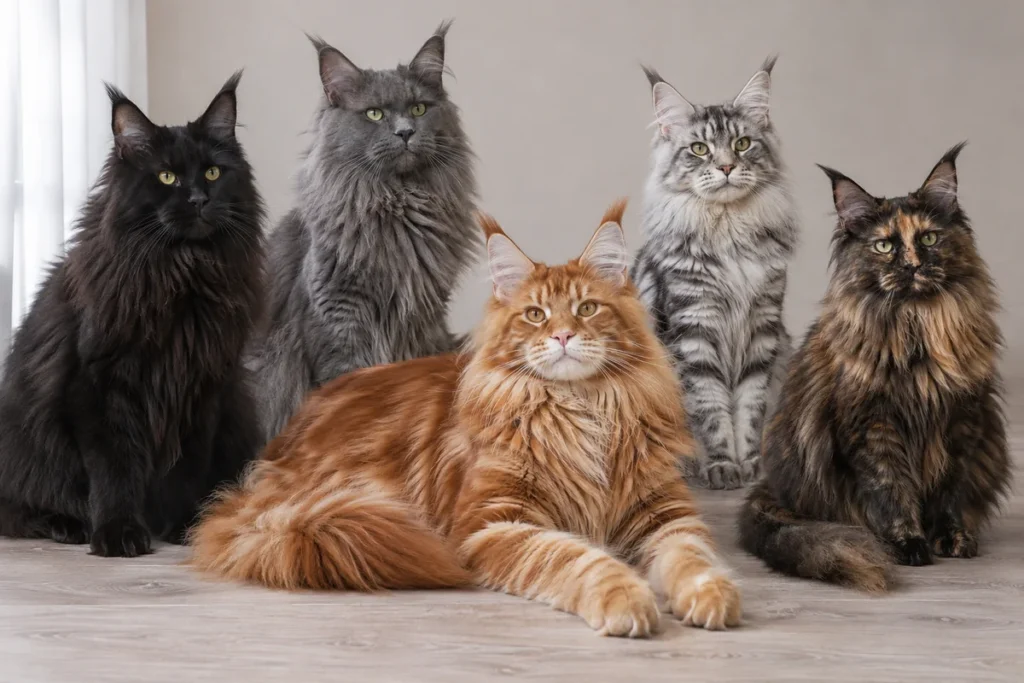
Maine Coon colors are sorted by the Cat Fanciers’ Association (CFA) into classes: solid, tabby, tabby and white, bi-color, parti-color, shaded and smoke. Each class has a written definition. Chocolate, lavender and the Himalayan pattern are not on the list, and the CFA disqualifies cats showing evidence of hybridization that produced them.
Owners often cannot tell which class their cat belongs to, because “grey” covers blue, smoke, silver and tabby coats. The classes below come from the CFA Maine Coon breed page, with a guide for each coat on this site.
What colors do Maine Coons come in?
Maine Coon colors in the CFA standard run from five solids (white, black, blue, red, cream) through tabbies, bi-colors, tortoiseshells, calicos, shaded silvers and smokes. The standard names the class and gives the exact shade, nose leather and paw pad color for each.
| CFA class | Colors the standard lists | Guide |
|---|---|---|
| Solid | White, black, blue, red, cream | White, black, blue, red |
| Tabby (classic, mackerel, ticked) | Brown, silver, red, blue, blue-silver, cream, cream-silver, cameo, plus patched (torbie) versions of brown, silver, blue and blue-silver | Tabby, silver |
| Tabby and white (including vans) | Each tabby color with white on bib, belly and all four paws | Tabby |
| Bi-color (including vans) | Black and white, blue and white, red and white, cream and white | Tuxedo |
| Parti-color | Tortoiseshell, blue-cream | Tortoiseshell |
| Parti-color and white | Calico, dilute calico, tortoiseshell and white, blue-cream and white | Calico |
| Shaded and smoke | Chinchilla and shaded silver, cameo, cream, tortoiseshell and blue-cream shells; black, blue, cameo, cream and tortie smoke | Black smoke, silver |
Solids are defined strictly. Red must be “without shading, markings, or ticking”, blue must be “one level tone from nose to tip of tail”, and black must be “free from any tinge of rust on tips or smoke undercoat”. A cat that fails those tests does not meet the solid definition.
Color carries 15 of the standard’s 100 points, listed as body color and pattern. Head and body are worth 30 points each, and coat adds 20, so a cat is judged first on structure. The grey Maine Coon guide sorts the blue, smoke, silver and tabby coats that people call grey.
What patterns do Maine Coons come in?
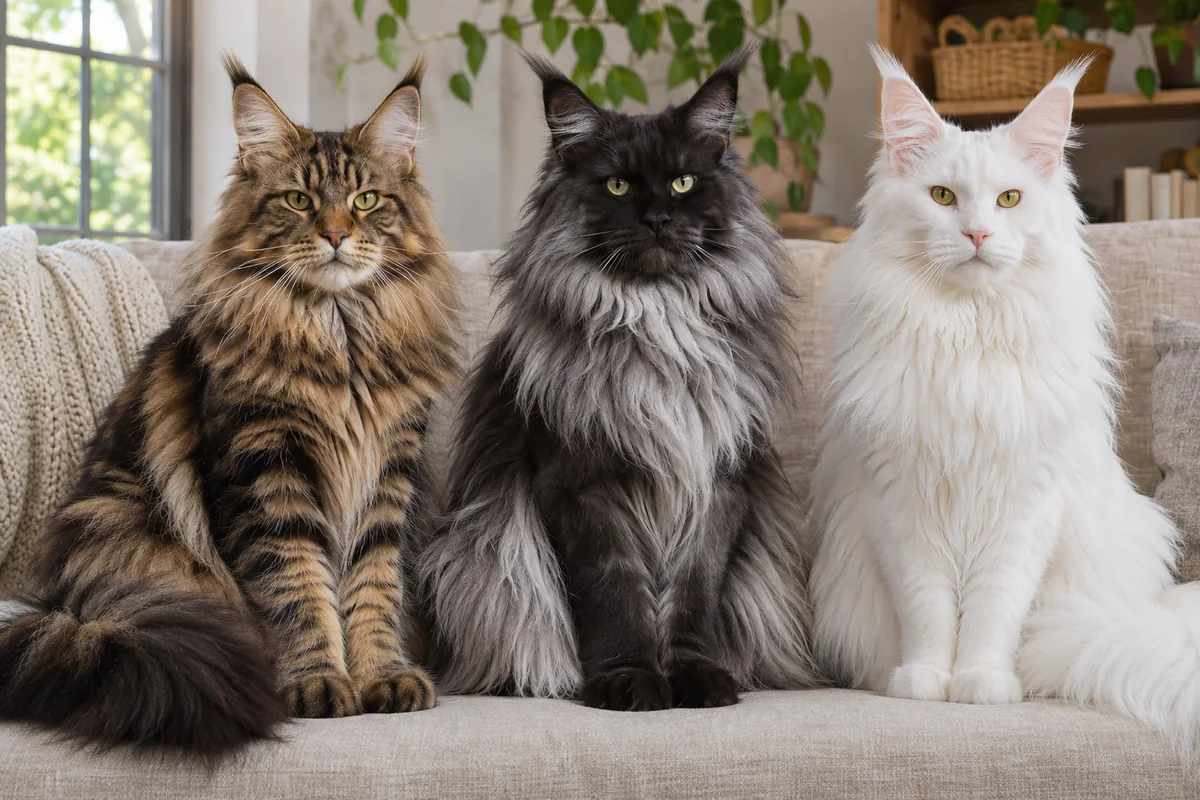
Three tabby patterns are recognized for the breed: classic, mackerel and ticked. Each is defined by markings. Classic shows broad, dense swirls and a butterfly shape over the shoulders, mackerel shows narrow pencil-thin stripes, and ticked shows ticked hairs on the body with tabby markings on the face and legs.
Patched tabbies, called torbies in the standard’s wording, add patches of red or cream to a brown or silver tabby base. The tabby Maine Coon guide lays out the three patterns in full, and the tortoiseshell Maine Coon guide covers the parti-colors.
How do smoke, shaded and silver Maine Coons differ?
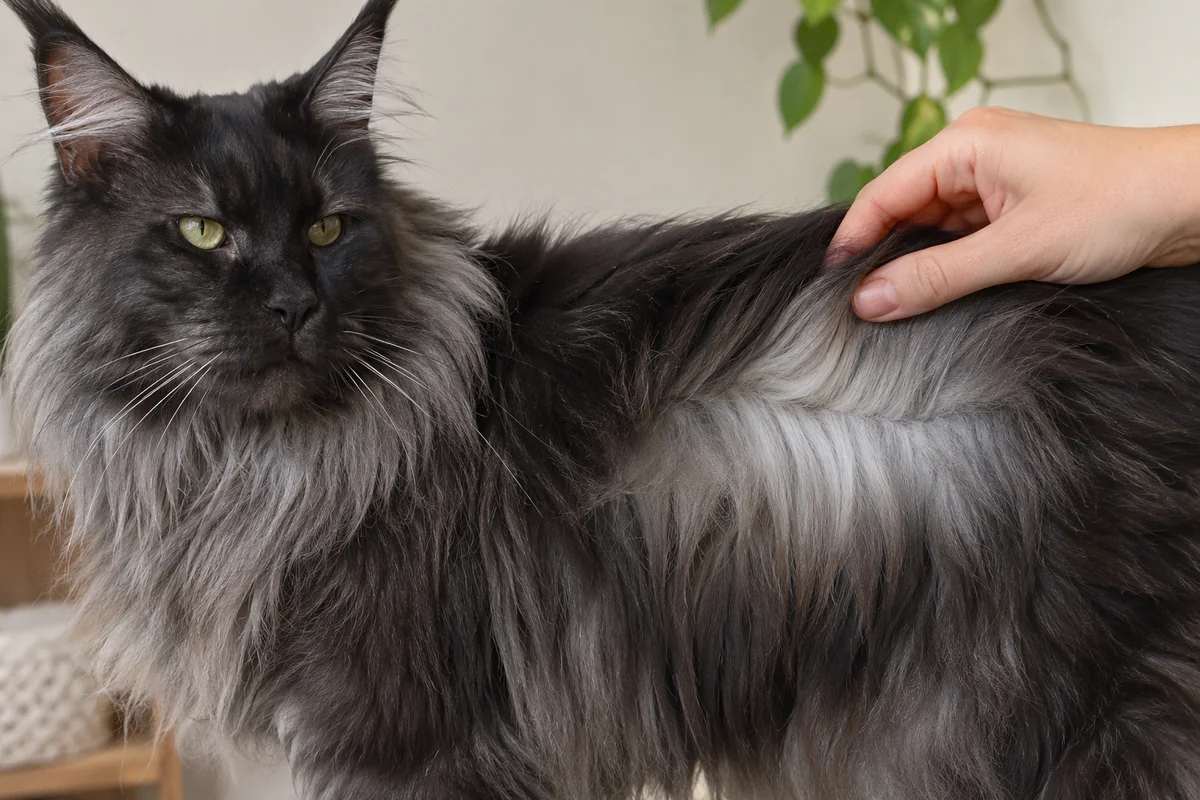
The difference is how far the dark color reaches down each hair. A smoke is deeply tipped over a white undercoat, a shaded silver darkens along the back and fades to white underneath, a chinchilla is only lightly tipped, and a silver tabby has a pale ground color with dense markings.
| Coat | CFA wording |
|---|---|
| Black smoke | “white undercoat, deeply tipped with black”; “cat in repose appears black. In motion the white undercoat is clearly apparent” |
| Shaded silver | “undercoat white with a mantle of black tipping shading down from sides, face, and tail”; “much darker than a chinchilla” |
| Chinchilla silver | “undercoat pure white”, back, flanks, head and tail tipped with black “to give the characteristic sparkling silver appearance” |
| Silver tabby | “ground color pale, clear silver. Markings dense black” |
| Blue smoke | “white undercoat, deeply tipped with blue”; appears blue at rest |
Smokes show it best when the cat moves. The black smoke Maine Coon guide and the silver Maine Coon guide take the two coats in detail.
How does white change a Maine Coon’s color class?
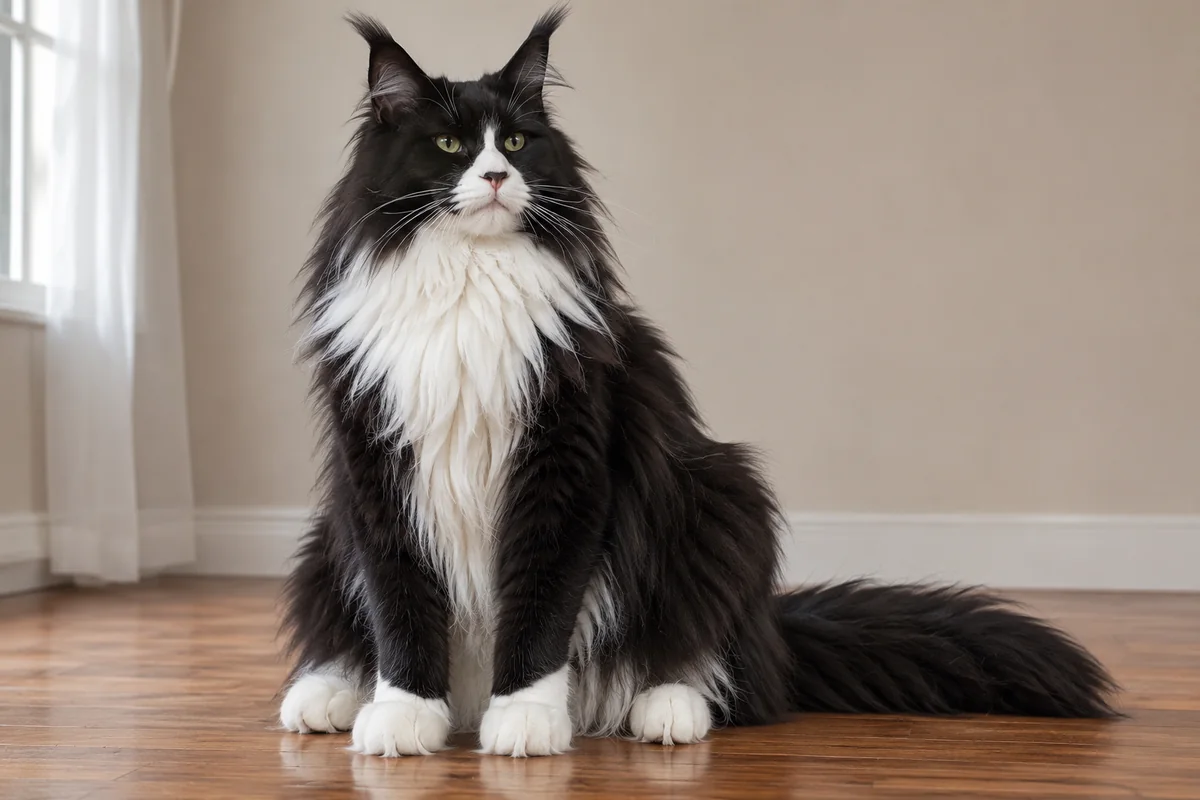
White moves a cat into a separate class with required markings. The standard says bi-colors, tabbies with white and tortoiseshell-and-white cats must have white on the bib, belly and all four paws, and it penalizes colors with white that lack those areas.
Small white marks are a different matter. The same standard lists “white buttons, white lockets, or white spots” among its disqualifications. The page does not say how that rule interacts with the white classes, so it is unclear how a cat with a single chest patch would be judged. The tuxedo Maine Coon guide goes through what the white classes mean when buying.
What eye colors can Maine Coons have?
Green, gold, green-gold or copper, according to the CFA standard. White cats and all cats with white may have blue or odd eyes. The standard gives no other eye colors for the breed, so blue eyes on a cat with no white fall outside the standard.
Eyes carry only 5 of the 100 points.
Which Maine Coon colors does the CFA not accept?
Chocolate, lavender and the Himalayan pattern. The standard disqualifies “cats showing evidence of hybridization resulting in the colors chocolate, lavender, or the Himalayan pattern”. A pointed or chocolate cat sold as a Maine Coon therefore sits outside the colors the standard lists. The guide to Maine Coon mixes covers the crosses behind such coats.
How do owners work out their cat’s color?
Mostly by asking. In r/mainecoons, an owner of a stray posted a photo and asked what color she was, noting “Shades of Grey’s in the shade but light browns and tan” in the light. One reply drew 23 upvotes:
“Blue. Crazy that somebody just abandoned their luxury cat”
– r/mainecoons (23 upvotes)
Another owner wrote, “I’m pretty sure he’s a gray or silver Smokey color but I was just looking to hear other people’s input”, and said he wanted the coat right for the cat’s new social accounts. CFA definitions separate those cases: a smoke shows its white undercoat in motion, while a silver tabby has a pale silver ground color.
FAQ
What is the rarest of the Maine Coon colors?
No source read ranks them. According to the CFA breed page, anyone who wants a particular color or sex should “expect a wait”, while finding a Maine Coon kitten at all “should not be a challenge”.
What is the most common Maine Coon color?
The CFA does not say. Its history article notes that the brown tabby with a bushy ringed tail is the color “most commonly in nature”, which is a statement about cats in general and not about registered Maine Coons.
Is there a cream Maine Coon?
Yes. Cream appears among the standard’s solids, described as “one level shade of buff cream, without markings”, plus cream tabby, cream smoke and cream-and-white versions.