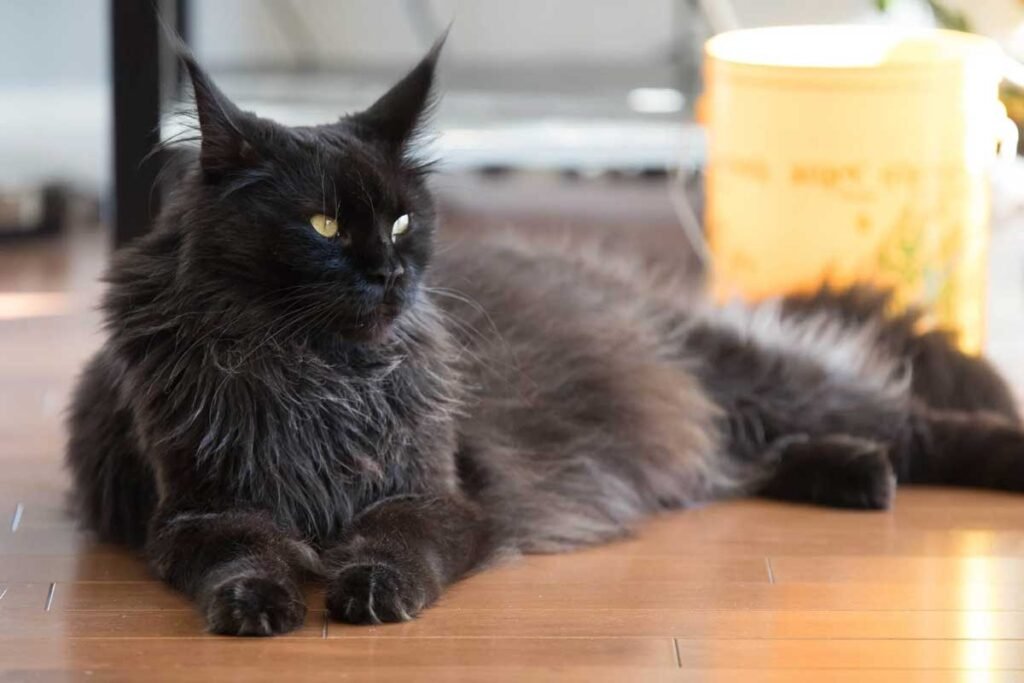
A black smoke Maine Coon is a black cat with white roots. Part the fur on her shoulder and the hair sits pale at the base and dark at the tip, so she reads as solid black standing still and flashes silver the moment she moves. That contrast is the entire pattern.
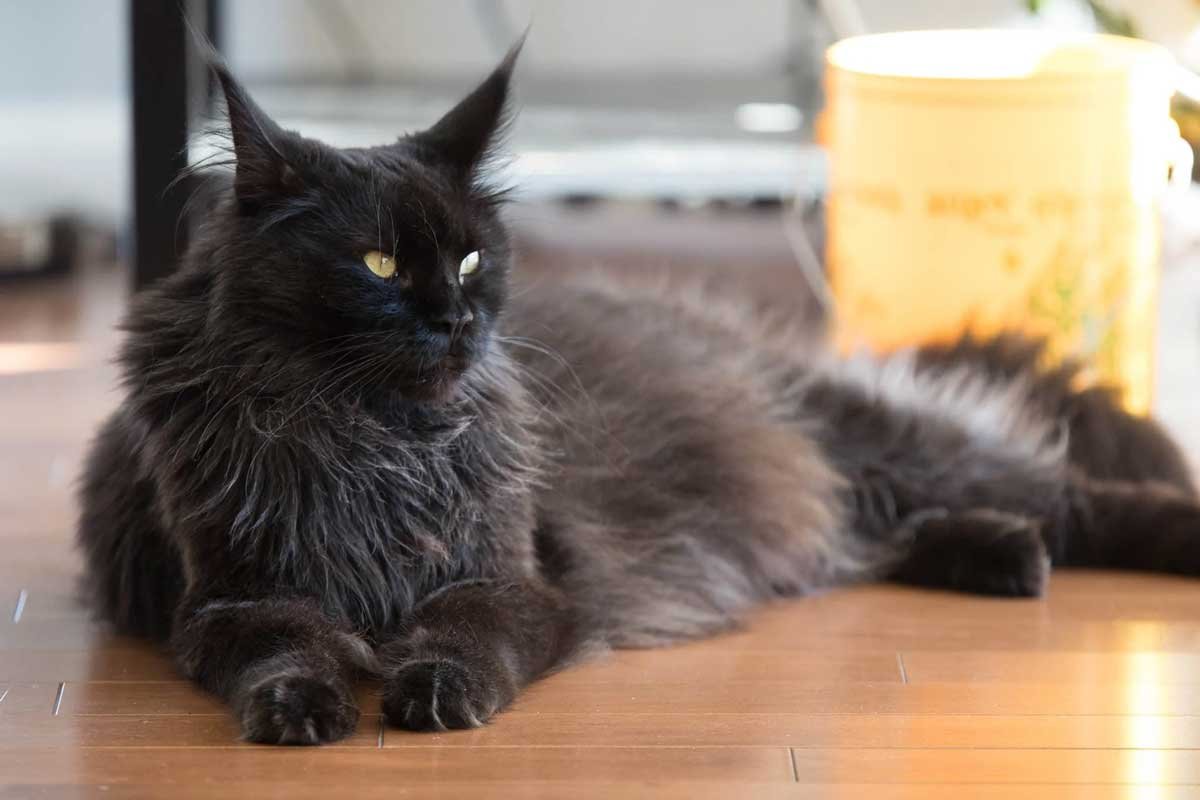
It is also why buyers get confused. Photographs of one cat, taken in different light and at different ages, can look like three separate animals, and a five-month-old kitten frequently looks nothing like the adult she will become. Sellers are not necessarily exaggerating when their photos disagree with each other. The coat genuinely does this.
How the Smoke Pattern Actually Works
Smoke needs two things at once: a solid, non-agouti coat colour, and the silver inhibitor gene that blocks pigment from developing along the lower part of each hair. Take the inhibitor away and you have an ordinary black cat. Add it to a tabby instead of a solid and you get a silver tabby, stripes and all.
The inhibitor gene documented in cat coat genetics is dominant, so a single copy from one parent is enough to produce smoke kittens. Breeders who own a silver-carrying stud tend to produce them repeatedly, which is why smoke kittens cluster in certain catteries rather than appearing evenly across the breed.
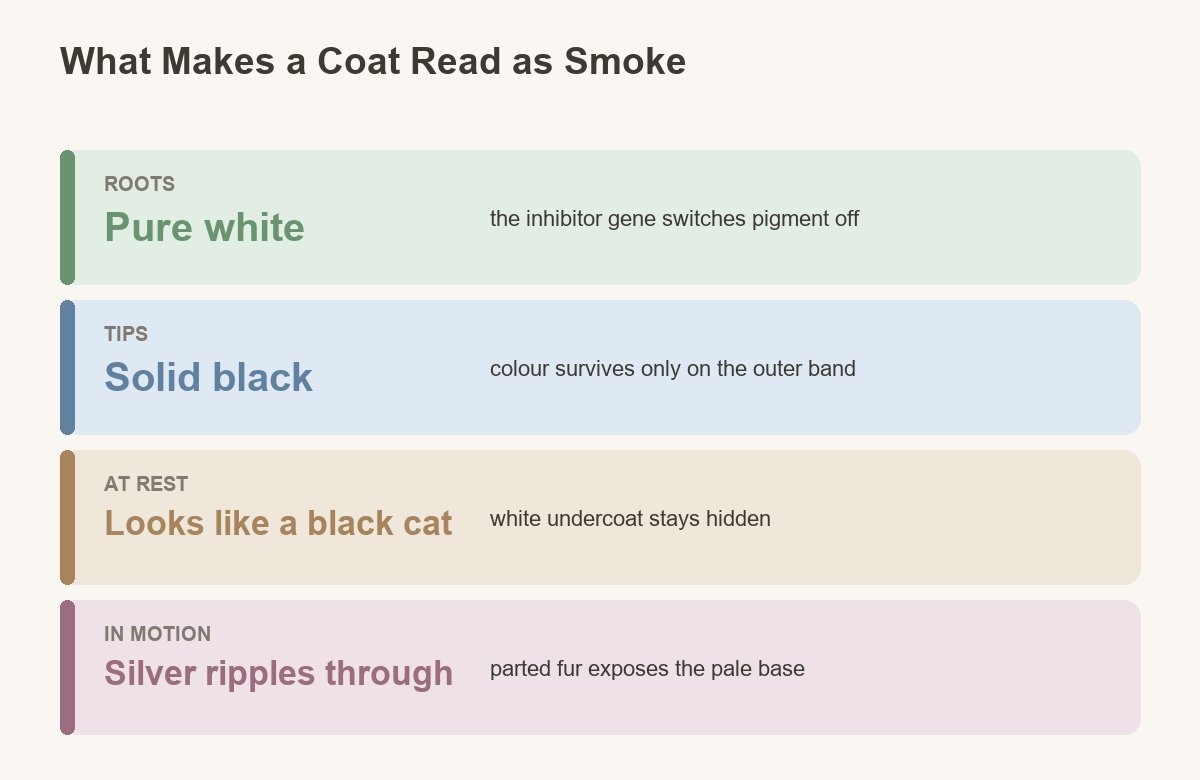
How far up the shaft the white climbs is what breeders mean by high smoke or low smoke. High smoke pushes the pale band further toward the tip and produces a cat that looks dramatically silver in motion; a low smoke can pass for solid black until you go looking. Neither is a separate variety, and no registry grades them.
In pedigree shorthand the coat is coded ns, where n stands for black and s marks the silver gene. Cattery pages sometimes print it beside a cat’s name without explaining it, and that two-letter code tells you more about the coat than any adjective in the listing.
Why Smoke Kittens Change So Much
Smoke kittens usually arrive looking like plain black kittens, and the silver reveals itself over the following months as the adult coat and the full ruff come in. Prospective buyers see photos of a nearly black five-month-old and a shimmering silver adult and reasonably wonder whether they are looking at the same cat.
“We have been told by the breeder that she’s a “black high smoke” colour and were really curious if anyone knew what she would look like as she got older! We have done a lot of research but have noticed that a lot of the “black high smoke” photos include very dark Maine coons, almost black and some grey.”
– r/MaineCoon, July 2026 (483 upvotes)
Both of those photo sets can be honest.
The contrast in any given photo depends on coat stage, lighting, and how far the white band runs on that individual cat. So the practical move for a buyer is to stop reading labels and ask the breeder for daylight photos of the kitten’s parents as adults, outdoors if possible. A queen and a stud you can see fully grown will predict your kitten’s adult coat far better than any adjective applied at five months, when the baby coat is still doing all the talking. Photos of littermates from a previous pairing work almost as well.
Expect the ruff and tail to show the effect first, since that is where the fur is longest and parts most readily.
Telling a Smoke From a Solid Black
Blow gently into the coat against the direction of growth. A smoke shows a pale, almost white band at the roots across the whole body; a solid black cat stays black all the way down to the skin. Do it in daylight rather than under a lamp, because warm indoor light hides the effect.
Two more places give it away: the ruff around the neck often looks noticeably lighter than the back, and the fur behind the ears carries a silver cast that photographs poorly but is obvious in person.
Watch out for the confusion with blue smoke, which is the same pattern on a diluted grey-blue base rather than black. And a smoke that shows faint ghost striping in strong sun is likely a smoke tabby, which registries file separately.
What a Black Smoke Maine Coon Costs
Expect roughly $3,000 for a black smoke Maine Coon kitten from a US cattery that keeps a dedicated waitlist for the colour, rising to about $3,500 when the kitten is also polydactyl. Those are the current published figures at Gold Rush Maine Coons, a cattery that runs a separate black or blue smoke list because demand outstrips what their lines produce.
A second published example: oregonmainecoon.com lists smoke kittens at $3,300 against a $3,000 base, and $3,600 when the kitten is also polydactyl. The full set of cattery and rescue prices is in the Maine Coon price guide.
The waitlist is the honest explanation for the price, not rarity in any genetic sense. Silver is a dominant gene and a cattery with the right stud produces smoke reliably; catteries without one produce none. Scarcity is a supply decision made years earlier when someone chose which cats to breed.
Weigh a smoke premium the way you would any other. Health testing on the parents, HCM scan dates, and registered lineage decide whether a kitten is worth four figures. A dramatic coat on untested parents is the expensive mistake in this breed.
FAQ
Are black smoke Maine Coons rare?
Black smoke Maine Coons are uncommon rather than genetically rare, because the silver inhibitor gene is dominant and any cattery with a silver-carrying parent produces them predictably. Waitlists exist because relatively few breeding programmes carry the gene.
What is the rarest Maine Coon colour?
No registry publishes colour frequency figures, so every rarest colour claim is an estimate rather than a count. Solid white and gold-shaded coats are scarce in most programmes, and any colour needing several recessive genes at once appears least often.
How do you spot a fake Maine Coon?
Check registration papers and structure, never the coat. A genuine Maine Coon has a long rectangular body, heavy boning, a square muzzle with a visible break, and a tail as long as the body; a fluffy black smoke cat with a round face and fine bones is a domestic longhair.
Does a black smoke coat change with the seasons?
Smoke coats look most dramatic when the full winter coat is in, because the longer fur parts more easily and exposes the white undercoat. After a heavy summer moult the same cat can read closer to solid black until the coat grows back.