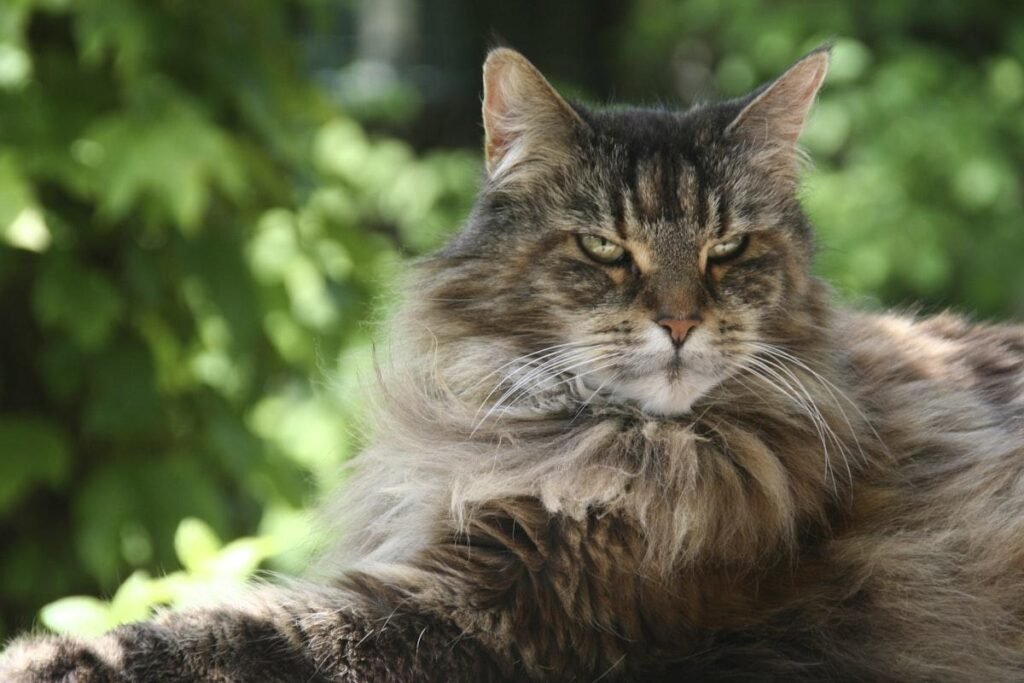
A Maine Coon Siberian mix is biologically straightforward and administratively impossible. The two breeds cross without difficulty, produce large semi-longhaired kittens, and those kittens cannot be registered as anything, because both breeds bar outcrossing at championship level.
The more interesting question is the one people ask underneath it: whether these two breeds were the same thing to begin with. The genetics answer that clearly, and the answer is no.
Are Maine Coons Just Siberian Cats?
No. The story that Maine Coons descend from Siberian or Norwegian Forest cats carried over by Vikings or sailors is folklore, and it does not survive genetic testing.
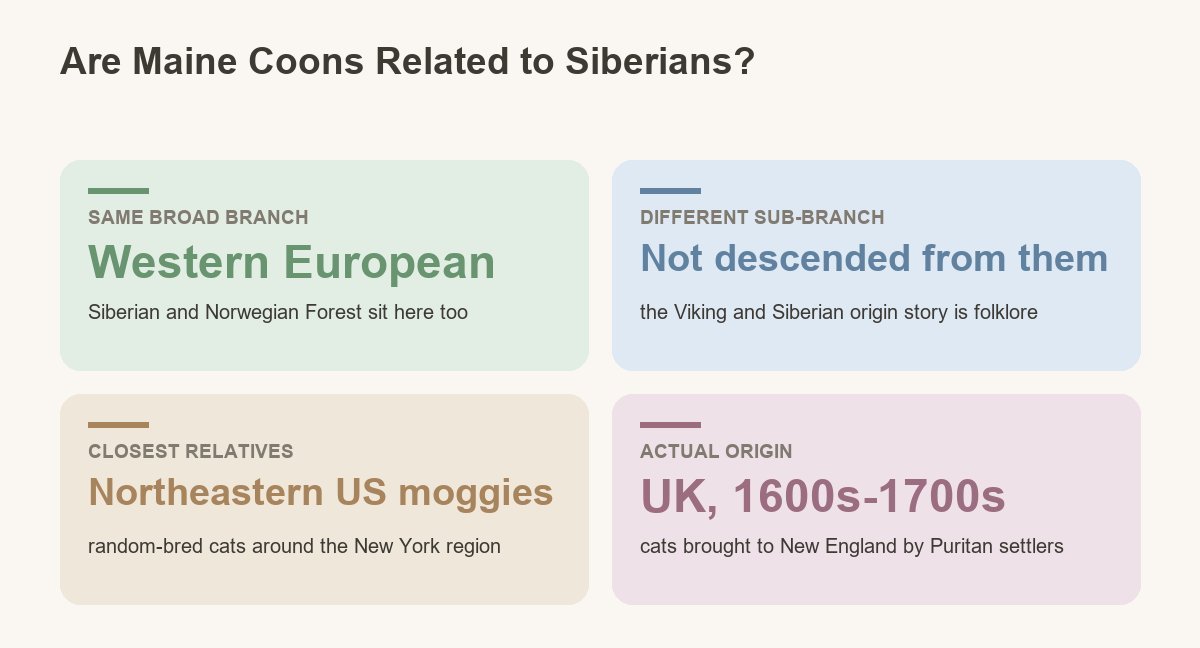
Phylogenetic studies place the Maine Coon in the Western European monophyletic cat branch, which does contain the Siberian and the Norwegian Forest Cat. But those two sit on a different sub-branch, and the Maine Coon’s closest genetic relationship is with the random-bred cat population of the northeastern United States around the New York region.
The documented origin is duller than the legend and easier to believe: cats brought to New England by Puritan settlers from Britain in the 1600s and 1700s, left to work barns and harbours, and shaped by the winters.
The three breeds look alike because cold climates produce the same solutions independently. Heavy coat, tufted feet, substantial frame: any cat population left to work outdoors through hard winters drifts toward that build, whether it does so in Maine, Norway or Siberia. Convergence is not kinship.
Can You Actually Get This Cross?
Yes, and it usually happens by accident rather than by design. Both breeds are ordinary domestic cats with no fertility barrier between them, so an unneutered Siberian and an unneutered Maine Coon in the same household or neighbourhood produce kittens exactly as any two cats would.
What you cannot get is paperwork, because registries treat both as closed breeds at championship level. A deliberate cross therefore produces cats no association will register as either breed, and a breeder marketing them as a designer hybrid is selling something with no standard behind it and nobody willing to certify it.
That matters more than it sounds. With no registry, there is no health-testing requirement, no pedigree to inspect, and nothing preventing a seller from applying the label to any large fluffy kitten.
What the Kittens Look Like
Kittens from this cross are unpredictable in the head and reliable everywhere else, which makes them less exotic than the price tags suggest. Both parents hand over the same coat and frame, so what varies is the face.
Both parents contribute a semi-longhaired double coat, a substantial frame, tufted ears and a plumed tail, so the kittens reliably inherit all of that. What varies is the head, because that is where the two breeds actually differ: the Siberian is built on circles with a round face and broad forehead, and the Maine Coon on rectangles with a square muzzle and a clear break. A cross can land anywhere between, and littermates frequently land in different places.
Adult size is a coin toss inside a narrow band. Our Siberian cat size guide sets out how far the two breeds’ weight ranges already overlap, which is why a cross does not produce a cat noticeably larger than either parent breed. Anyone promising an oversized hybrid is promising something the genetics do not support.
Telling a Cross From a Domestic Longhair
Most cats sold or rehomed as Maine Coon Siberian mixes are neither. Both breeds descend from ordinary regional cat populations, which means the traits people use to identify them are traits ordinary cats carry too, and a big fluffy semi-longhair is the single most common cat in the shelter system.
The only evidence that establishes a cross is documentation on at least one parent: a registered Siberian queen and a known Maine Coon sire is a real, traceable claim, while a seller who cannot name either parent is describing a domestic longhair.
Our guide to telling whether a cat is a Maine Coon mix works through the structural checks in full, and every one of them applies here.
What to Pay and What to Ask
Treat a four-figure price on an unregistered cross as the warning it is, since a pedigree Maine Coon or Siberian kitten commands that price on the strength of health testing and traceable lineage that a cross has neither of.
If you find one you like, ask three things: which parent was which breed, whether either parent has registration papers, and whether the parents were screened for hypertrophic cardiomyopathy, which affects both breeds. A seller who answers all three is worth talking to. A seller who answers none is selling a rescue cat at a cattery price.
Adopting is the honest version of this transaction, and shelters are full of large semi-longhaired cats with exactly the look people are paying four figures for.
FAQ
Is it possible to get a Maine Coon mixed with a Siberian cat?
Yes, the two breeds cross without any biological barrier, and accidental litters do occur. No registry will recognise the offspring as either breed, since both are closed to outcrossing at championship level.
Are Maine Coons Siberian cats?
No. Phylogenetic studies place Maine Coons on a different sub-branch from Siberians, with their closest relationship being to random-bred cats of the northeastern United States rather than to any Russian breed.
How big does a Maine Coon Siberian mix get?
Expect an adult within the ordinary range for either parent breed, roughly 4.5 to 10 kilograms depending on sex and which parent the cat favours. The cross does not produce a cat larger than a purebred Maine Coon.
Is a Maine Coon Siberian mix hypoallergenic?
There is no reliable way to predict allergen levels in a cross. Siberians are known for producing less Fel d 1 than most cats, but a kitten inherits unpredictably, so anyone buying for allergy reasons should spend time with the individual cat first.