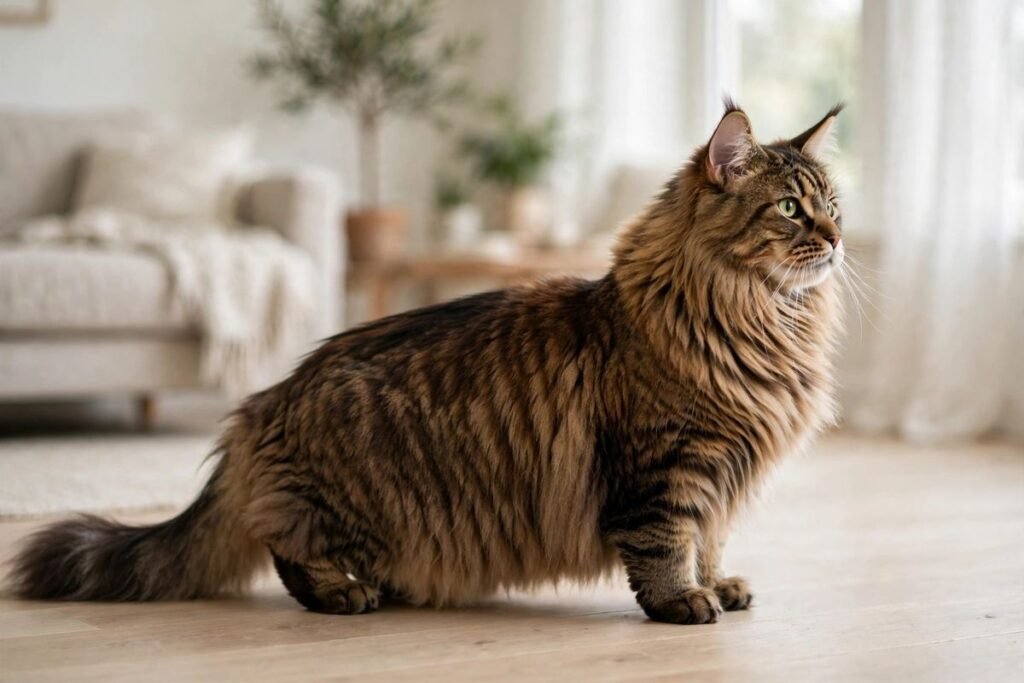
A Munchkin Maine Coon mix has one Maine Coon parent and one Munchkin parent. The Munchkin side passes on a dwarfism variant that shortens the leg bones, and the animal welfare charity UFAW advises against breeding cats that have it. None of the sources reviewed says how big or how short-legged the cross grows.
If you’re weighing a Munchkin Maine Coon mix, or you’ve just learned that a cat you own is one, the questions worth asking are narrower than a breed profile suggests. What makes the legs short, how a litter might split, what welfare bodies say and what to ask a seller all have sourced answers. Adult size doesn’t, and the size section says so plainly.
What short legs mean in a Munchkin cross
The Munchkin is defined by its legs. In a 2020 BMC Genetics study of 89 cats, Struck and colleagues describe standard Munchkin cats as having disproportionate dwarfism (chondrodysplasia) in which all four legs are short. A structural variant in the UGDH gene very likely causes the trait. PetMD puts the legs about 3 inches shorter than typical.
Not every cat sold under the name has short legs. The same study calls long-legged cats from Munchkin lines “non-standard” Munchkins, and the non-standard kitten it genotyped had two normal copies of the gene. A kitten with one Munchkin parent can land on either side of that line, a point the inheritance paragraphs below return to.
How short is short? The only bone-level numbers in the sources come from one cat. OMIA quotes the study’s CT scan of a 4-year-old standard Munchkin tomcat. Compared with a domestic cat, its humerus was 71% shorter, the radius 58%, the ulna 64%, the metacarpals 84%, the femur 74% and the tibia 70%. The metatarsals, the hind paw bones, had normal length. The humerus was slightly rotated and the radius was bent by about 43 degrees, which left the elbow and wrist joints poorly matched.
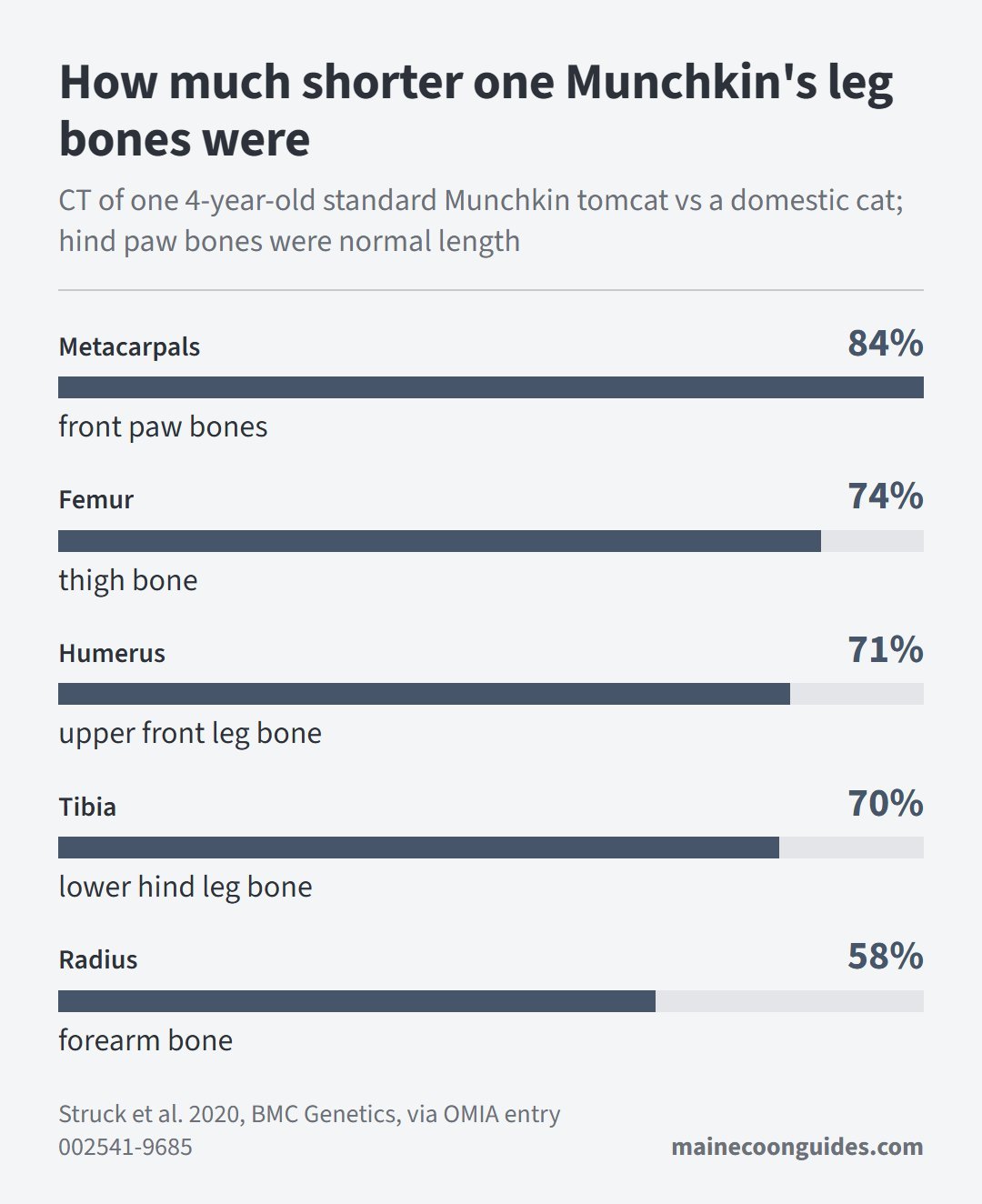
That is one animal. No study in the sources reports an average for Munchkins, and none reports leg measurements for a Maine Coon cross, so take the chart as the scale of change in a single cat.
If you want the wider list of Maine Coon crossbreeds, the Maine Coon mixes page has it.
How big does a Munchkin Maine Coon mix get?
None of the sources reviewed measures adult Maine Coon and Munchkin crosses, so any weight or height quoted for the cross is an estimate with no measurement behind it.
What the sources do provide is each parent on its own. CFA calls the Maine Coon the largest of all pedigreed cats and says mature males reach or exceed 20 pounds, with females usually smaller. The breed can take up to three years to finish growing, and CFA’s standard asks for legs of medium length in proportion to the body. For real weights by age and sex, the Maine Coon growth chart collects sourced figures. On the other side, PetMD’s veterinarian-reviewed profile says Munchkins generally weigh 6 to 9 pounds.
Splitting the difference between those two numbers would be a guess. The CT figures above describe limb bones, and nothing in the sources says that overall frame or weight blends between the parents. A seller who quotes a fixed adult weight for a cross is offering you a forecast, so ask what it’s based on and whether you can see the parents’ records. If the word “mini” comes up, the mini Maine Coon page sorts out what that label means.
Leg length is the one trait the sources do speak to, and it follows an either-or pattern, covered in the section on telling short legs from a small cat.
Health risks and why welfare bodies say not to breed
UFAW’s page on the Munchkin is the clearest statement. It says the limb bones fail to grow normally, behaviour can be affected, and the cats are predisposed to painful osteoarthritis. It puts the recommendation this way, “We suggest that, because of risks to quality of life, cats with this abnormality should not be used for breeding.” UFAW also reports that a proportion of kittens born to Munchkin parents die before birth, and that many breed clubs refuse to recognise the breed.
The genetics point the same way. Struck and colleagues found no cats with two copies of the variant and saw reduced litter sizes, which suggests that two copies are lethal. Breeders reported smaller litters when two standard Munchkins were mated, according to the study.
That risk comes from mating two Munchkins. A Munchkin Maine Coon mix has only one, so on the dominant model no kitten inherits two copies, though the sources report no litter records for such crosses. The leg and joint problems remain for any kitten that inherits one copy, since UFAW says all Munchkin cats are affected.
The other side of the debate is real. TICA recognises the Munchkin as a breed, and has since 1994 according to the study OMIA quotes. PetMD reports that CFA does not, and notes controversy over whether the mutation poses health risks. FIFe goes furthest: its Health and Welfare Rules name the Munchkin as an example of the shortened-limb breeds it won’t register, and cats with such a cat in their ancestry can’t be bred, registered, exhibited or advertised.
Veterinary voices agree on the joints. PetMD quotes Paula Simons, DVM, of Cornell Veterinary Specialists, saying the mutation causes a defect in cartilage formation and predisposes cats to osteoarthritis and mobility problems. A 2021 imaging study of five cats with feline disproportionate dwarfism found significant deformity in all limbs. MRI of the spine in two of them found no spinal pathology, and the study called the incidence of disc degeneration inconclusive, so the spine question remains open.
UFAW limits its own page: it says welfare effects haven’t been evaluated in the scientific literature as far as it knows, and the text carries a 2011 copyright date. The recommendation therefore rests on the known bone changes and on breed-club positions rather than on long-term welfare studies, and none of these sources studies a Maine Coon cross.
Short legs or just a small cat? How to tell
Size alone tells you little, because a Maine Coon can take up to three years to finish growing, according to CFA. Proportion is the better signal: the Munchkin trait is disproportionate dwarfism, so the legs look short against the body on all four corners. When you meet a kitten, look at all four before you judge.
Front legs only is a different picture. An October 2026 post in r/MunchkinCats, with 31 upvotes, described exactly that in a feral litter:
“The other two look “off” and it took me a while to figure out why. They have short front legs. I know nothing about munchkins, but could this be due to being a munchkin mix?”
– r/MunchkinCats, October 2026 (31 upvotes)
Standard Munchkins in the study had all four legs short, so a litter with only short front legs doesn’t match that description, and none of the sources reviewed explains the pattern. Replies in the post called it a genetic defect, which is one user’s view and not a diagnosis. A vet visit is the way to find out, since every study here that measured bones used CT, radiographs or MRI.
Inheritance explains why you shouldn’t expect a cross to be a little bit Munchkin. Struck and colleagues propose autosomal dominant inheritance, meaning one copy of the variant is enough, and UFAW says all Munchkin cats are affected, with no symptom-free carriers. In the study’s pedigree data, three matings between a standard Munchkin tomcat and queen produced seven standard and two long-legged kittens. For a litter from a Maine Coon and a standard Munchkin, a textbook dominant pattern would put roughly half the kittens on each side, but the sources hold no litter records for the cross to test that.
A normal-legged kitten from a Munchkin parent isn’t automatically in the clear for breeding. UFAW says it may be safer to avoid breeding even from cats with apparently normal conformation that were born to Munchkin parents, because the genetic basis was not well defined when it wrote the page.
For the Maine Coon side of the question, see how to tell if your cat is a Maine Coon mix. The American Bobtail mix involves a tail trait, so none of the leg-length points above apply to it.
Questions to ask before you buy or adopt
These six questions turn the sources above into things you can put to a seller or a rescue.
- Which parent has the Munchkin variant, and does that parent have short legs? UFAW reports no symptom-free carriers, so a standard Munchkin parent is an affected parent.
- What do the parents’ registration papers say? FIFe won’t register cats with a Munchkin-type cat in their ancestry, and TICA’s rules on crosses couldn’t be retrieved, so ask for the registry’s written policy.
- What happened in earlier litters? UFAW reports kittens lost before birth in Munchkin litters, and breeders reported smaller litters from two standard Munchkins. Ask how many kittens were born and how many survived.
- Has a vet examined this kitten’s legs and joints? Ask for the findings in writing. Osteoarthritis is the main long-term concern in the sources, and the studies that measured bones used imaging.
- What are the parents’ adult weights? The Maine Coon parent can be compared with the growth chart. A promised adult size for the kitten itself has no measurement behind it, whatever the label says.
- Who pays if mobility problems appear? UFAW says osteoarthritis is treated with painkillers and that side effects are common, so get any health guarantee in writing.
A seller who can’t name the Munchkin parent, the registry or the vet has answered all three questions for you.
Housemates, jumping and daily life
Jumping is disputed. UFAW says even breed advocates acknowledge that it is affected, while PetMD quotes a TICA breed chair saying some people believe short legs prevent jumping, though not always. Neither source measures jump height, so if you hear that a Munchkin cross climbs like a Maine Coon, treat it as unproven.
Weight is the part you control, and you can score it at home. PetMD says added weight strains a Munchkin’s spine, and the body condition checker on this site scores ribs, waist and belly on the 9-point chart vets use.
Temperament has no study behind it for crosses. What exists is owner talk, such as this December 2025 comment in a r/MunchkinCats post about keeping a Munchkin alongside a Maine Coon:
“I have a Munchkin amongst my brood and he is the feistiest, chattiest one who certainly bosses the others especially my Floofy Cowboy who is a very big cat.”
– r/MunchkinCats, December 2025 (8 upvotes)
That is one household, and it says nothing about how a cross will behave.
Frequently asked questions
Is a Munchkin Maine Coon mix the same as a mini Maine Coon?
No. A Munchkin cross is a different animal, with short legs from the dwarfism variant described above. The mini Maine Coon page sorts out the other things sellers mean by that label.
Can a Munchkin cross kitten have normal legs?
Yes. Struck and colleagues describe long-legged non-standard Munchkins, and in their pedigree data three matings of two standard Munchkins produced seven short-legged and two long-legged kittens. UFAW still says it may be safer not to breed from normal-legged cats born to Munchkin parents.
How big can a Munchkin cat get?
PetMD, in a veterinarian-reviewed profile, says Munchkins generally weigh 6 to 9 pounds and have legs about 3 inches shorter than typical. None of the sources reviewed offers an adult size for a Maine Coon cross.
Do cat registries accept Munchkin crosses?
It depends. FIFe bars registering cats with a Munchkin-type cat in their ancestry. TICA recognises the breed, and PetMD says CFA does not. TICA’s rules on crosses couldn’t be retrieved, so ask any seller for the registry’s written policy.
One Comment