Maine Coon weight data
Maine Coon weights from published weighing studies
Measured weights from peer-reviewed studies, each with its source named on the page, and a check that shows where your own cat sits.
- 13.4 / 10.6 lbMeasured adult mean, males / females (lean cats, 1 year or older)
- 4.4 lbMean male weight at 12 weeks; females 3.9 lb
- 4 studiesWeighed Maine Coons on a scale; none covers 5 to 11 months
Check your cat’s weightLast updated 8 November 2026
Maine Coon cats are renowned for their impressive size and gradual development, making a maine coon cat growth chart an essential tool for owners. These gentle giants follow a unique growth pattern that differs significantly from other domestic cat breeds. Understanding your Maine Coon’s development through a comprehensive maine coon cat growth chart helps ensure proper nutrition, health monitoring, and realistic expectations throughout their extended maturation period.
Curious when all this growing finally ends? See our complete timeline of when Maine Coons stop growing.
Maine Coons grow slowly. The Cat Fanciers’ Association says the breed can take up to three years to reach full growth, and some owners report cats still filling out after that, which is considerably longer than most domestic cats who reach maturity by their first birthday. This extended development timeline makes tracking growth through a maine coon cat growth chart particularly valuable for identifying potential health concerns or nutritional deficiencies early in their development.
Average Maine Coon Weight: Male and Female Size Chart
An adult male Maine Coon commonly weighs 15 to 25 pounds and a female 10 to 15 pounds, according to the Basepaws breed profile, which gives no source for those ranges. The Cat Fanciers’ Association says only that a mature male reaching or exceeding 20 pounds is not unusual and that females are usually smaller. Weighing studies report lower averages: lean adult males averaged 13.4 lb and females 10.6 lb, and the heaviest of 81 healthy blood donors was 18.7 lb. No weighing study we found reports an average as high as 15 to 25 lb, so treat that range as unmeasured (see the measured weights below).
| Adult cat | Weight range | Where it comes from |
|---|---|---|
| Male | 15 to 25 lb | Basepaws breed profile (a cat DNA test company; no source given for the range) |
| Female | 10 to 15 lb | Basepaws breed profile (same limit) |
| Male | 20 lb or more is “not unusual” | Cat Fanciers’ Association breed page, read 31 October 2026 |
Neither source reports a measured average, so these ranges are a guide rather than a mean. The weights owners report at each age are in the sections below.
Measured Maine Coon Weights: What Studies Actually Weighed
Measured, not estimated: lean adult Maine Coons weighed 13.4 lb for males and 10.6 lb for females on average in a 2011 German study, and healthy adult blood donors in Italy averaged 14.8 lb with a heaviest cat of 18.7 lb. At 12 weeks, breeders’ scales gave 4.4 lb for males and 3.9 lb for females.
Four peer-reviewed studies weighed Maine Coons on a scale. They give birth to 12 weeks from breeders’ records, and adult means from cat shows and veterinary visits, and from blood donors. Here they are on one chart, with a check for your own cat.
- Males
- Females
- Blood donors, mean and range (both sexes)
Ages are evenly spaced, not to scale. Lines join measured ages; dashed lines cross the gap where no weights were found and are not data. Whiskers show one standard deviation (SD). Birth is shown once because the study did not split it by sex. Sources: Moik & Kienzle 2011; Kienzle & Moik 2011; Spada et al. 2015.
Where does your cat’s weight sit?
Pick the age group, enter a weight and compare it with the cats in the studies. It covers the three ages that were measured: 4 weeks, 12 weeks and adults. For 5 to 11 months no published study measured Maine Coons, so the owner-reported weights further down are the best available guide.
Choose the sex and age, enter the weight, then press Check weight.
| Age or group | Males | Females | Cats (n) | Source |
|---|---|---|---|---|
| Birth | 115 g (4.1 oz), SD 19, both sexes | 79 | Moik & Kienzle 2011 | |
| 4 weeks (28 days) | 558 g (1.23 lb), SD 54 | 530 g (1.17 lb), SD 46 | 26 / 27 | Moik & Kienzle 2011 |
| 12 weeks (84 days) | 1,985 g (4.38 lb), SD 189 | 1,772 g (3.91 lb), SD 162 | 19 / 15 | Moik & Kienzle 2011 |
| Adults, 1 year or older, ideal body condition | 6.1 kg (13.4 lb), SD 1.2 | 4.8 kg (10.6 lb), SD 1.0 | 28 / 22 | Kienzle & Moik 2011 |
| Healthy adult blood donors, 1 to 8 years | Mean 6.7 kg (14.8 lb), range 4.9 to 8.5 kg (10.8 to 18.7 lb), both sexes | 81 (39 male, 42 female) | Spada et al. 2015 | |
| Young adults, about 2 years old | Mean 5.0 kg (11.0 lb), SD 1.0, both sexes | 23 | Chetboul et al. 2005 | |
- Males pull ahead early. At 12 weeks the males averaged 1,985 g and the females 1,772 g, about 12% more, and the authors report the difference as significant. The gap carries on into adulthood, as the male vs female Maine Coon comparison shows.
- A 12-week kitten is about a third of the way there. The 12-week males weighed 4.4 lb against the 13.4 lb adult mean, roughly 33%; the females 3.9 lb against 10.6 lb, roughly 37%. The kittens and adults were different cats from different samples, so treat these as a rough guide.
- The measured adult means are lower than the ranges above. The breed profile quotes 15 to 25 lb for males and 10 to 15 lb for females. The measured male mean was 13.4 lb, and the heaviest cat among the 81 blood donors was 18.7 lb. The Cat Fanciers’ Association’s statement that 20 lb is not unusual for a mature male still stands, but a 20 lb male sits well above these measured averages. More on adult size is in how big Maine Coons get.
- Nothing measured fills the gap from 12 weeks to 1 year. The owner-reported weights in the sections below are self-reports from forum threads, not measurements. When growth actually ends is covered in when Maine Coons stop growing.
Common questions
How much does a Maine Coon weigh at 12 weeks?
In the one study that weighed Maine Coon kittens at 84 days, males averaged 1,985 g (4.4 lb) and females 1,772 g (3.9 lb), from breeders’ records in Germany.
How much does an adult Maine Coon weigh?
Lean adult Maine Coons weighed in Germany averaged 6.1 kg (13.4 lb) for males and 4.8 kg (10.6 lb) for females. Healthy Italian blood donors averaged 6.7 kg (14.8 lb), with the heaviest at 8.5 kg (18.7 lb).
Is there a measured month-by-month chart?
No. We found no published study that weighed Maine Coons between 12 weeks and 1 year, so the chart above leaves that stretch blank instead of filling it with estimates.
More resources
Update log: 8 November 2026, added measured weights from published studies, the growth chart and the weight check. Next review: when a new weighing study appears, or November 2027.
Sources read on 8 November 2026: Moik K, Kienzle E. Birth weight and postnatal growth of pure-bred kittens. British Journal of Nutrition 2011;106 (Suppl 1):S32-S34, doi:10.1017/S0007114511003333. Kienzle E, Moik K. A pilot study of the body weight of pure-bred client-owned adult cats. British Journal of Nutrition 2011;106 (Suppl 1):S113-S115, doi:10.1017/S0007114511001802. Spada E, et al. Haematological and biochemical reference intervals in adult Maine Coon cat blood donors. Journal of Feline Medicine and Surgery 2015;17(12):1020-1027, doi:10.1177/1098612X14567549. Chetboul V, et al. Reference range values of regional left ventricular myocardial velocities and time intervals assessed by tissue Doppler imaging in young nonsedated Maine Coon cats. American Journal of Veterinary Research 2005;66(11):1936-1942.
Understanding Maine Coon Development Stages
Birth to Three Months: Rapid Initial Growth
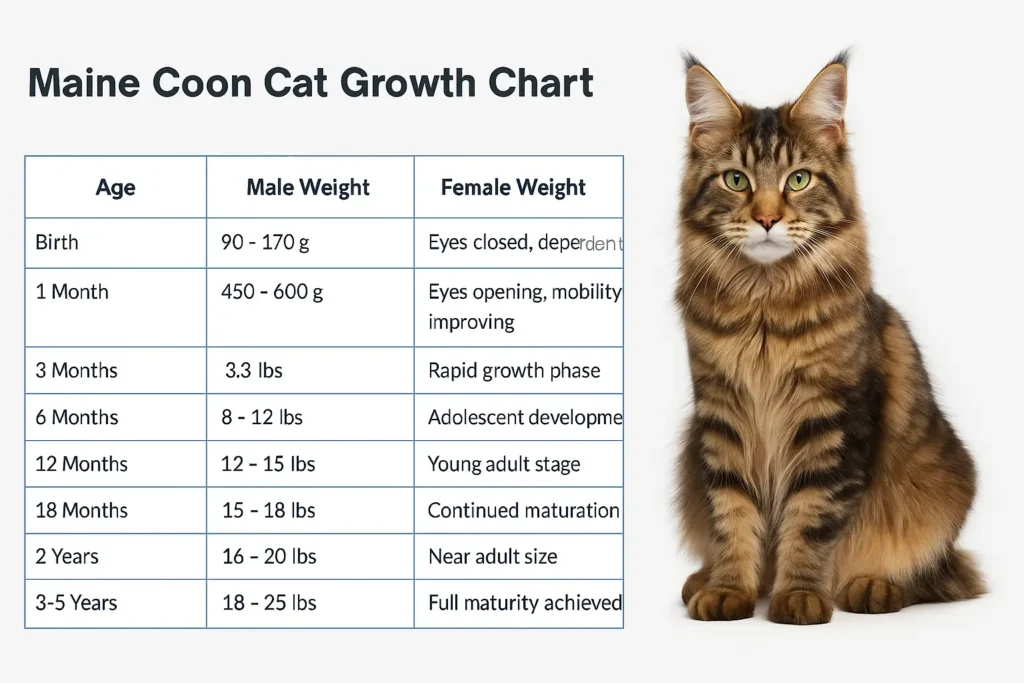
The first phase documented in any maine coon cat growth chart shows remarkable development during the initial months. Newborns typically weigh between 90-170 grams at birth. By the end of the first month, their weight increases to around 450-600 grams. This represents nearly a five-fold increase in body weight within just thirty days.
During this critical period, In the one study that weighed Maine Coon kittens at 12 weeks, males averaged about 4.4 lb and females about 3.9 lb (breeders’ records, see the measured weights above). The maine coon cat growth chart during this stage reflects the most dramatic weight gains your kitten will experience. Female kittens weigh less than males at this age.
Three to Twelve Months: Sustained Growth Period
The maine coon cat growth chart from three to twelve months demonstrates continued rapid development. The first year is the fastest growth phase, with steady muscle development afterward. During this period, owners will notice significant changes in their cat’s physical structure, including leg length, body mass, and overall proportions.
By the end of its first year, it can weigh almost 15 pounds for male Maine Coons, while females typically reach 10-12 pounds. This substantial weight gain requires careful attention to nutrition and regular veterinary check-ups to ensure healthy development patterns align with standard maine coon cat growth chart expectations.
Adult Maine Coon Size Specifications
Male Maine Coon Growth Chart
Adult male Maine Coons represent the larger end of the maine coon cat growth chart spectrum. Males typically weigh between 20-25 lbs at full maturity, though some exceptional individuals may exceed these ranges. A male Maine Coon adult cat weighs between 15 and 25 pounds, with height measurements averaging 10-16 inches and lengths spanning 19-32 inches.
The maine coon cat growth chart for males shows continued development well into their third year, with some cats adding muscle mass and bulk until age five. This extended maturation period distinguishes Maine Coons from other domestic breeds and emphasizes the importance of long-term growth monitoring.
Female Maine Coon Growth Chart
Female Maine Coons follow a more conservative maine coon cat growth chart pattern. Females are generally smaller, averaging 10-15 lbs at full size. Most adult queens settle between 10 and 15 pounds, yet the normal span runs from 8 right up to 18 pounds, indicating significant individual variation within the breed.
The maine coon cat growth chart for females typically shows peak weight achievement between ages 2-3 years, with minimal additional growth afterward. However, some females may continue filling out until age four, particularly in terms of coat density and muscle definition.
Monthly Maine Coon Growth Chart Breakdown
| Age | Male Weight | Female Weight | Development Notes |
|---|---|---|---|
| Birth | 90 – 170 g | 90 – 150 g | Eyes closed, dependent |
| 1 Month | 450 – 600 g | 400 – 550 g | Eyes opening, mobility improving |
| 3 Months | ~3 lbs (owner-reported) | 2.5 – 2.8 lbs (owner-reported) | Rapid growth phase. Measured at 12 weeks: males 4.4 lb, females 3.9 lb (Moik & Kienzle 2011) |
| 6 Months | 8 – 12 lbs (owner-reported) | 6 – 9 lbs (owner-reported) | Adolescent development |
| 12 Months | 12 – 15 lbs (owner-reported) | 8 – 12 lbs (owner-reported) | Young adult stage |
| 18 Months | 15 – 18 lbs (owner-reported) | 10 – 13 lbs (owner-reported) | Continued maturation |
| 2 Years | 16 – 20 lbs (owner-reported) | 11 – 14 lbs (owner-reported) | Near adult size |
| 3–5 Years | 18 – 25 lbs (owner-reported) | 12 – 15 lbs (owner-reported) | Near or at full size |
Figures in this table are owner- and breeder-reported and have no weighing study behind them; see the measured weights above for study data.
Weighing studies found lean adult males averaging 13.4 lb; the heaviest healthy adult in the largest study weighed 18.7 lb (see the measured weights above).
What Owners Actually Report at 3, 6, 12 and 24 Months
The chart above is the tidy version. The figures below are what Maine Coon owners posted in five r/mainecoons and r/MaineCoon weight threads across 2025 and 2026, converted to pounds where people posted in kilograms. The spread is much wider than any chart admits, and that width is the point.
| Age | Males, as reported | Females, as reported | What owners noted alongside |
|---|---|---|---|
| 3 months | ~3–4 lb (owner-reported, no source) | ~2.5–3 lb (owner-reported, no source) | Owner posts are rare this young; weight talk starts around 5 months. Measured at 12 weeks: males 4.4 lb, females 3.9 lb (Moik & Kienzle 2011) |
| 6 months | 8.5–15 lb | ~7.7 lb in the few female reports | Littermates 4 lb apart at the same age was common |
| 12 months | 18–19 lb | 7.7–8.6 lb | The sex gap is at its widest here |
| 24 months+ | 18–20 lb typical, 30 lb reported once | 12.8–17.5 lb | Several owners said filling out continued past year four |
Two warnings before you measure your own cat against this. These are self-selected posts, so people with strikingly large cats are more motivated to reply than people with average ones, which pushes the top of every range upward. And home scales, vet scales, and estimates all sit in the same column here.
What the numbers do show reliably is the size of the gap between siblings. One owner in an r/mainecoons thread described a female at 3.5 kg and her brother at 5.5 kg at the same six months of age, a difference of roughly 4 lb between two kittens from one litter.
Read the reference chart as the middle of a wide band, not a target your cat is failing to hit.
Factors Influencing Maine Coon Growth Patterns
Genetic Contributions
Heredity plays a crucial role in determining where individual cats fall on the maine coon cat growth chart. Cats from larger breeding lines typically produce offspring that exceed average size expectations, while those from more moderate bloodlines may fall toward the lower end of standard maine coon cat growth chart ranges.
Quality breeding programs focus on maintaining healthy growth patterns rather than simply maximizing size. Reputable breeders provide maine coon cat growth chart data from previous litters to help new owners understand their kitten’s potential development trajectory.
Nutritional Requirements
Proper nutrition directly impacts how closely your cat follows an ideal maine coon cat growth chart. Kittens need more calories than adult cats since they’re growing constantly. High-quality kitten food should be provided until at least 12-15 months of age, with gradual transitioning to adult formulations.
The extended growth period shown in maine coon cat growth chart data necessitates sustained nutritional support beyond what other breeds require. Premium protein sources, appropriate fat levels, and essential vitamins support optimal development patterns outlined in comprehensive maine coon cat growth chart guidelines.
Health Monitoring Through Growth Charts
Regular weight monitoring using a maine coon cat growth chart helps identify potential health issues before they become serious problems. Sudden changes in growth velocity, whether accelerated or stunted, may indicate underlying conditions requiring veterinary attention.
Monthly weigh-ins during the first year, followed by quarterly assessments until maturity, provide valuable data points for comparison against standard maine coon cat growth chart benchmarks. Always weigh her on the same scale each time so you can spot real change, not scale error.
Regional Variations in Growth Patterns
Maine Coon cats from different geographic regions may show slight variations from standardized maine coon cat growth chart expectations. Climate, breeding practices, and genetic diversity within regional populations can influence final adult sizes and growth timelines.
European Maine Coons occasionally exceed North American maine coon cat growth chart standards, while cats from certain breeding programs may mature slightly earlier or later than typical timelines suggest. Understanding these variations helps owners set realistic expectations based on their cat’s specific background.
When to Consult Veterinary Professionals
While maine coon cat growth chart guidelines provide excellent reference points, individual cats may deviate from expected patterns for various reasons. Consultation with veterinary professionals becomes necessary when growth deviates significantly from maine coon cat growth chart norms.
Warning signs include failure to gain weight for extended periods, excessive weight gain suggesting obesity rather than healthy growth, or developmental delays in physical milestones. Early intervention guided by maine coon cat growth chart comparisons often prevents minor issues from becoming major health concerns.
Creating Your Personal Maine Coon Growth Chart
Developing a customized maine coon cat growth chart for your specific cat provides valuable insights into their individual development pattern. Record monthly weights, measurements, and developmental milestones alongside standard maine coon cat growth chart benchmarks for comparison.
Photography documentation complements numerical data in your personal maine coon cat growth chart, helping visualize changes in body proportions, coat development, and overall physical maturation. This comprehensive approach to tracking growth provides veterinarians with detailed information during routine examinations.
For additional guidance on Maine Coon care and development, Mainecoon Guides offers extensive resources for owners throughout their cat’s growth journey.
Is My Maine Coon Too Small?
A Maine Coon sitting below the chart is usually normal, not stunted. Size in this breed is driven by parentage more than by feeding, and a cat who is lean, active, eating well, and gaining steadily is developing correctly even when a chart says otherwise. The figure that matters is the trend on your own cat, not the gap to an average.
Smaller Can Be the Healthier Outcome
Owners tend to discover this at the vet rather than online.
“My girlies are 12 and 14 lbs. I used to think they were tiny until the vet told me they’re just a healthy weight for their age, and that they’ll have less joint problems because of it.”
– r/mainecoons, June 2026 (681 upvotes on the thread)
That trade-off is real. Extreme size carries a heavier load on hips and heart, and some buyers deliberately choose breeders who do not select for maximum size. A 12 lb Maine Coon is still a large cat by any other breed’s standard.
Females Are Meant to Be Lighter
Female Maine Coons commonly settle between about 12 and 17 lb, while males in the same threads reported 18 lb and up. Owners comparing a girl against a male-heavy chart routinely conclude something is wrong when nothing is. If your female is under 12 lb and holding steady with good muscle tone, she is small, not unwell.
If You Took Home the Runt
A runt who eats, drinks, plays, and gains weight steadily is on a slower curve rather than a failing one, and many never catch their littermates in size without that costing them anything. What warrants a vet visit is not smallness by itself but smallness with a symptom: weight loss or a stalled scale over several weeks, poor appetite, lethargy, a pot-bellied look, or diarrhoea. Parasite screening and a calorie check are where a vet will usually start. If the cat is small but not a runt, the mini Maine Coon guide explains what the label does and does not mean.
Lean Until Four Is Normal
Maine Coons build frame first and fill it in afterwards, which is why an eighteen-month-old can look gangly and underweight while being entirely on track.
“On average can take up to 5 years for them to stop growing. Most of their growth is the first year, though. But I also have sisters where one is about double in size.”
– r/mainecoons, June 2026 (12 upvotes)
The same pattern shows up whenever someone posts a lanky adolescent and asks whether they are underfeeding.
“He’ll likely stay lean for a couple years, even while eating a ton. He’s a fine-looking kitty.”
– r/mainecoons, October 2025 (18 upvotes)
Weigh monthly, write it down, and judge the line rather than the single number. A cat gaining steadily on her own curve is the only growth chart that applies to her.
Conclusion
Understanding and utilizing a maine coon cat growth chart proves invaluable for Maine Coon owners committed to supporting their pet’s healthy development. These magnificent cats follow unique growth patterns requiring extended patience and consistent monitoring to ensure optimal outcomes. Regular tracking against established maine coon cat growth chart standards helps identify potential issues early while celebrating the remarkable transformation from tiny kitten to majestic adult cat.
The maine coon cat growth chart serves as more than just numbers on paper it represents a roadmap for providing appropriate care throughout your cat’s extended maturation period. By following established maine coon cat growth chart guidelines while remaining attentive to individual variations, owners can ensure their Maine Coon reaches their full genetic potential in terms of size, health, and development.
Whether you’re a first-time Maine Coon owner or an experienced enthusiast, maintaining awareness of maine coon cat growth chart expectations helps you provide the best possible care for these remarkable felines. Have you considered how your Maine Coon’s individual growth pattern compares to standard maine coon cat growth chart expectations?
3 Comments