Maine Coon Care
Maine Coon Litter Box: The Size You Actually Need
The standard sizing rule asks for 27 to 39 inches of interior. The pet aisle stops at about 28. Here is what to do about that.
- ✓Work out the number for your own cat in ten seconds
- ✓Three formats that reach it, one of them cheap
- ✓The 22 lb ceiling that rules out most self-cleaning boxes
Affiliate link. We may earn a commission at no extra cost to you.
The short answer. A Maine Coon litter box needs roughly 27 to 39 inches of interior length, sides 8 to 10 inches high, and an open top. That first number is the problem: the standard sizing rule, applied honestly to this breed, asks for a box larger than anything sold as a litter box.
Below is the Maine Coon litter box arithmetic, the point at which the market stops, and what owners of this breed actually put on the floor once the arithmetic and the catalogue disagree.
The Sizing Rule, Done Properly
The convention shelters behind one sentence: a litter box should measure at least 1.5 times the length of the cat from nose to the base of the tail. Not nose to tail tip. The tail does not need floor space.
For a domestic shorthair at 15 inches of body length, that gives 22.5 inches, and a large plastic pan clears it easily. Run the same sum for this breed and the answer changes character.
Our own size guide for the breed puts adult males at up to 38 to 40 inches of total length with a tail measuring as much as 14 inches. Subtract the tail and a large male carries 24 to 26 inches of body. A typical female sits closer to 18 to 20.
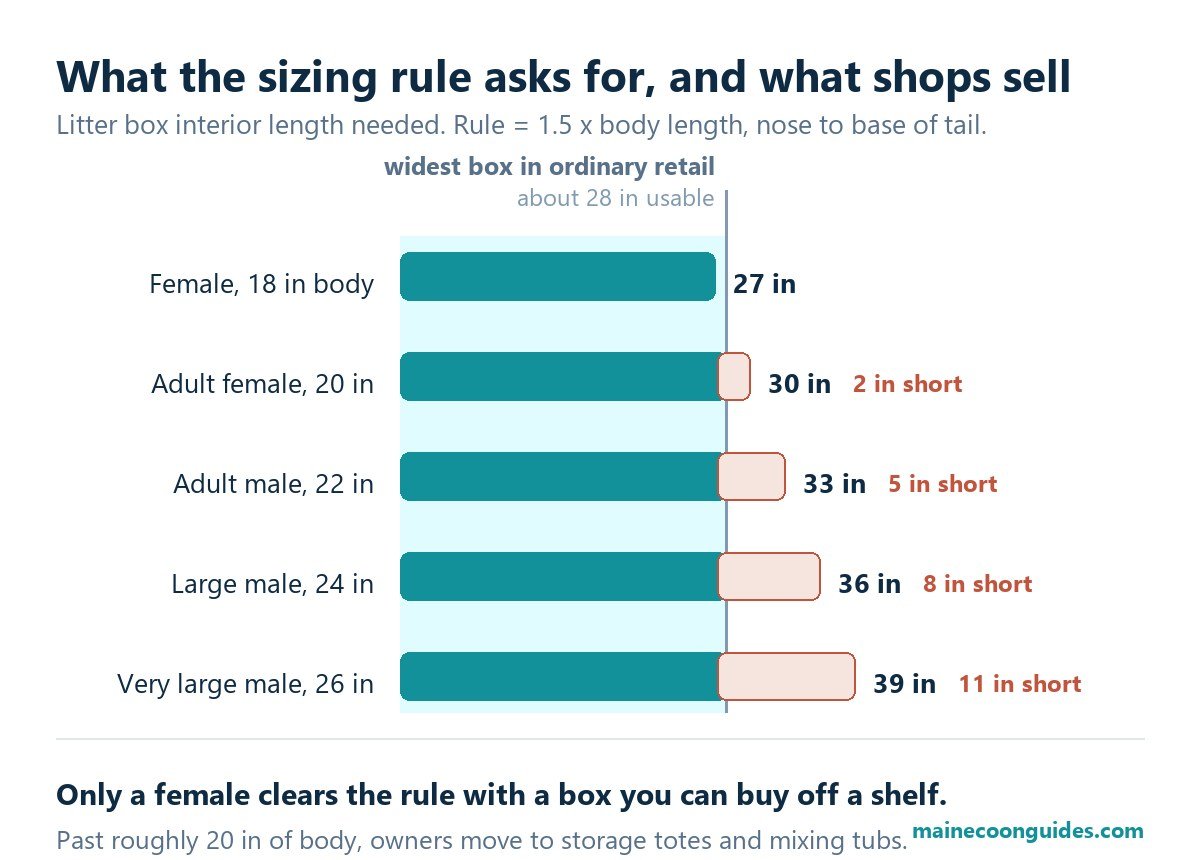
| Body length, nose to tail base | Rule minimum (1.5x) | Who this is |
|---|---|---|
| 18 in | 27 in | Female, or a male still filling out |
| 20 in | 30 in | Average adult female |
| 22 in | 33 in | Average adult male |
| 24 in | 36 in | Large male |
| 26 in | 39 in | The ones people post photographs of |
Measure your own cat before trusting the middle of that table. A soft tape along the spine while the cat is standing takes ten seconds and settles the question. Kittens make this harder, because the box you buy at six months will be wrong at eighteen; the growth chart by age gives you the number to plan against.
Where the Maine Coon Litter Box Market Stops
The widest litter box in ordinary retail gives a Maine Coon roughly 28 inches of usable floor, which satisfies an adult female and leaves an average male about five inches short. Held against the column of numbers above, the pet aisle runs out before the breed does.
Boxes advertised as large tend to measure 22 to 24 inches on the outside. Boxes advertised as XL or jumbo reach 24 to 30 inches, again on the outside. Interior length is always shorter once walls, lips and moulded corners take their share, and the difference is frequently two or three inches.
So the widest commercial pan lands somewhere near 28 inches of usable floor. That satisfies an 18-inch female. It falls short for an average male by five inches and misses a large male by eight.
The gap is easy to miss because the rule and the product listing are never printed side by side. One is a formula about your cat; the other is a number on a carton. Put them in the same sentence and a 24-inch box stops reading as extra large.
None of which makes those boxes useless. A cat that fits imperfectly still uses the box. What it means is that the rule describes a target most owners will approach and not reach, and knowing that changes how you shop: you stop hunting for the box that satisfies the formula and start choosing between the compromises.
What Maine Coon Owners Put on the Floor
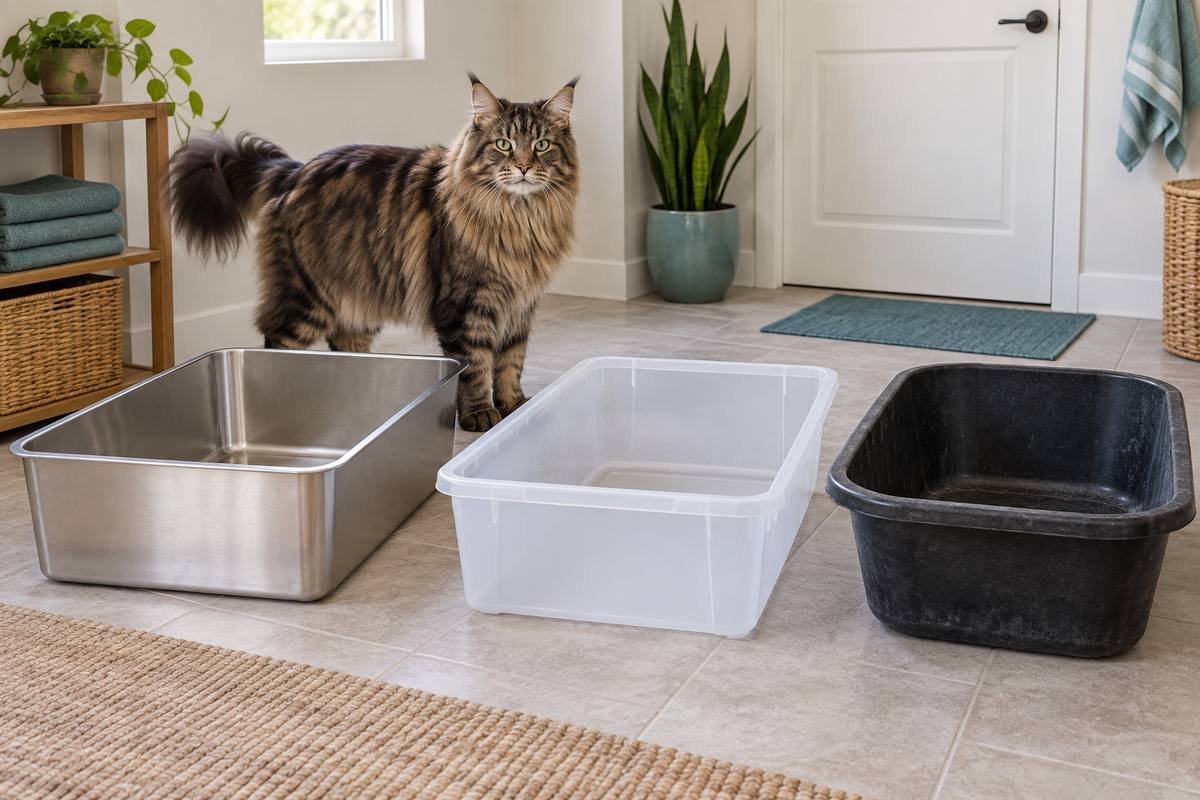
Three Maine Coon litter box setups come up again and again in breed communities, and they sit in a clear order of size.
Shop PETKIT Boxes →
Affiliate link. Sizes shown are formats, not products; PETKIT boxes are rated to 22 lbs.
24 to 30 inches, non-porous, immune to the scratch damage that turns a plastic box permanently smelly. The standard upgrade.
34 to 42 inches is ordinary in the storage aisle, at a fraction of the price. The only common option that clears the rule for a large male.
Typically 24 by 36 inches, with walls high enough to stop almost all scatter. Ugly, cheap, effective.
The pattern is hard to miss. Once a cat passes roughly 20 inches of body, owners stop shopping in the pet aisle. That is not a failure of taste; it is what happens when a category’s largest product stops matching its largest customer.
“XXL (largest size you can find) stainless steel litter box w sifter. We use it with pine pellets. Pine pellets are healthier and cheaper. If your kitty can get used to it, highly recommend it. Only down side is it won’t hide the smell much so need to clean up as soon as possible.”
– r/mainecoons, August 2026
Sides, Entry Height, and the Case Against Lids
Length is the headline, but three smaller measurements decide whether the box works day to day.
See Low-Entry Boxes →
Affiliate link. We may earn a commission at no extra cost to you.
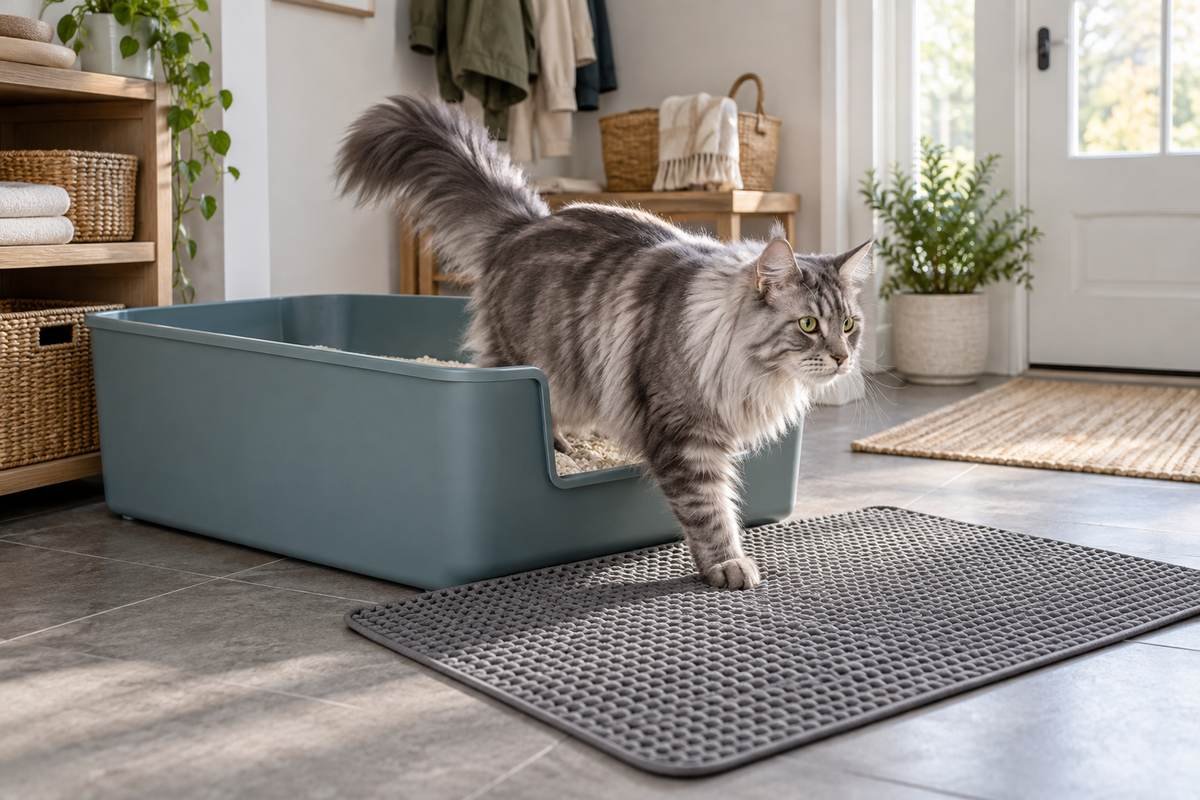
- Side height: 8 to 10 inches. This breed digs with force and flings litter well past the rim of a shallow pan. High walls solve most tracking complaints on their own, before you buy a mat.
- Entry height: 5 to 6 inches for an adult, lower for a kitten or a senior. One low side or a cut notch keeps a high-walled box accessible. Arthritis arrives early in some lines, and a cat that has to jump will eventually decide the rug is easier.
- Open top. Hoods and top-entry designs shrink the turning circle exactly where this breed has none to spare, and they hold odour against the cat’s face. If you want containment, get height, not a roof.
Shape matters less than the marketing suggests, with one caveat. Cats turn before they squat, and a round pan removes the corners a large cat bumps into. A rectangle of the same interior area works fine as long as the shorter dimension is not the binding constraint, which on a 34-inch tote it never is.
Self-Cleaning Boxes and the 22-Pound Ceiling
This is the question that fills the breed forums, and it has a specific numerical answer that manufacturers publish and almost no review mentions.
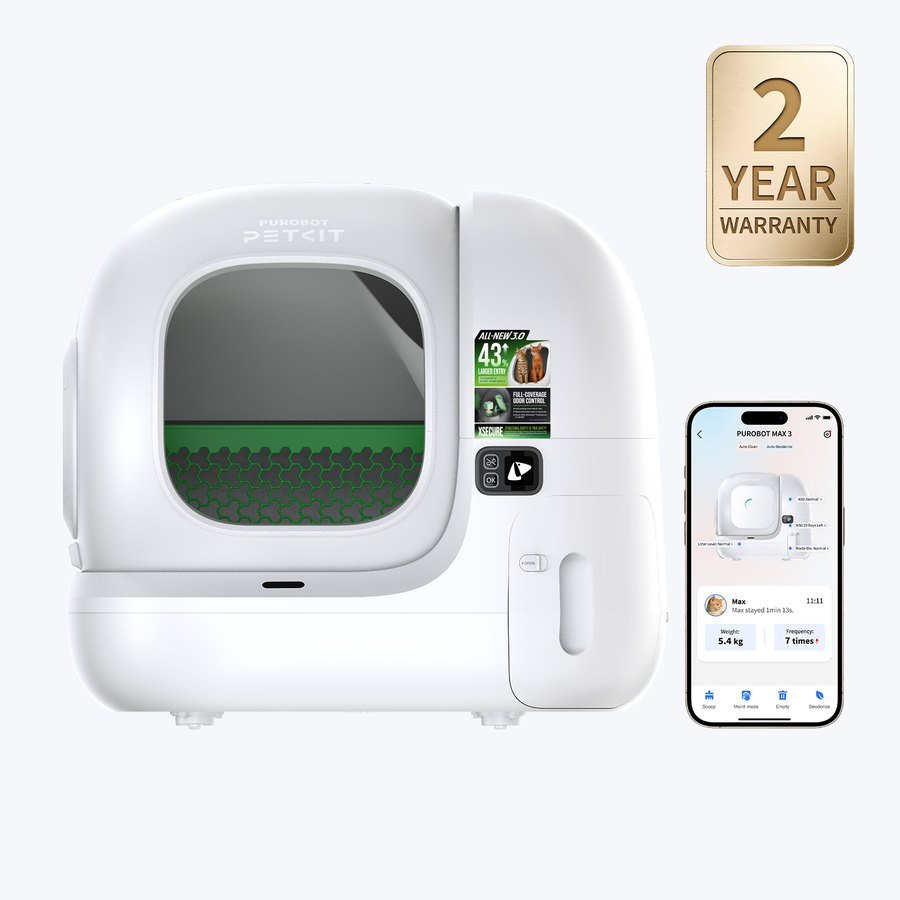
PETKIT states a recommended weight range of 3.3 to 22 lbs (1.5 to 10 kg) for the Purobot Max 3, and the same 22-pound ceiling for the Purobot Ultra and the Purobot Max Pro 2. The Max 3 measures 24.4 by 21.2 by 21.7 inches on the outside with an entry opening of 10.51 by 10.74 inches. Those figures are published on PETKIT’s own product pages, which is where the numbers in this section come from. The link above is an affiliate link.
Set that against the breed. Our growth chart puts fully mature males at 18 to 25 lbs and notes that some exceed 25. Females land at 12 to 15. So the ceiling is not a marketing hedge that everyone ignores; for a large male it is a real line, and he is on the wrong side of it.
Which produces a clean rule:
A self-cleaning box is a reasonable purchase. Most females and many younger males sit here comfortably.
Inside the rating, though the 10.5 inch entry becomes the binding constraint before the weight sensor does.
Outside every published rating on the market. An open XXL pan is the answer.
Owner reports track the same boundary from the other direction. Two of the most popular premium units draw repeated complaints from this breed specifically, not about reliability but about fit.
“I’ve tried litter-robots (LR4 and LR5), but my Maine Coons don’t fit comfortably.”
– r/mainecoons, July 2026
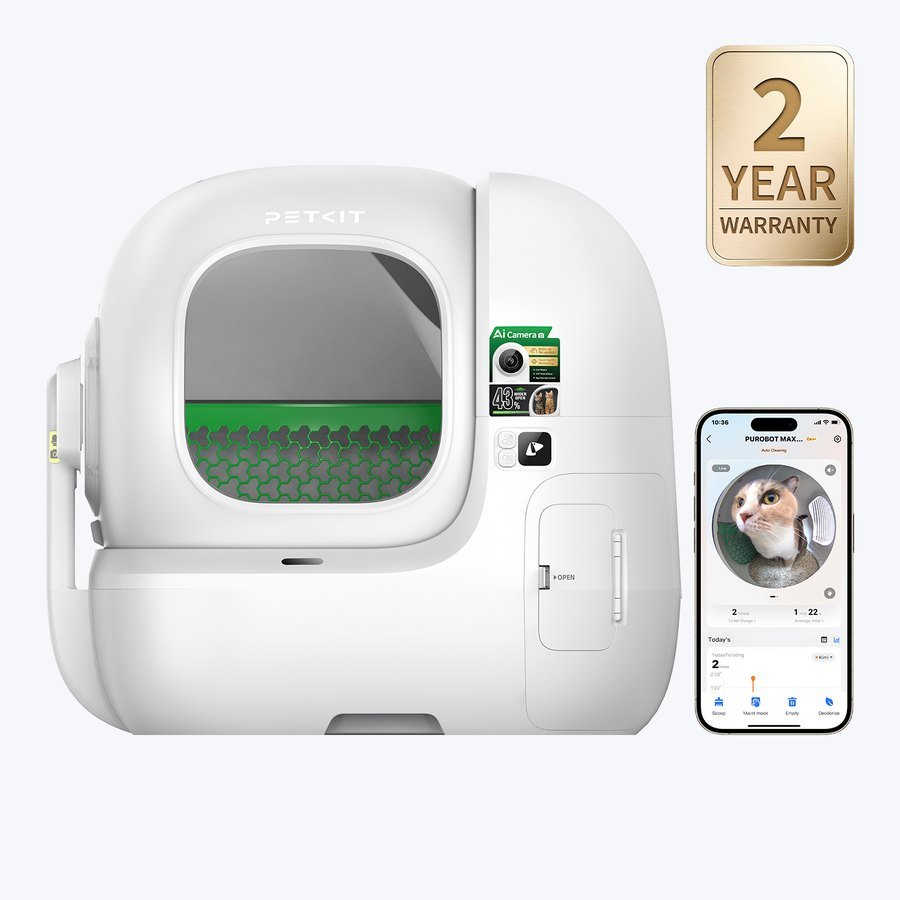
If your cat sits inside the rating, these are PETKIT’s three self-cleaning units. All three carry the same published 3.3 to 22 lb range, so choosing between them is about chamber size, monitoring and price, not about fit.
The baseline
Purobot Max 3
$399.99 · 24.4 × 21.2 × 21.7 in · 7L bin
Wide low entry and a 7L side bin PETKIT rates at up to 15 days hands-free in a single-cat home. The sensible starting point when your cat sits comfortably under the weight line.
If you want the health log
Purobot Max Pro 2
$499.99 · 25.86 × 21.18 × 23.74 in · AI camera
The version that hands back some of what you lose by not scooping: an AI camera with multi-cat recognition that logs visits per cat. A shift in frequency shows up in the log before a person would spot it.
The largest footprint
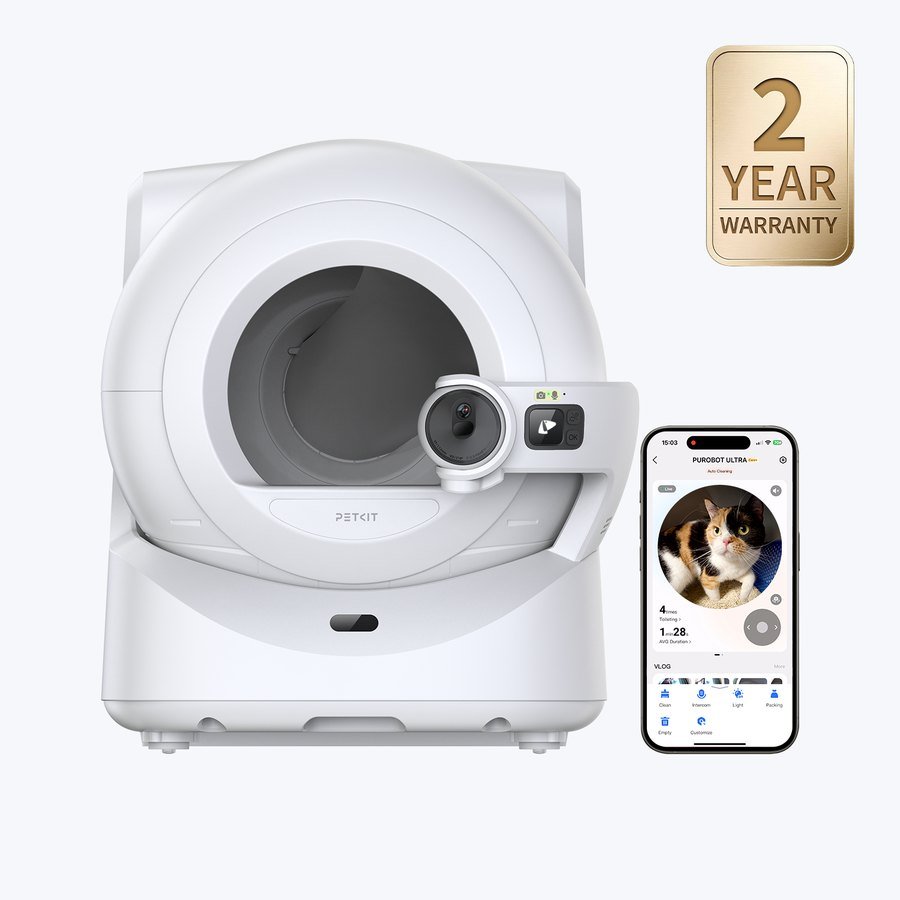
Purobot Ultra
$799.99 · 20.94 × 32.20 × 24.09 in · AI camera
PETKIT’s flagship and the deepest of the three at 32.2 inches front to back, with stool and urine monitoring in the app. The same 22 lb ceiling applies, so it buys room and data, not a higher limit.
Product links are affiliate links. Prices, dimensions and the weight range are PETKIT’s own published figures, checked on their product pages.
If you buy one, buy it where it can be returned, and measure the entry opening against your cat’s shoulder height before the return window closes. The specification sheet is a better guide here than any review, because reviewers rarely own a 24-pound cat.
What Scooping Buys You, and What Automation Takes Away
There is a second argument against automation that has nothing to do with size, and the people making it are not luddites.
“I get automation makes life easy, there isn’t a substitute for picking the poop out after you’ve heard them cover it PLUS you get to see the poop the cat has produced and be able to identify if you have any issues with said cat.”
– r/mainecoons, July 2026
Daily scooping is an inspection. You see consistency, volume, blood, mucus, and the number of urine clumps, and you notice the day those change. Cats conceal illness with unusual skill, and for many owners the litter box is the only place the concealment breaks down. That matters more in this breed than most, since Maine Coons are predisposed to conditions where early detection changes the outcome; our guide to what to watch for works through the list.
An automatic box removes the inspection and hands back a different signal. Units with weight sensors and app logging record each visit, its duration and the cat’s weight, and a shift in frequency shows up in the log before it shows up to a human eye. One owner in the same thread credits exactly that with catching a thyroid problem early.
Neither signal dominates. Scooping sees the output; the log sees the pattern. What you should refuse is the third option, which is an automatic box with no monitoring at all, because that combination deletes the inspection and returns nothing for it.
Where Cheap Automation Fails a Large Cat
One more consideration belongs to this breed specifically. A mechanism sized and tested around a 9-pound cat meets different forces when a 22-pound animal decides to climb in halfway through a cycle.
In July 2026 an owner of two Maine Coons posted video of what appeared to be a pinch point near the end of the cleaning cycle on an inexpensive XXL unit, and the thread that followed carried a consistent thread of caution about budget automatic trays. Sensor coverage, cycle-abort behaviour and the shape of the moving parts are the things that separate units at this size, and they are also the things a specification sheet describes least well.
Practical version: if you automate, buy from a manufacturer that publishes its sensor count and its weight limits, run the first week with the cat supervised, and keep the manual pan in the house until you have watched a full cycle interrupted.
How Many Boxes, and Where They Go
The n+1 convention holds for this breed exactly as it does for any other: one box per cat, and one spare. Two cats means three boxes, in three separate places, and buying a single enormous pan does not discharge the second half of that rule.
Size does not buy you out of the count. A single enormous pan is one location, and the reason for the extra box is territorial and logistical, not volumetric. Two cats in a one-box household produce guarding behaviour, and a guarded box is an unused box.
Placement rules that matter more at this size:
- Room to circle. A 34-inch pan wedged into a 36-inch alcove leaves the cat no approach. Allow a body length of clear floor on the entry side.
- Separate rooms. Two boxes side by side count as one location to the cat doing the guarding.
- Away from the food and the noisy machines. A washing machine spin cycle three feet from the pan will end its career.
- Off carpet. A large digger sends litter far enough that a hard floor and a wide mat save more effort than any lid.
Kittens should learn on the largest pan they can climb into, with a cut-down entry if needed; our walkthrough on litter box training covers the sequence. For disposal at this volume, a dedicated system earns its place faster than it does with a smaller cat, and we compare the options in our guide to litter disposal systems.
The Order to Decide In
- Measure the cat, nose to tail base, and multiply by 1.5. That number is your target, and you will probably not hit it.
- Decide open or automatic using weight. Over 22 lbs settles it: open pan.
- Buy for interior dimensions, never the exterior figure on the listing. Ask the seller if it is not published.
- Check the entry against the cat’s shoulder, not against the box’s overall height.
- Count locations, not pans. n+1, in separate rooms.
FAQ
Do Maine Coon cats need a special litter box?
They need a larger one. Nothing about a Maine Coon litter box calls for a different mechanism, material or shape, but the standard sizing rule pushes an adult Maine Coon past what most manufacturers build. An XXL pan, a storage tote or a mixing tub all qualify; a standard 18 by 15 inch box does not.
What size litter box does a Maine Coon need?
Between 27 and 39 inches of interior length depending on the individual, from 1.5 times body length measured nose to tail base. Sides of 8 to 10 inches, and an entry of 5 to 6 inches for an adult in good health.
What is the best litter box for a Maine Coon cat?
For most adults, the largest open stainless pan you can accommodate, on a hard floor, with a scoop kept beside it. For a cat over about 22 lbs, a long storage tote or a mixing tub is the only format that reaches the rule. Self-cleaning units suit cats under roughly 18 lbs and become a fit problem above that.
Can a Maine Coon use a self-cleaning litter box?
Many can. PETKIT publishes a 3.3 to 22 lb range across its Purobot line, so the answer turns on your particular cat, not on the breed. Weigh him, compare against the manufacturer’s figure, and treat the entry opening as the tighter of the two constraints.
Is a storage tote actually a good litter box?
For a large Maine Coon it is frequently the best available option, and it is common practice in the breed community. Choose rigid, opaque plastic, discard the lid, and cut and sand an entry notch if the sides are too high for the cat to step over.
How do I stop the litter going everywhere?
Height first, then floor. Sides of at least 8 inches inside a box large enough that the cat is not digging against a wall will stop most of it, and a wide mat on a hard floor catches the remainder. A lid relocates the problem without solving it, and it costs turning space the cat has no spare of.
Under 22 pounds? A self-cleaning box is on the table.
PETKIT publishes its weight range and its interior dimensions, which is more than most brands do. Check your cat against the figure first, and buy where it can be returned.
Affiliate link. We may earn a commission at no extra cost to you.