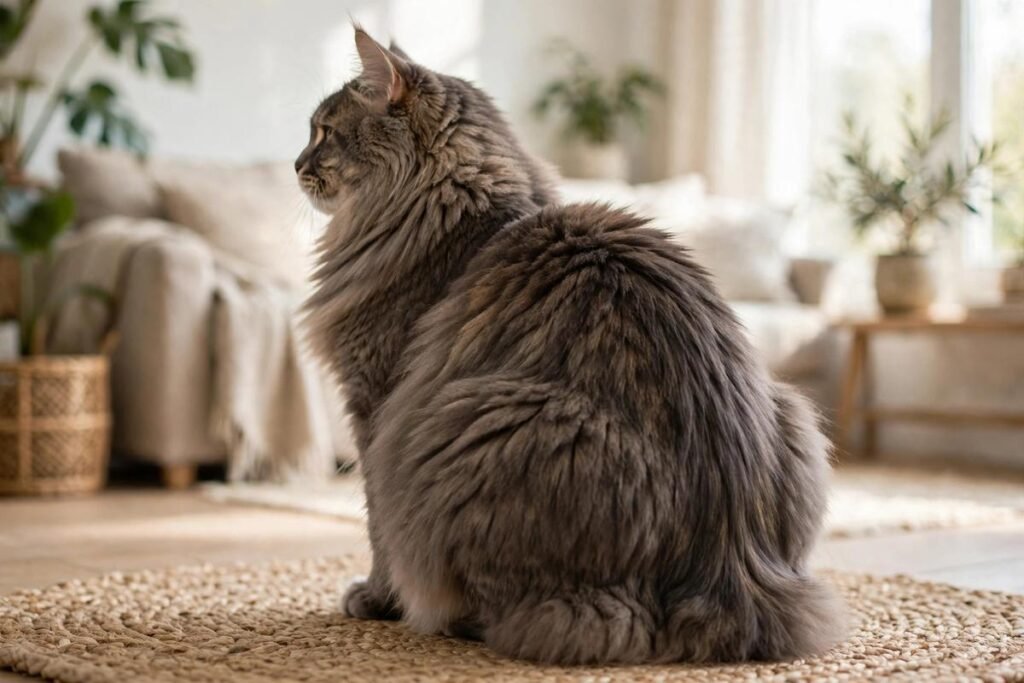
A Manx Maine Coon mix is a cross between a Maine Coon and a Manx, the tailless breed from the Isle of Man. When the Manx parent carries one copy of a dominant tail mutation and the Maine Coon carries none, roughly half the kittens inherit it, so one litter can hold tailless, stub-tailed, and fully tailed kittens side by side.
Both halves of the story come from one mutation. In this cross, the same gene that shortens the tail can disturb the spine, the bladder, and the bowel, which is why the genetics, the health risks, and the question of whether anyone should breed these kittens belong in a single answer.
The T-box gene behind the missing tail
A Manx tail is not an injury and not a docking job. It comes from mutations in the T gene, which codes for a T-box transcription factor called Brachyury. A 2013 study in Mammalian Genome sequenced the T gene in Manx lines from both the US and the Isle of Man and found four distinct mutations: three single-base deletions and one duplication/deletion, each a frameshift that truncates the Brachyury protein. Mutant protein activated its downstream target at a substantially lower level than the normal form, which the authors describe as haploinsufficiency, meaning one working copy is not enough for normal tail development (Buckingham et al., via Europe PMC).
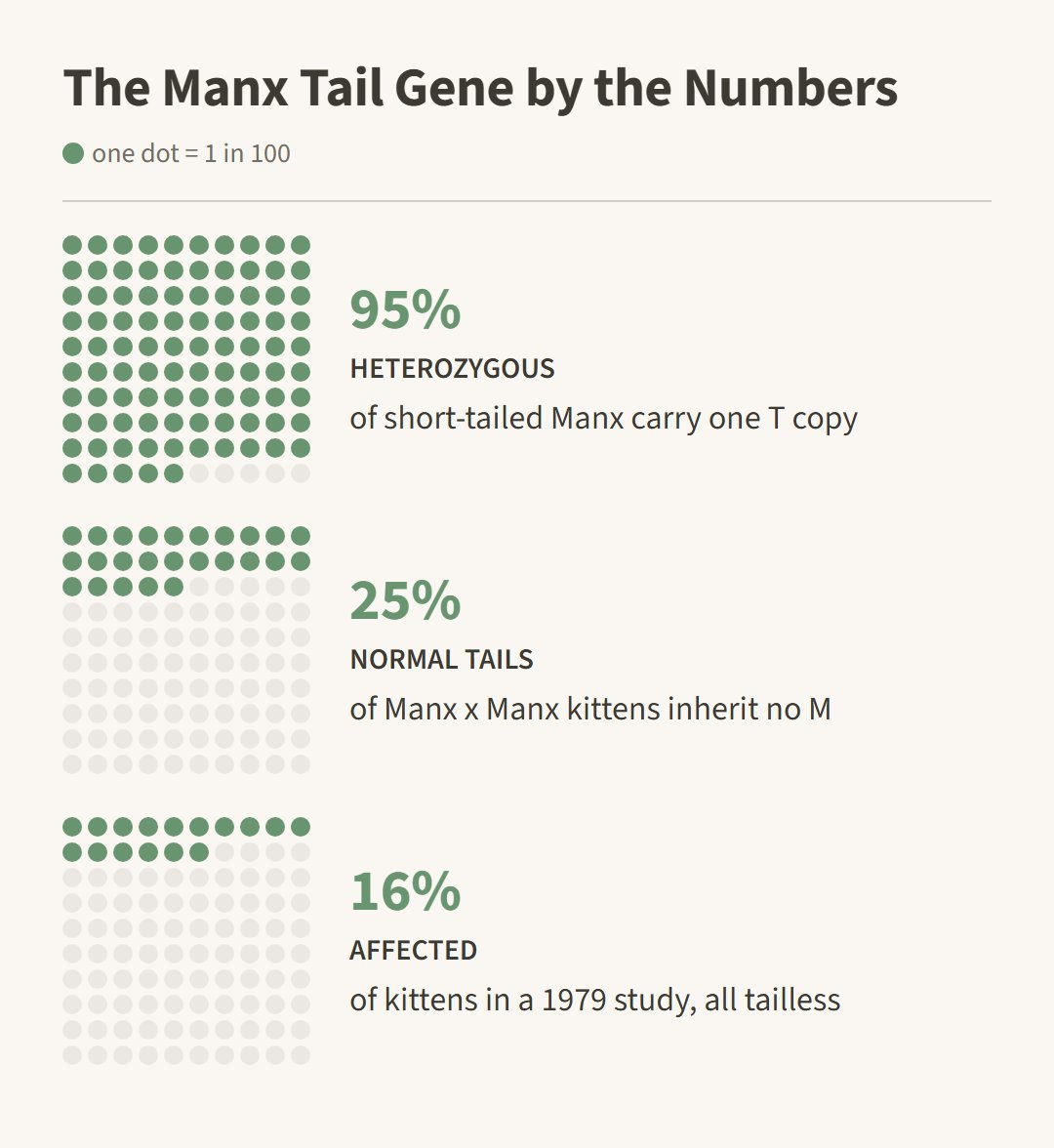
Two properties of this gene drive everything else about the cross. Dominance comes first: a kitten needs only one copy to lose some or all of its tail, and in that study 95% of short-tailed Manx cats were heterozygous carriers. Two copies are lethal. Embryos that inherit the mutant allele from both parents die early in development, so every living tailless Manx carries exactly one mutant and one normal allele.
One more finding from the same study deserves a sidebar. A single mutant T allele turned up in Manx cats and in two newer American breeds, the American Bobtail and the Pixie-Bob, so a short tail in those breeds can trace back to the very same mutation. Breed makeup still differs a great deal; the bobtail side of that story has its own page on the American Bobtail Maine Coon mix.
What tail does a Manx Maine Coon mix get?
Any of four outcomes, and no seller can promise one in advance. A Manx Maine Coon mix kitten that inherits the mutant allele can be born with no tail at all, a fused knob, a short mobile stump, or a longer tail, because the gene’s expression varies even between littermates.
Veterinary literature groups the outcomes into four types, described by Deforest and Basrur in 1979 and summarized in the UFAW welfare reference:
| Type | Tail vertebrae | What you see | What to know |
|---|---|---|---|
| Rumpy | None | Completely tailless | Most often affected by spinal problems |
| Rumpy-riser | 1-7, fused upright | A small immobile knob of bone | Fused vertebrae cannot flex |
| Stumpy | 2-14 | A short, sometimes kinked tail that moves side to side | Prone to painful arthritis in the stump |
| Longie | A longer tail | A tail well past a stump | Still carries the mutant allele |
Kittens that inherit no mutant allele have ordinary tails. Where the Manx parent carries one copy and the Maine Coon none, each kitten has about a 50% chance of getting the allele; in Manx-to-Manx litters, about a quarter of kittens inherit no copy at all. Which tail a carrier kitten actually grows is only partly predictable, because modifying genes and other factors account for much of the variation.
Size, coat, and build: what the Maine Coon side adds
Parent size sits at opposite ends of the range. The Cat Fanciers’ Association calls the Maine Coon the largest of all pedigreed cats, a slow-maturing breed that can take up to three years to reach full growth, with mature males often reaching or exceeding 20 pounds. Manx cats are medium and compact, built on roundness, with a broad chest, a short arched back, and hind legs longer than the front legs; CFA’s standard says a Manx should feel surprisingly heavy when lifted.
Expect the mix to land somewhere between those poles, and expect the final size to stay unknown for a few years. The Maine Coon growth chart gives a month-by-month reference for tracking a kitten.
Coat is the other open variable. Maine Coons carry a heavy, shaggy coat that is shorter on the shoulders and longer on the stomach and britches, while Manx cats come in both shorthair and longhair varieties. Kittens can therefore range from a short double coat to a full semi-long one, with grooming needs to match.
Manx syndrome: the risk that travels with the gene
Manx syndrome is the umbrella term for the spinal problems that ride along with the tail mutation. Spina bifida is the most common of them: the neural tube that forms the spinal cord fails to close completely during development. Because the affected nerves serve the hind limbs, the bladder, and the bowel, the damage shows up in all three.
Documented signs include a plantigrade, hopping gait; loss of sensation around the hindquarters; urinary and faecal incontinence; constipation severe enough to distend the colon (megacolon); and rectal prolapse. Signs are present at birth or appear over the first weeks to months, and usually there is no effective treatment. UFAW’s welfare reference, now hosted by Science for Animal Welfare, adds that severely affected kittens die in the uterus or are euthanized early (UFAW, Manx Syndrome).
Risk tracks tail length. Fully tailless rumpy cats are affected most often; in the 1979 study that UFAW cites, 7 of 44 recorded kittens (16%) were affected, and every one of them was a rumpy. Stumpy cats are prone to painful arthritis in their deformed tail joints. A kitten that inherits no copy of the mutation has an ordinary tail and none of this risk.
Photos make the tailless kitten in a mixed litter look like the jackpot. It is the outcome with the highest medical risk attached, and CFA advises anyone considering a Manx to ask the breeder about Manx syndrome in the lines, since it is typically found before kittens reach four months of age.
Is that cat really a Manx Maine Coon mix?
Usually you cannot know from looks alone. Stub-tailed or tailless cats without papers are mostly domestic cats of unknown ancestry, and only pedigree records or a DNA test can settle what a Manx Maine Coon mix claim really is.
Breed-guessing threads on r/catbreeds land in the same place almost every time: without papers, the answer is “domestic longhair” or “domestic shorthair,” because the overwhelming majority of cats have no breed ancestry at all. Owners of cats that fit the Manx type describe tells beyond the missing tail, as one r/manx owner does here:
“His name is Vader and will be 4 in August! Adopted from a bunny & guinea pig shelter (along with Raven the girl). Vet said his nub was from birth. No injury to my knowledge. Does bunny hop. His back legs look longer imo & I’ll joke saying he looks like a deer sometimes. Looks like he’s got brown stripes in the sunlight. Also, he is stupid & I love him so much hehe. 😭🫶🏼 (scroll to end for kitten pic)”
– r/manx, June 2026 (288 upvotes)
Longer hind legs and a rabbit-like hop match the Manx type in CFA’s standard. A short tail on its own proves little, though, and it gets misattributed in creative ways; the bobcat-ancestry rumor is common enough to have its own page on the Maine Coon bobcat mix question.
For a firmer answer, a vet can examine the sacral and tail vertebrae directly, and x-rays show the bony abnormalities when they exist. Wider mix indicators are listed in how to tell if your cat is a Maine Coon mix, and the hub on mixed-breed Maine Coon cats shows where this cross fits among the others.
Should anyone breed a Manx Maine Coon mix?
No. The cross is not a recognized breed, and the welfare case against producing it on purpose is unusually clear-cut: the mutation that creates the tailless look is the same one behind Manx syndrome, and two copies of it are lethal to the embryo.
Even inside the pedigree Manx world, where the trait is the whole point of the breed, management is defensive. CFA says breeders test and monitor kittens, may wait to place them until health is assured, and use tailed Manx cats in their programs to keep the gene pool healthy. A casual cross with an unscreened Maine Coon drops every one of those safeguards, and it also skips the Maine Coon side’s screening, where breeders x-ray for hip dysplasia and use saliva tests and echocardiograms for hypertrophic cardiomyopathy.
UFAW goes further than risk management. Its reference states that the ethics of continuing a breed whose defining trait rests on a damaging gene should be seriously considered, because as long as people buy Manx cats, the disease the gene causes persists. Breeding for the look on purpose in a new cross imports the problem along with the appearance.
If a cat from this cross already lives in your home, none of that is a verdict on your cat. It is a reason to find a vet who knows to watch the spine, the bladder, and the bowel. Producing more of these kittens on purpose is where the line sits.
Manx Maine Coon mix FAQ
What is the difference between a Maine Coon and a Manx?
They differ in origin, build, and genetics. The Maine Coon is an American breed, the largest pedigreed cat, with a shaggy coat and a full plumed tail. A Manx comes from the Isle of Man and is a compact, round cat defined by the dominant T-box mutation that shortens or removes its tail. Kittens from a cross can show traits from either parent in any combination.
Is a Manx Maine Coon mix healthy?
It depends on whether the kitten inherited the Manx tail allele and how that allele expressed. A kitten with no copy of it avoids Manx syndrome entirely, while a fully tailless kitten carries the highest risk of spinal, bladder, and bowel problems.
The Maine Coon side adds its own watch list, since the breed is screened for hip dysplasia and hypertrophic cardiomyopathy. A vet exam in the first months, with attention to gait, bladder control, and stool, is the practical starting point for any tailless or stub-tailed kitten.
How rare is a Manx cat?
No public census counts the breed, so any precise number is unverifiable. UFAW’s reference says only that Manx and Cymric breeding seems to have decreased greatly in the UK in recent years.
One Comment