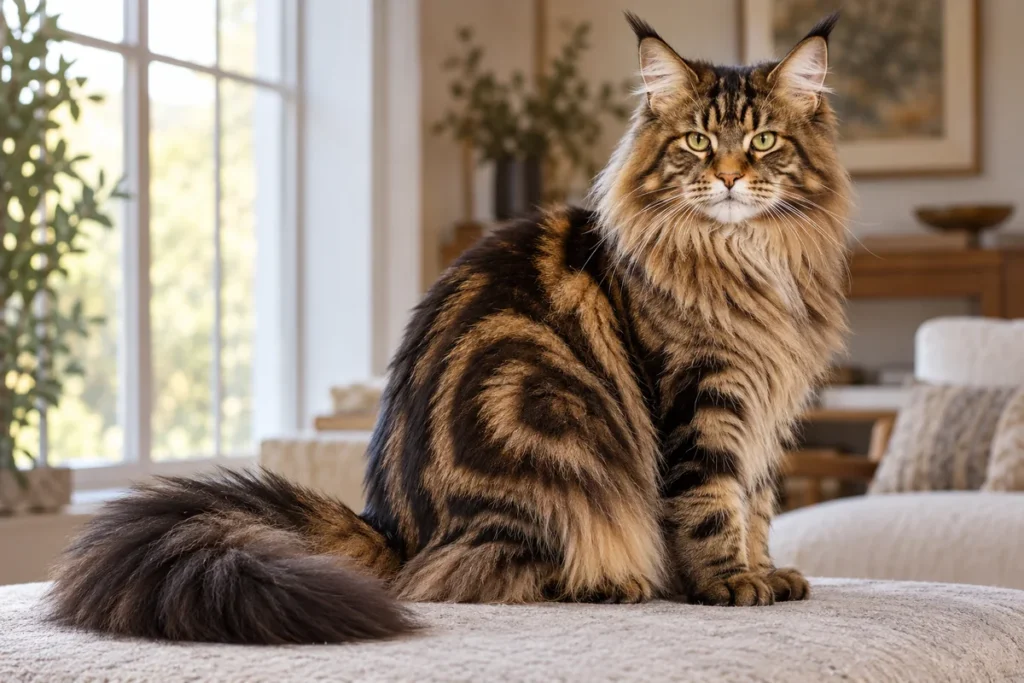
A tabby Maine Coon is a Maine Coon wearing one of three tabby patterns, classic, mackerel or ticked, over a colour such as brown, silver, red or blue. Tabby is a pattern and not a colour, which is why the Cat Fanciers’ Association standard lists brown tabby, silver tabby and blue tabby as separate colour entries inside the same breed.
In the CFA’s colour guide, the gene that produces a tabby coat is the dominant one, and a solid coat is the exception.
What makes a Maine Coon a tabby?
A tabby carries the agouti gene. The CFA’s breed-awareness guide to colours describes “A” as the wild type, dominant, producing “banded or ticked (agouti) hair” and so a tabby coat, while “a” is the recessive non-agouti mutation that suppresses ticking and gives a solid coat. A cat needs two copies of “a” to be solid.
Orange cats are always tabbies, the same guide adds, because the orange gene masks the non-agouti gene. Readers after that colour, which the standard calls red tabby, will find it in the orange Maine Coon guide.
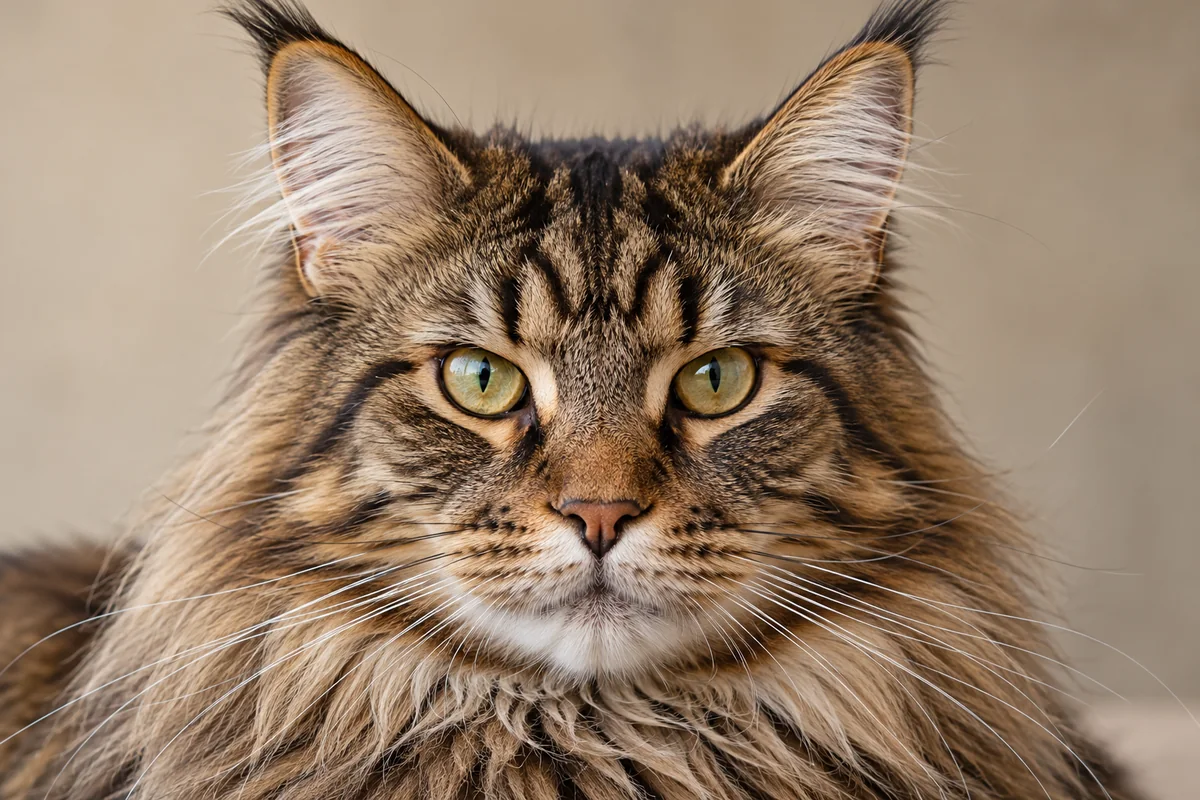
An M on the forehead is part of the pattern, not the breed. In the CFA standard, “frown marks on forehead” form “an intricate letter M” in the classic tabby entry and the head is “barred with an M” in the mackerel one, so any tabby can carry it. Features that do point to the breed are scored in the Maine Coon traits checklist.
Which tabby patterns does the CFA list for Maine Coons?
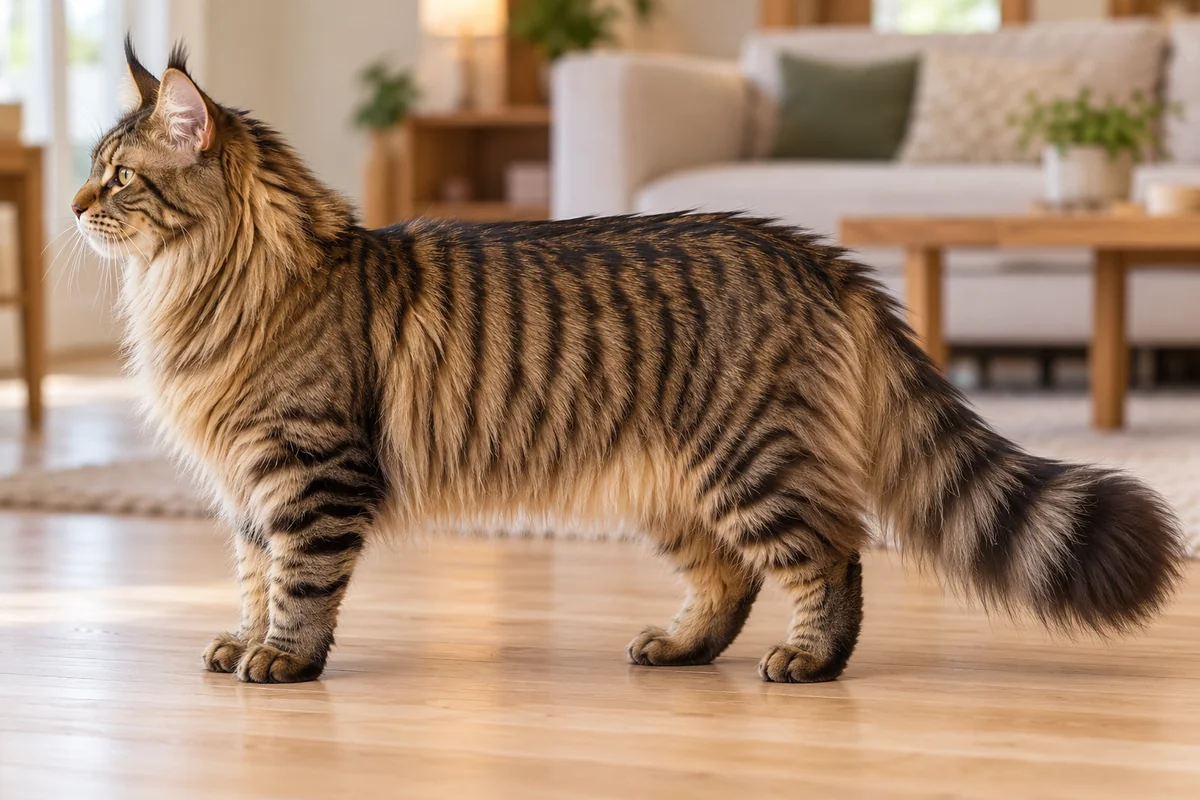
The CFA standard names three tabby patterns for the Maine Coon: classic, mackerel and ticked. They differ in how the markings sit on the body, from broad blotches to narrow pencil lines to almost none, and the table quotes the standard’s wording for each.
| Pattern | CFA wording | What shows on the cat |
|---|---|---|
| Classic | Markings “dense, clearly defined, and broad”; a “large solid blotch on each side” encircled by unbroken rings | A blotch ringed by unbroken lines on each flank, with a butterfly shape over the shoulders |
| Mackerel | Markings “all narrow pencillings” | Narrow pencil-line stripes running around the body |
| Ticked | “Pronounced ticking on body”, free of “any noticeable spots, stripes or blotches” | A ticked body, with full tabby markings only on the face and legs |
Spotted is not one of the three, and the Maine Coon standard lists no spotted class. Spotted tabbies in domestic cats, according to the CFA colour guide, are usually due to polygene influence on the mackerel pattern.
Owners usually name pattern and colour together. In an r/MaineCoon thread asking what colour and pattern a tabby kitten was, one commenter answered:
“Classic tabby, brown”
– r/MaineCoon (9 upvotes)
That two-word answer is the registry’s format too: pattern in brackets, colour as the class.
Which colours can a tabby Maine Coon be?
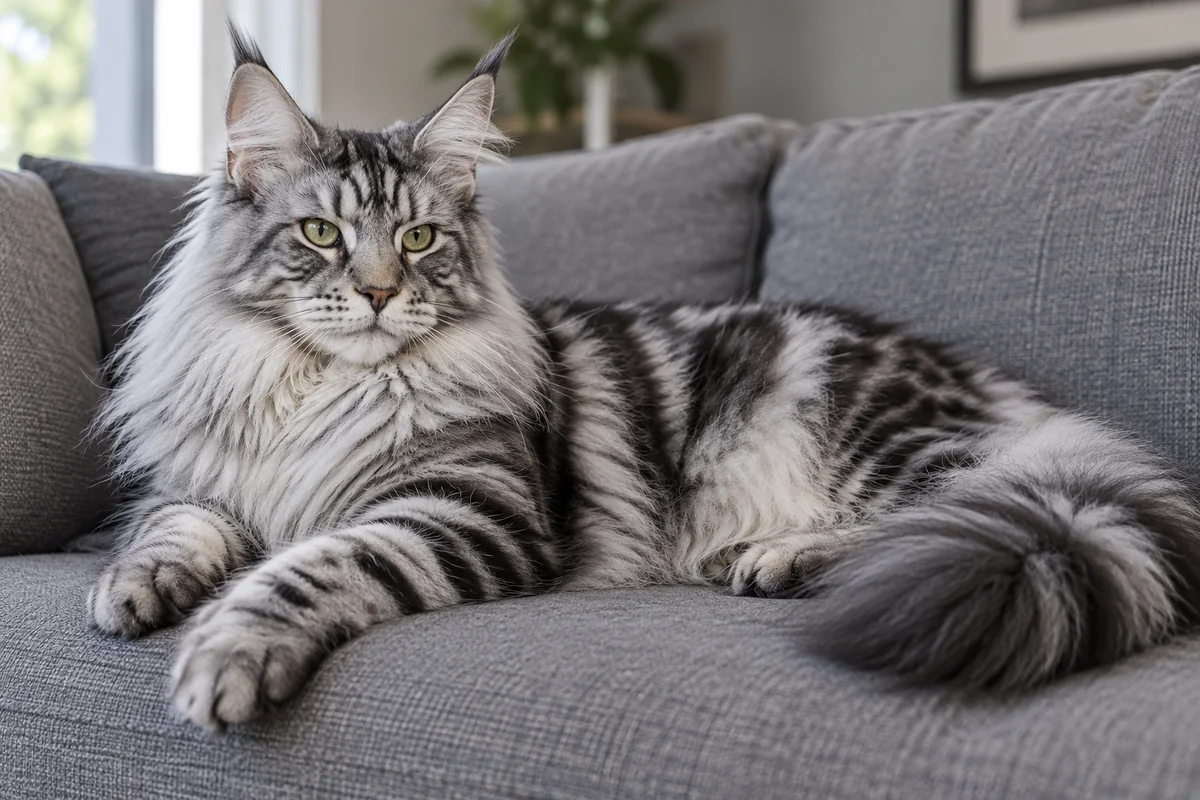
Brown, silver, red, blue and cream are the CFA’s tabby colours, each also listed with white, and brown, silver and blue also come in patched versions. Brown tabby is defined as “ground color brilliant coppery brown”, with markings “dense black” and the back of the leg “black from paw to heel”.
| Colour class | CFA wording |
|---|---|
| Brown tabby | Ground “brilliant coppery brown”; markings “dense black” |
| Silver tabby | Ground “pale, clear silver”; markings “dense black” |
| Red tabby | Ground “red”; markings “deep, rich red” |
| Blue tabby | Ground “pale bluish Ivory”; markings “a very deep blue” |
| Cream tabby | Ground “very pale cream”; markings buff or cream, darker than the ground |
Patched versions exist for brown, silver and blue, and the standard describes the brown patched tabby as having markings “dense black with patches of red”. Patchy coats are covered in the tortoiseshell Maine Coon guide, and the silver and blue versions in the silver Maine Coon guide and blue Maine Coon guide.
How is the tabby pattern inherited?
Two genes are involved. Agouti decides whether a cat is tabby at all, and a second tabby gene decides which pattern. In the CFA guide, “T” stands for mackerel, “tb” for classic (a recessive allele) and “Ta” for ticked, which it calls epistatic and not located at the same place as the other two.
On the molecular side, a 2012 study in Science by Kaelin and colleagues identified Transmembrane aminopeptidase Q (Taqpep) as the gene responsible for tabby pattern variation in domestic cats. Alleles come from the CFA guide and the gene from the Science paper. Neither says how many Maine Coons carry each pattern.
FAQ
Is a tabby Maine Coon a separate breed?
No. Tabby is a pattern inside the Maine Coon breed, and the CFA Maine Coon breed page lists classic, mackerel and ticked tabbies under one body standard. A cat that only looks like a tabby Maine Coon is covered in the Maine Coon tabby mix guide and the Maine Coon vs tabby comparison.
Is a tabby Maine Coon rare?
No source read gives a count of tabby Maine Coons. Instead, the CFA colour guide calls the tabby gene the dominant, wild-type form, which says how the gene behaves and not how many cats carry it.
What gene makes a cat a tabby?
Agouti, according to the CFA colour guide, with the pattern set by a second tabby gene. Kaelin and colleagues’ 2012 study in Science names Taqpep as the gene behind tabby pattern variation in domestic cats.
Do tabby Maine Coons act differently?
None of the sources read compares Maine Coon colours or patterns on temperament, so nothing supports a link between the tabby coat and behaviour. Judge the individual kitten and its parents, not the stripes.