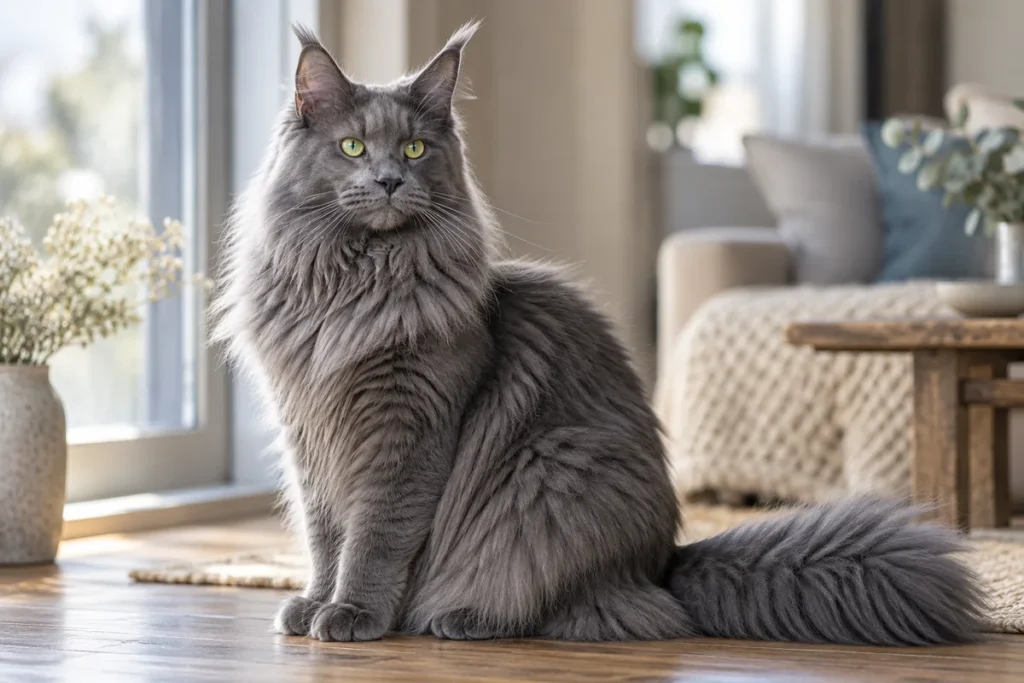
A grey Maine Coon is a blue Maine Coon as far as the Cat Fanciers’ Association is concerned, and its breed standard never uses the word grey. A recessive dilution gene turns black pigment grey, and the pattern layered on top of it (solid, tabby, smoke or silver) decides which grey a cat actually has.
Eye colour is a separate matter, and a grey coat does not bring blue eyes with it.
Is a grey Maine Coon the same as a blue one?
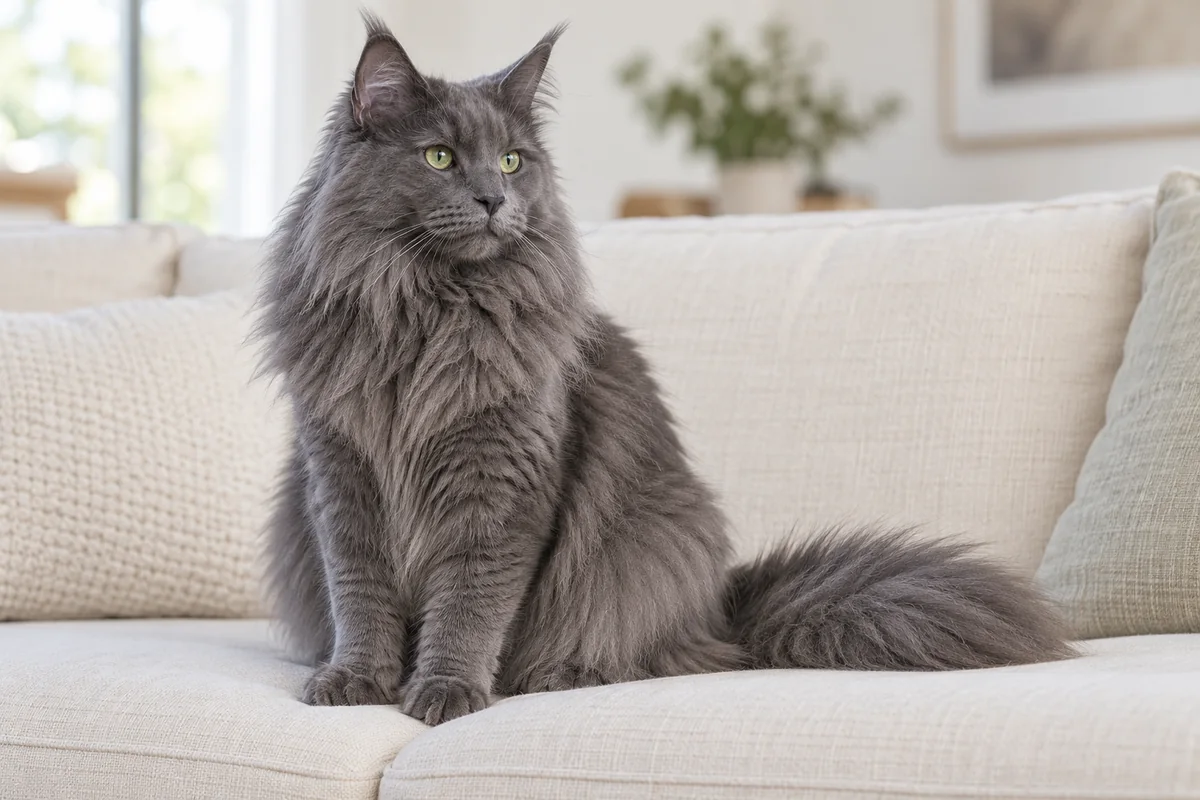
Yes. Under the CFA standard the colour is blue, defined as “one level tone from nose to tip of tail. Sound to the roots.” Neither gray nor grey appears anywhere in the breed page text read on 1 November 2026, so a cat sold as grey is a blue one on paper.
A 2006 study in Genomics by Ishida and colleagues traced the dilute coat in domestic cats to a single-base deletion in the MLPH gene, inherited as a fully penetrant autosomal recessive trait. Dilution lightens both pigments, so black appears grey and orange appears cream. Ishida’s team examined 97 unrelated dilute cats from 26 breeds, plus random-bred cats.
Recessive means a kitten needs one copy from each parent, and parents that are not themselves grey can carry it. A breeder in an r/mainecoons thread described a litter where both parents carried one copy of dilution, and that kind of pairing is how grey kittens turn up from non-grey parents.
That gene also explains the CFA’s cream colours. Blue-cream is listed as “blue with patches of cream”, and dilute calico as white with patches of blue and cream, so the patchy coats covered in the tortoiseshell Maine Coon guide have grey versions too.
Which grey coat does a Maine Coon have?
Four CFA colour classes can read as grey: solid blue, blue tabby, blue smoke and the blue silvers. Below is the standard’s own wording for each.
| Registry name | CFA wording | What shows on the cat |
|---|---|---|
| Blue (solid) | “one level tone from nose to tip of tail” | An even grey with no pattern |
| Blue tabby | Ground “pale bluish Ivory”; markings “a very deep blue” | Grey stripes or swirls on a pale ground, with an M on the forehead |
| Blue smoke | “white undercoat, deeply tipped with blue” | Looks solid blue at rest; white shows when the cat moves |
| Chinchilla or shaded blue silver | White undercoat tipped with blue; shaded is “much darker than a blue chinchilla” | A sparkling pale grey (chinchilla) or a darker mantle of grey over white (shaded) |
Pattern is the quickest sorting question. Per the standard, classic and mackerel tabby heads carry an M on the forehead, so a grey cat with that mark and stripes or swirls on the body is a blue tabby, not a solid. The blue Maine Coon guide covers the solid, and the silver Maine Coon guide covers the silvers.
A grey cat with white on the face, bib, belly and paws is a different class again, listed with the “& White” colours. The grey-and-white cats in the white Maine Coon guide sit near that boundary.
Which genes sit behind each grey class?
Dilution makes the grey, and two other switches decide which class it is. The CFA’s breed-awareness guide to colours lists the dilute colours (dd) as blue, lilac or lavender, fawn and cream, against black, chocolate, cinnamon and red for the dense colours (DD or Dd).
Blue is therefore black with dilution added, and cream is red with dilution added.
Smoke and silver come from the inhibitor gene. The same guide calls it the silver gene, describes “I” as the mutant and dominant allele, and writes the smoke genotype as non-agouti (aa) with I-. A 2009 mapping study in the Journal of Heredity by Menotti-Raymond and colleagues also finds silver due to a dominant “Inhibitor” locus, describes smoke as silver on a non-agouti (black) background, and placed the locus in a 3.3-megabase region of cat chromosome D2. That paper reported the region and candidate genes, not the gene itself.
Putting those genotypes together, a solid blue is dilute and non-agouti, a blue tabby is dilute with a tabby pattern, a blue smoke is dilute, non-agouti and carries the inhibitor, and a blue silver is dilute with the inhibitor over a tabby pattern. Breeder pages such as the Almonte Cats guide lay out the same combinations in genotype shorthand.
How can you tell blue from blue smoke?
Look at the undercoat. Per the CFA, a blue smoke in repose “appears blue” while in motion “the white undercoat is clearly apparent”, so a smoke shows pale hair at the roots and a solid blue does not. Part the fur against the lie of the coat, or watch the cat run.
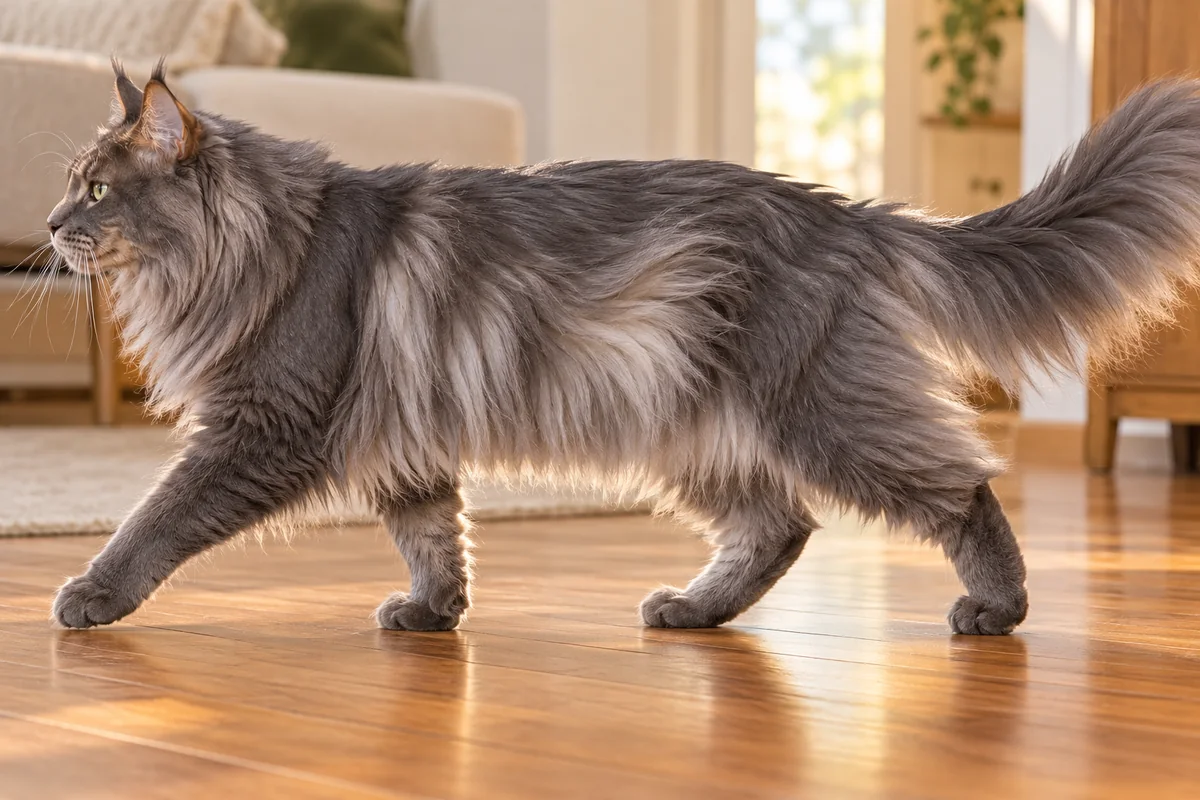
Photos blur the two easily. One commenter in the r/mainecoons thread above wrote:
“Probably blue solid. My blue gremlin’s fur looks lighter in the summer and he almost looks like a blue smoke, but his papers say blue solid and I confirmed that with genetic testing.”
– r/mainecoons, March 2026 (19 upvotes)
That is one owner’s experience, but it matches the standard’s wording: a lightened coat is not enough to call a smoke. Papers and, where there is doubt, a genetic test settle it. The black smoke Maine Coon guide explains how the smoke effect is built, and a blue smoke is the dilute version of it.
Do grey Maine Coons change colour as they grow?
Breeders report that they do. Almonte Cats’ grey Maine Coon page, a cattery’s own guide read on 1 November 2026, says kittens are born dark and that the final shade develops over one to three years. That is a breeder’s statement, not a measured study, and none of the sources read counts how many cats shift or by how much.
An owner in another r/mainecoons thread described a cat that was “consistently black” until almost four years old, then lightened to a grey “smoke” colour on the chest and belly. One reply suggested the longer water-repellent coat coming through first, and the commenter added they were “not an expert.” For black cats the CFA standard asks for fur “free from any tinge of rust on tips or smoke undercoat”, which is why a darkening or lightening coat is worth a vet or breeder question and not a guess.
Do grey Maine Coons have blue eyes?
Not as a rule. Maine Coon eye colour, per the CFA, “can be shades of green, gold, green-gold or copper”, and “white cats and all cats with white may have blue or odd eyes.” A solid or tabby grey cat with no white therefore has green, gold or copper eyes under the standard.
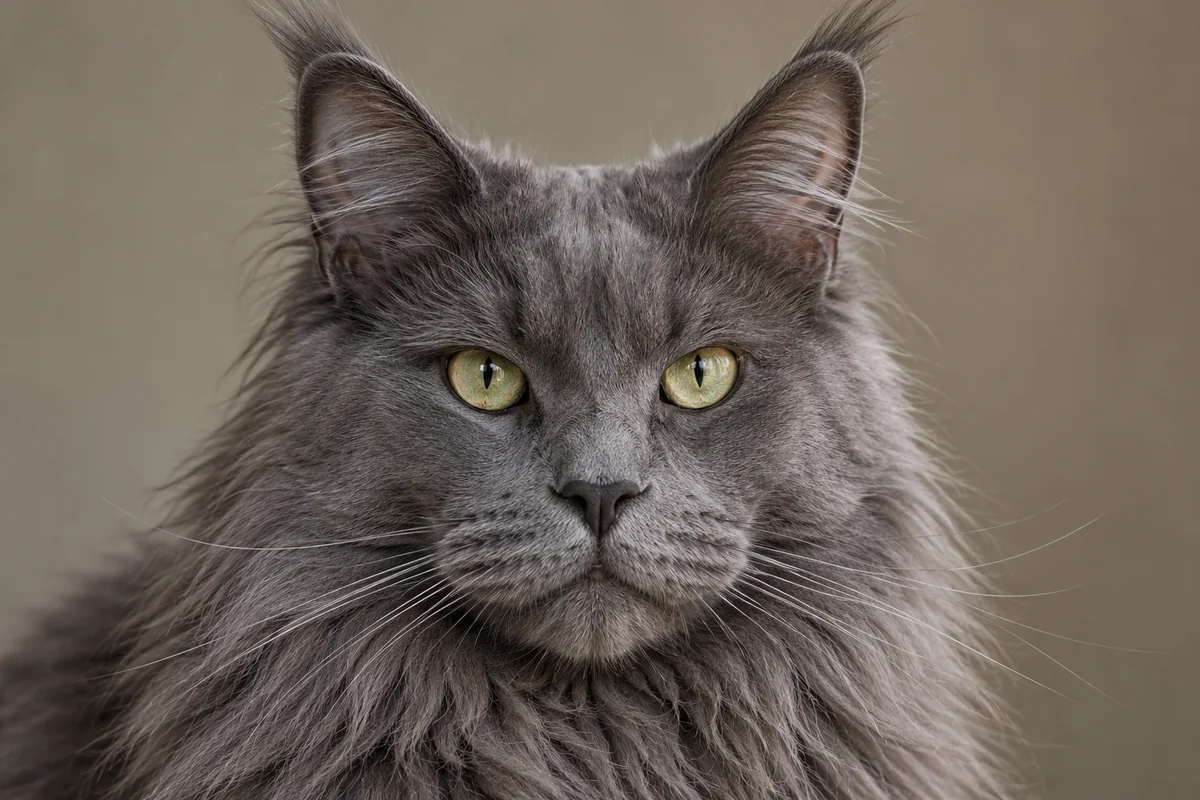
A grey-and-white cat is the case where blue eyes can appear, and they come from the white. One r/MaineCoon poster titled a thread “Blue eyed maine coons is not standard”, and the CFA wording agrees for cats without white.
FAQ
Are grey Maine Coons rare?
No count of grey Maine Coons turned up in the sources read. CFA classes that read as grey are blue, blue tabby, blue smoke and the blue silvers, and price differences by colour, where cattery lists itemise them, are in the Maine Coon price guide.
Is a grey Maine Coon a separate breed?
No. Blue is a colour class inside the Maine Coon breed, and the CFA Maine Coon breed page sets one body standard for every colour.
What gene makes a Maine Coon grey?
It is the dilute gene, MLPH, according to the 2006 Ishida et al. study in Genomics. A kitten needs two copies to show it, and the pattern, tabby or smoke or silver, is set by other genes.
Does coat colour change a Maine Coon’s temperament?
The sources read do not compare Maine Coon colours on temperament, so nothing supports a link between grey and behaviour. Judge the individual kitten and its parents, not the coat.