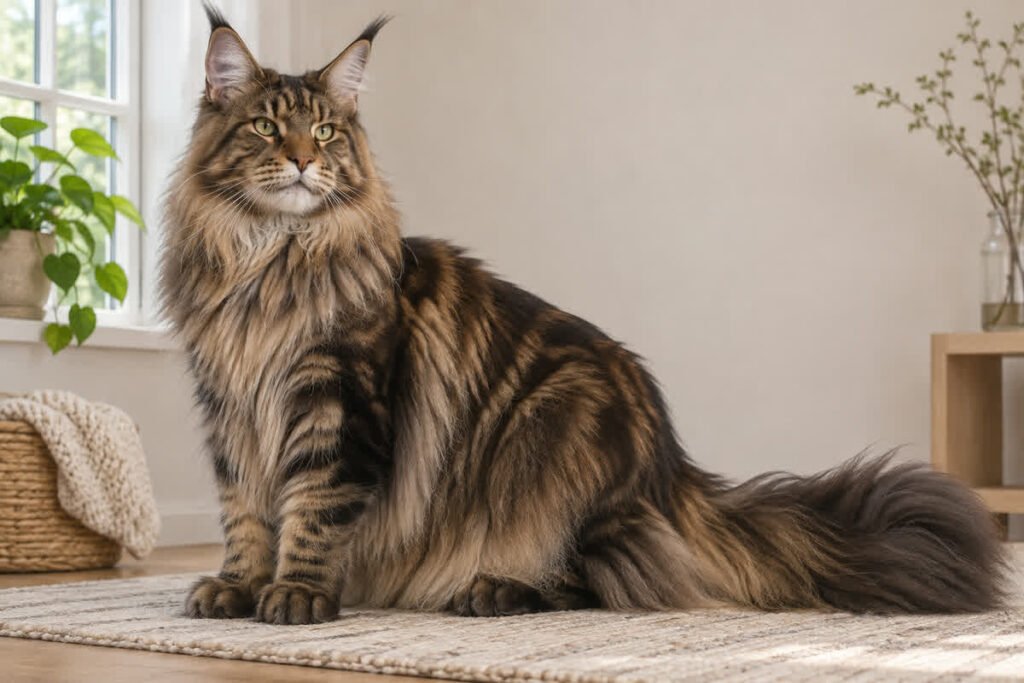
The CFA’s Maine Coon breed standard scores a cat out of 100 points: 30 for the head, 30 for the body, 20 for the coat, 15 for color and 5 for balance. Size gets no points of its own, and the text says quality should never be sacrificed for it.
That is the Cat Fanciers’ Association show standard in its 2025 revision. The International Cat Association (TICA) and other registries publish their own wording, so a cat that wins under one text can lose points under another. What follows walks through the CFA document line by line and says where each line matters to someone buying a kitten rather than entering a ring.
How the Maine Coon Breed Standard Awards 100 Points
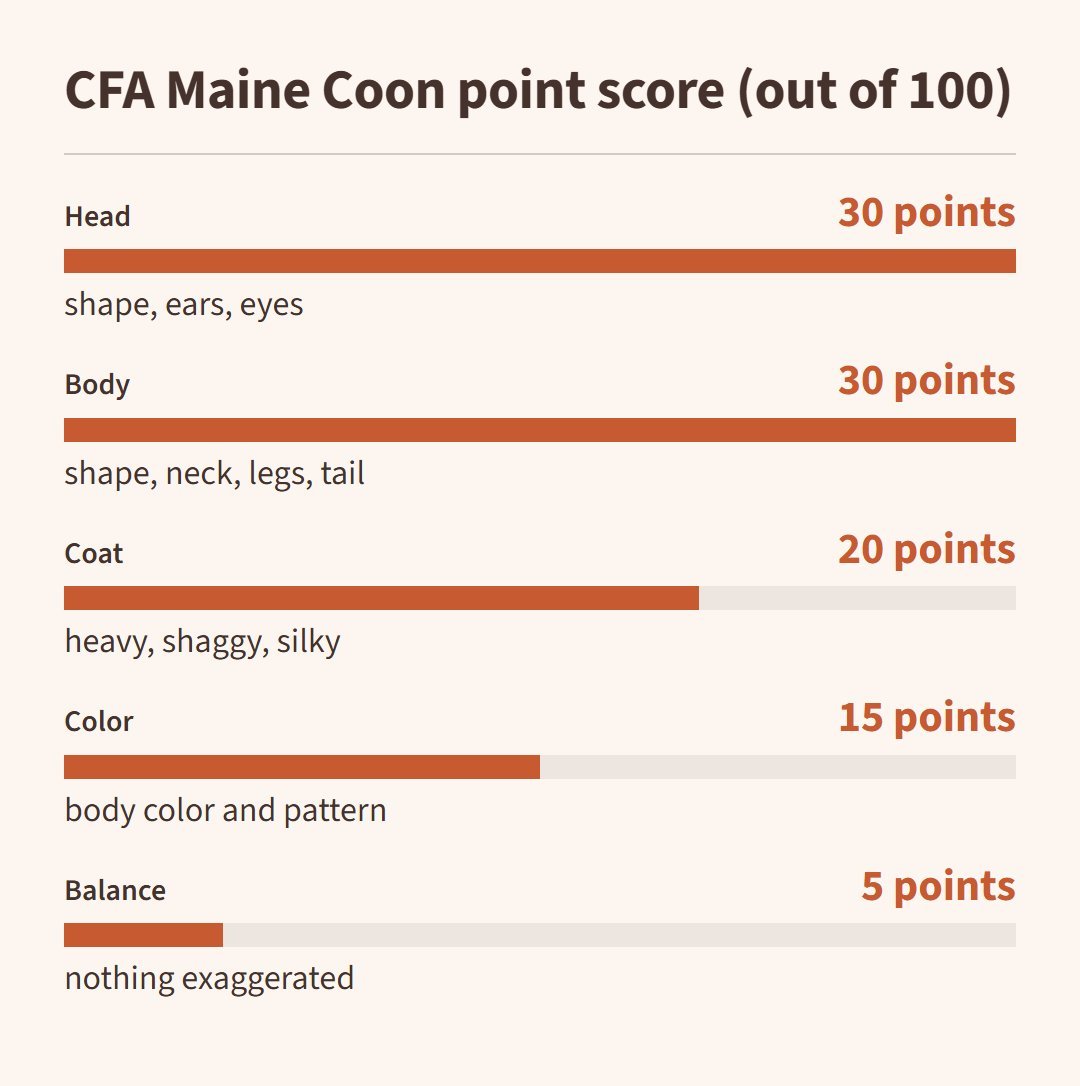
Inside those headline numbers, the head splits into shape (15), ears (10) and eyes (5), while the body splits into shape (15), neck (5), legs and feet (5) and tail (5). Coat takes 20, color and pattern 15, balance 5.
Head and body together hold 60 points, so structure decides most of a score. Color, the first thing most buyers ask about, is worth 15, the same as head shape alone or body shape alone. Coat is worth more than color.
Size is the missing line. The general description calls for a medium to large cat and notes that females are generally smaller than males. It also asks for a well-proportioned, balanced appearance “with no part of the cat being exaggerated” and states that quality should never be sacrificed for size. A heavier cat earns nothing extra, because the scoring sheet has no weight column at all.
Slow growth is built into the text. Judges are told to make allowance for slow maturation, and owners describe the same thing from the sofa side.
“Also, as they grow up they will naturally calm down. Maine Coons take 4 years to mature.”
– r/mainecoons (30 upvotes)
For real weights at each age, the Maine Coon growth chart carries the measured figures, and when Maine Coons stop growing covers the timeline in more detail.
What Should a Maine Coon Head Look Like?
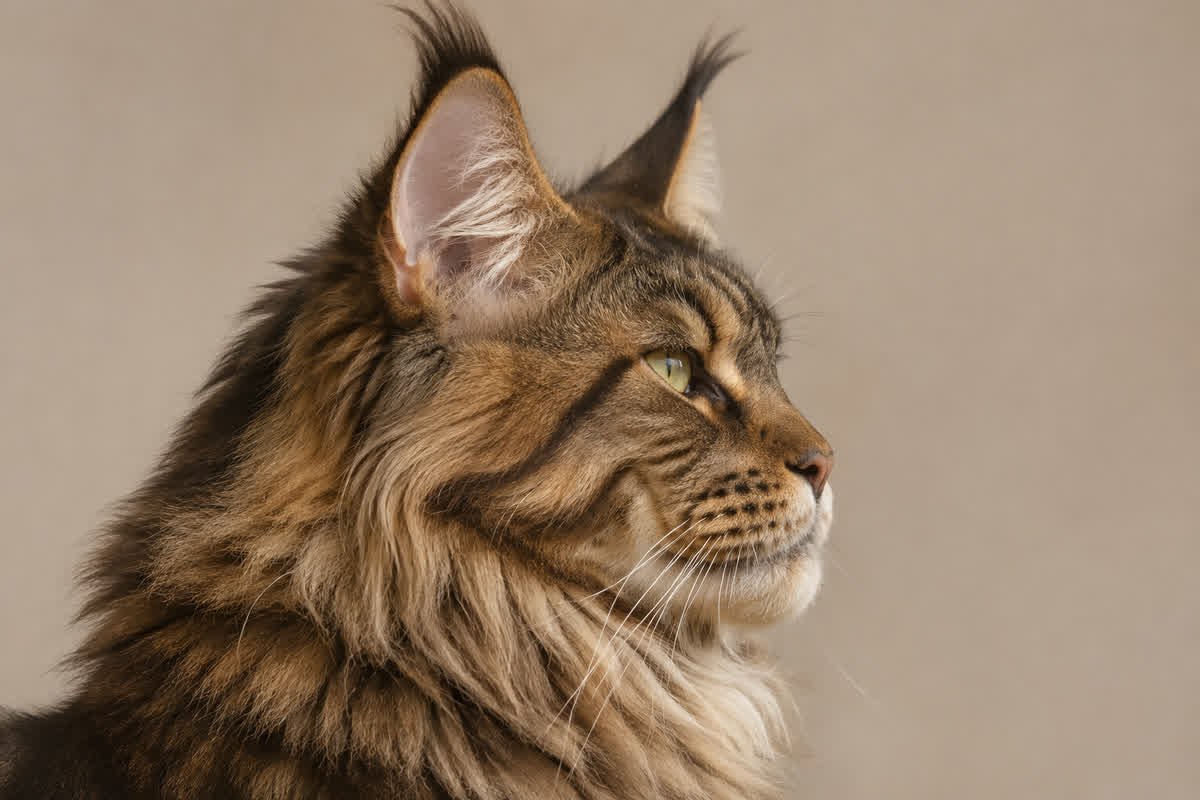
A correct Maine Coon head is medium in width and slightly longer than it is wide, with high cheekbones and a visibly square, blunt muzzle. In profile it shows a slight concavity, never a straight line from brow to nose and never a “break” or “stop”.
The muzzle can look like a rectangle but should not taper or point. The chin should be strong and firm, in line with the upper lip and nose, and deep enough in profile to give the impression of a 90-degree angle. A chin that tapers from the jaw line to the lip is described as not strong, not firm and not desirable.
Side-on photos show the chin best.
Ears carry 10 points, twice what the eyes get. They should be large, well tufted, wide at the base and tapering to a point, set about one ear’s width apart and not flared. Eyes are large, expressive, wide set and open oval, with a slightly oblique setting that slants toward the outer base of the ear.
The text also makes one allowance: heads can broaden in older studs. On a kitten photo, the features that can be judged are muzzle shape, chin depth, ear set and ear tufts. Broadness comes later.
How Is a Maine Coon Built Differently From a Regular Cat?
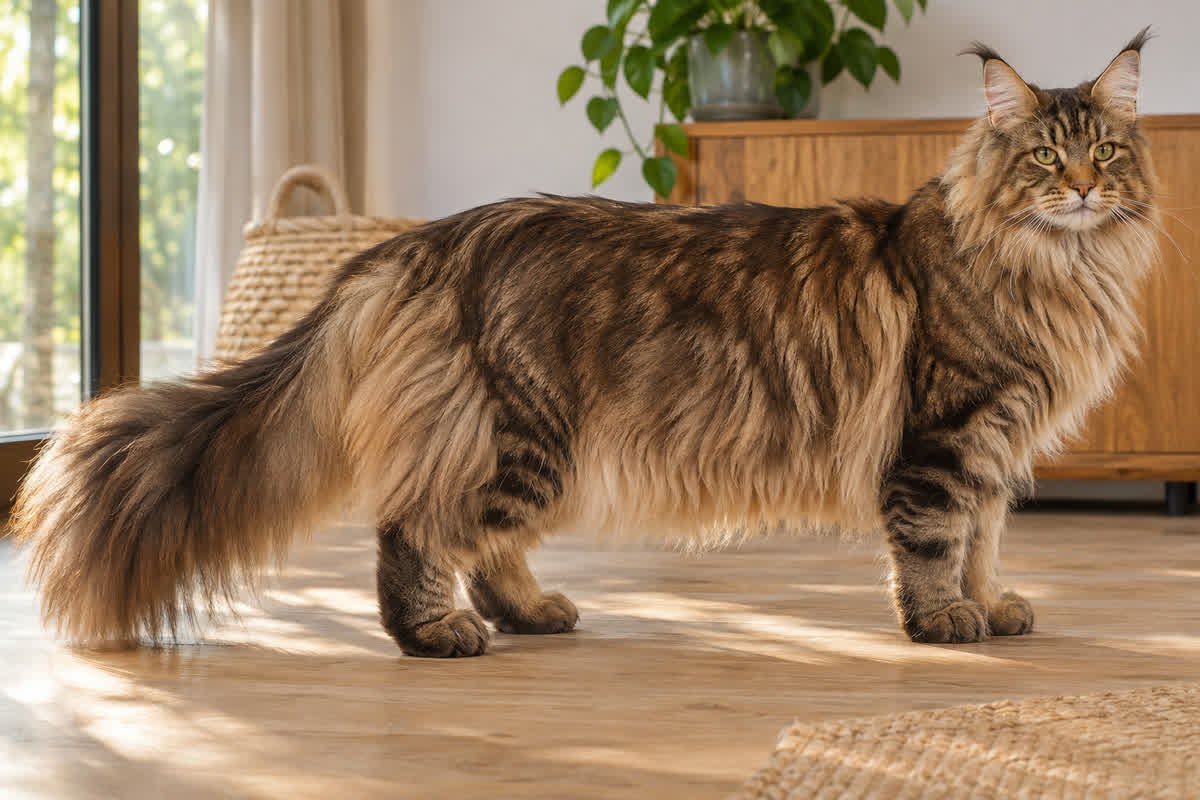
A Maine Coon is built as a long rectangle: muscular and broad-chested, with substantial wide-set legs, large round tufted paws, a long tail wide at the base and a heavy shaggy coat. The CFA text opens by calling it originally a working cat that can endure a harsh climate.
That working-cat framing runs through every body line. The neck is medium long. Forelegs are straight, and the back legs are straight when viewed from behind. Paws carry five toes in front and four behind. The tail is long, wide at the base and tapering, with fur that is long and flowing. The standard asks for a body in which no part is exaggerated to the point of weakness. For the breed’s New England background, see Maine Coon origin.
The coat is heavy and shaggy: shorter on the shoulders, longer on the stomach and britches, with a frontal ruff desirable and a silky texture that falls smoothly. Judges are told to penalize a coat that is short or even all over. At 20 points, the coat is the largest single line on the sheet.
Which Colors and Eye Colors Does the Standard Accept?
The CFA accepts nearly every color and pattern except the hybrid colors chocolate and lavender and the Himalayan pattern. Its classes run from solids and tabbies through smoke, shaded, bicolor, parti-color and calico, with a catch-all class for any other color.
Solid colors are white, black, blue, red and cream. Tabbies come in classic, mackerel and ticked patterns across brown, silver, red, blue and cream. Eye color can be shades of green, gold, green-gold or copper, and white cats and any cat with white may have blue or odd eyes.
White has its own rules. Every bicolor, calico and tortoiseshell-and-white must show white on the bib, belly and all four paws. Cats with white that lack those areas are penalized, and white buttons, lockets or spots on a cat that is not meant to carry white are a disqualification. Individual shades are covered at Maine Coon colors and in the page on the cream Maine Coon.
What Disqualifies a Maine Coon, and Does It Matter for a Pet?
The CFA disqualifies delicate bone structure, an undershot chin, crossed eyes, a kinked or abnormal tail, an incorrect number of toes, white buttons, lockets or spots, and evidence of hybridization resulting in chocolate, lavender or the Himalayan pattern. A disqualification ends a cat’s show career and says nothing else about it.
An undershot chin means the lower incisors overlap or project beyond the upper ones when the mouth is closed. A kinked tail means a change of direction in the tail. Incorrect toe count means anything other than five toes in front and four behind, so extra-toed cats fall outside this standard; the polydactyl Maine Coon page covers what that means for the cat itself.
A disqualification is a ruling about a show ring, not about whether a cat is loving or healthy. The scoring sheet has no line for health testing, so screening is something a breeder offers on top of registration.
“My two were $2000/cat and came with genetic testing and parents EKGs and TICA registration.”
– r/mainecoons (219 upvotes)
A buyer who wants a pet can treat the standard as a checklist of what a purebred should look like: square muzzle, tufted ears, rectangular body, five and four toes, a shaggy coat. Those points can be checked from photos. Cats with mixed parentage are a separate case, covered in Maine Coon mixes.
Weight, final coat length and adult head width only show up with time, which is why the standard asks judges to allow for slow maturation.
2 Comments