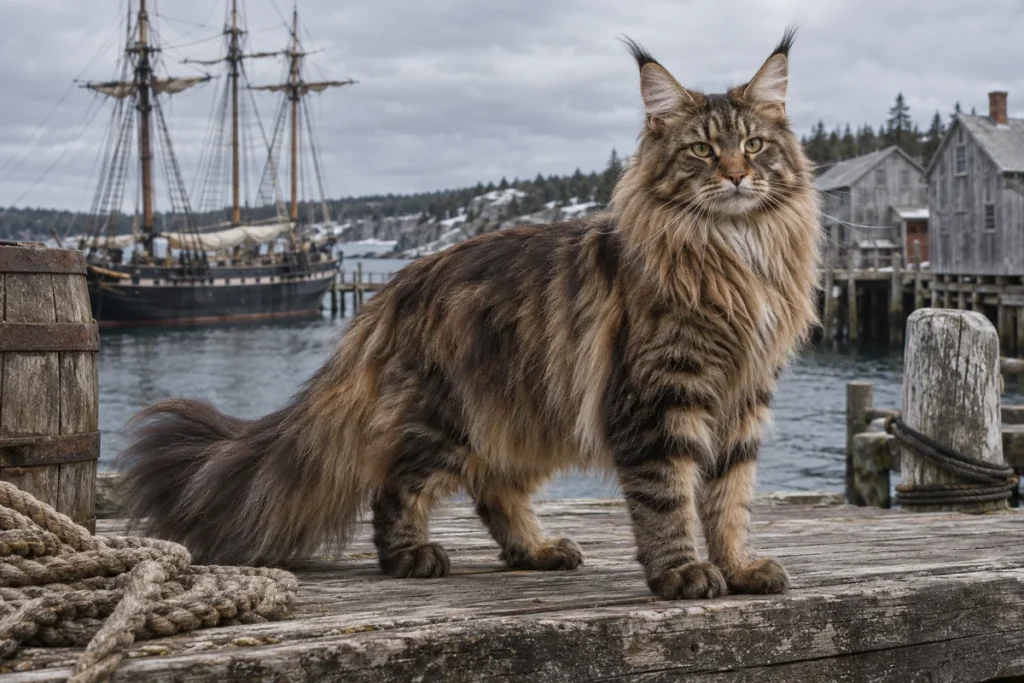
The Maine Coon origin is undocumented. The Cat Fanciers’ Association (CFA) says the breed’s roots are “shrouded in the mists of time”, and its own “more logical conclusion” is that settlers’ shorthaired cats bred with longhaired cats that sailors brought home. Raccoon, bobcat and Marie Antoinette stories are legends.
Records begin in the 1860s, when Maine farmers showed their cats at a county fair, and the best account is the CFA’s own Maine Coon history article. Below, the legends are sorted from the show records, the near-disappearance and the club that rebuilt the breed.
What is the Maine Coon origin story?
Short-haired ship cats landed with early New England settlers, according to the CFA breed history, and longhaired cats arrived later on trading ships and bred with them. Harsh winters decided which kittens survived. The CFA offers this as reasoning, not a documented pedigree.
A 2007 genetic study of cat breeds sampled 31 Maine Coons and grouped the Maine Coon and the American Shorthair with the seven Western European breeds in the study. It did not trace which cats founded the Maine Coon, so the result fits the settler-and-sailor idea only loosely.
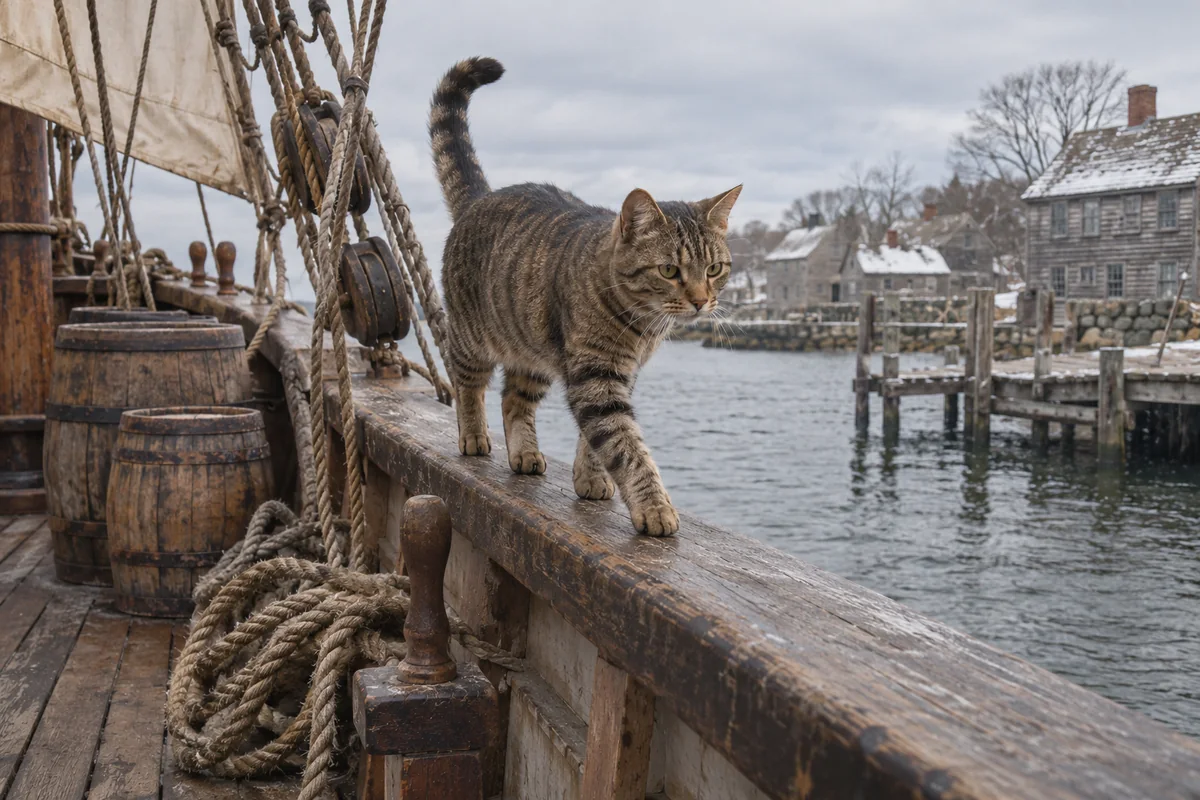
Is the Maine Coon part raccoon or part bobcat?
No. The CFA calls it “genetically impossible” for domestic cats to breed with raccoons or bobcats, because they belong to different genera and do not hybridize. The myths survived because of how the cat looks and sounds.
The CFA offers three explanations for why the stories took hold:
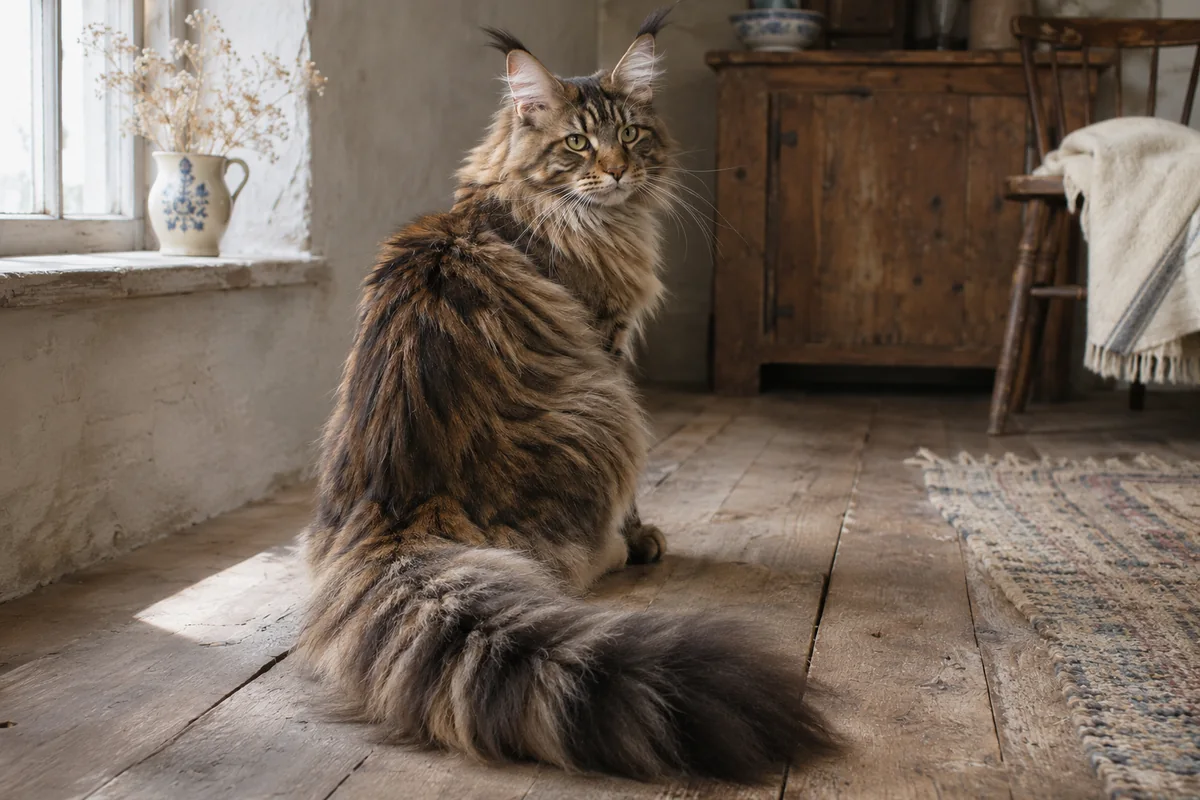
- A brown tabby’s bushy, ringed tail resembles a raccoon’s, and brown tabby is the most common colour in nature.
- Ear tufts and the fur between the toes look like a bobcat’s.
- Maine Coons trill and chirp in a way the CFA compares to “the cry of a young raccoon”.
The “Coon” in the name probably comes from the raccoon story, though the CFA breed page presents that as a theory and not as a record. The Maine Coon bobcat mix guide covers why the bobcat claim keeps resurfacing, and the guide to telling a Maine Coon mix explains what a mixed cat can actually show.
Which legends explain where the Maine Coon came from?
The CFA retells two sea-captain legends and one Viking tale, and presents all three as stories. Captain Samuel Clough supposedly carried six of Marie Antoinette’s longhaired cats to Wiscasset, Maine. An English captain named Coon supposedly sailed the New England coast with an army of cats.
In the first, Clough’s ship Sally sailed after a plot to smuggle the queen out of France failed, with her cats aboard. In the second, locals called the longhaired kittens “one of Coon’s cats”. Neither story cites a document in the CFA article.
A Norwegian version has the ancestors arriving with the Vikings as Skogkatts. For that one the CFA quotes a letter between two fanciers and presents it as a tale, not a finding, while its own preferred explanation stays the plainer one in the first section.
Online, the Viking version circulates as settled fact. A post in r/PiratePets that drew 937 upvotes carried the title:
“Did you know that Maine Coons traveled with Vikings”
– r/PiratePets (937 upvotes)
That title states the claim as a fact, yet no genetic source read tests it.
When did the Maine Coon first appear in cat shows?
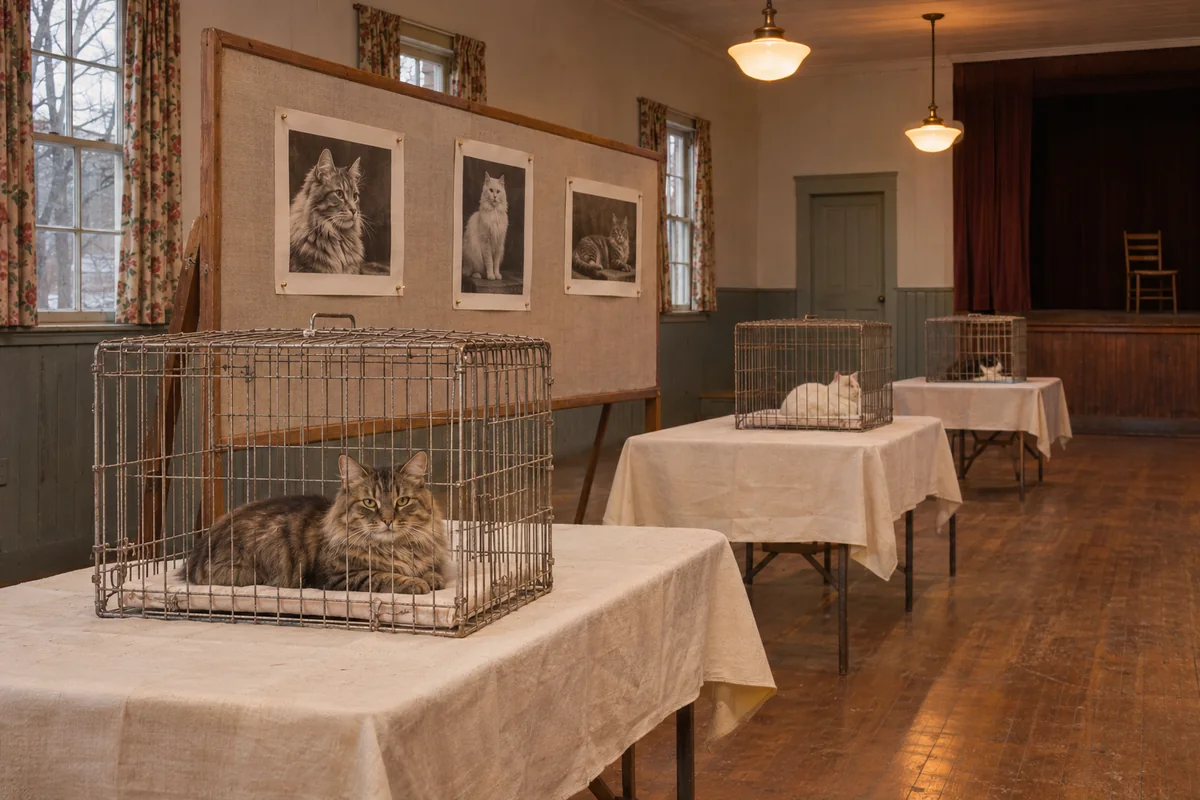
Maine farmers began showing their cats in the 1860s, according to the CFA. The Skowhegan Fair awarded the title “Maine State Champion Coon Cat”, and a dozen Maine Coons were listed in the program of a Boston show in January 1878. The CFA calls the breed “America’s first indigenous show cat”.
May 1895 brought the breed’s most famous early win. At Madison Square Garden in New York, a brown tabby named Cosey, owned by Mrs. E. N. Barker, took the prize, and the CFA Foundation later bought the silver collar for its library. The CFA’s history article calls Cosey a female while its breed page says “his”, so the sex is left open here. Judges classed Maine Coons there with Persians and Angoras as “longhairs”, so the CFA says the number entered cannot be worked out. The names of Cosey and the other early show winners are collected in Maine Coon names.
| Date | What the CFA says happened |
|---|---|
| 1860s | Farmers hold a cat show at the Skowhegan Fair; the prize title is “Maine State Champion Coon Cat” |
| January 1878 | A dozen Maine Coons are listed in a Boston show program |
| May 1895 | Cosey wins the Madison Square Garden show |
| 1908 | The CFA is founded; its first stud book lists 28 “Maine Cats” |
| 1911 | A longhaired blue Maine cat takes best of show in Portland, Oregon, the breed’s last big recorded win for over 40 years |
| Late 1950s | The breed is declared extinct, which the CFA calls “an exaggeration” |
Did the Maine Coon almost go extinct?
It faded from show halls and registries, but the cats did not die out. The CFA says the breed lost popularity as other pedigreed longhairs came into favour, then “slipped into the background” and appeared only occasionally in the AOV class. A declaration of extinction in the late 1950s was, in the CFA’s words, “an exaggeration”.
Paperwork vanished, not the cats. In the early 1950s Alta Smith and Ruby Dyer formed the Central Maine Cat Club to stop the breed becoming “a regional oddity”. Its shows ran for 11 years, it wrote one of the first written breed standards and kept breeding records, and it ended in 1963 after outgrowing every local hall it used.
When did the CFA recognise the Maine Coon?
Provisional status began on 1 May 1975 and championship status on 1 May 1976. Years of refusals came first. Nancy Silsbee proposed a universal breed club in 1968, and in 1970 the board called provisional status premature with only 20 Maine Coons registered. It declined again in February 1971.
The Maine Coon Cat Club formed in 1973. By spring 1974 it could report a standard, a breed club and 133 registered cats, and at its October 1974 meeting the board accepted the breed for provisional status starting in May 1975. CFA’s first Maine Coon grand champion followed in the 1977-78 season.
Is the Maine Coon the official state cat of Maine?
Yes. Title 1, section 217 of the Maine statutes reads: “The state cat shall be the Maine coon cat.” Its history note cites Public Law 1985, chapter 737, which places the designation in the 1985 legislative session.
FAQ
Is the Maine Coon origin proven anywhere?
No source read proves it. The CFA calls the origins lost and prefers the settler-and-sailor explanation as the more logical one. The earliest records are the 1860s Skowhegan Fair and the January 1878 Boston show, and both come after the cats already existed.
Why is it called a Maine Coon?
“Maine” is where the breed took shape, and “Coon” probably comes from the raccoon story. The CFA’s breed page says the bushy ringed tails of brown tabbies prompted a theory that cats had mated with raccoons, “hence the ‘Coon’ part”. A second story in the CFA article credits a captain named Coon, and neither has a document behind it.
Is the Maine Coon the oldest American breed?
The CFA calls it “America’s first indigenous show cat”. That claim concerns show records, not how long the cats have existed, and no source read dates the first Maine Coon.
Was the Maine Coon always the largest breed?
The CFA’s current breed page calls it the “largest of all pedigreed cats”, but the history article gives no early weights, so the records read here do not show whether early Maine cats matched today’s show cats. The American versus European Maine Coon guide compares the two show types today.
Are Maine Coons related to Norwegian Forest cats?
The CFA retells a story that Norwegian Skogkatts came with the Vikings, but gives it as a legend, and no genetic source read tests that link. The Maine Coon versus Norwegian Forest Cat guide compares how the two look and behave today.