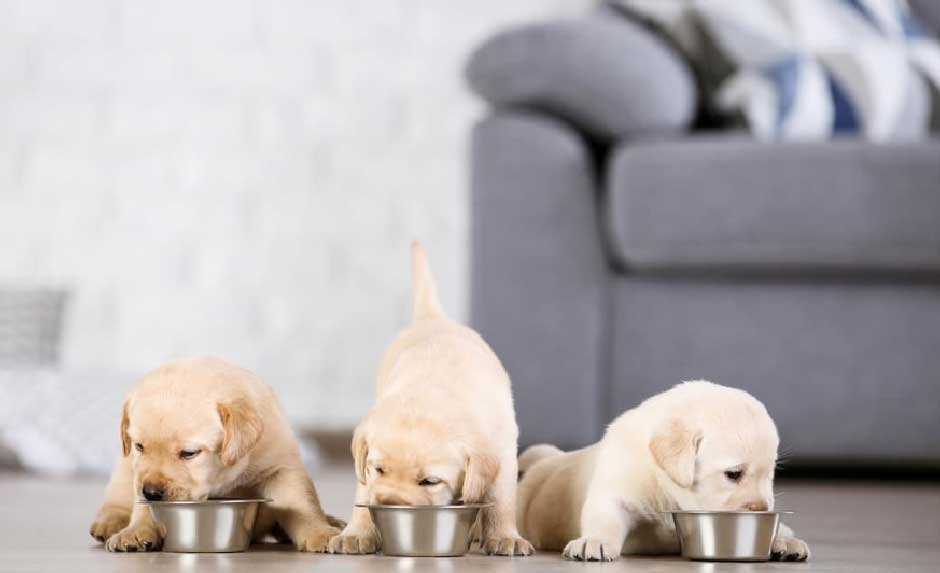
A 3-month-old puppy usually needs three meals a day, with the total amount based on current weight, expected adult size, and the calories in the food. For many puppies, that lands somewhere between 1/2 cup and 3 cups of dry food per day, but the label and body condition matter more than a universal cup number.
The honest answer is slightly annoying: cups are a rough measuring tool, not a nutrition plan. A dense puppy kibble can have almost twice the calories per cup as another brand, so the same scoop can mean a very different meal.
The Short Answer for a 3-Month-Old Puppy
How much food should a 3 month old puppy eat? Start with the daily amount on the puppy-food label for your puppy’s age and expected adult weight, split it into three meals, then adjust every 1 to 2 weeks by weight gain, stool quality, and body shape.
Most 3-month puppies are still in the rapid-growth stage. The World Small Animal Veterinary Association nutrition toolkit emphasizes body condition scoring and diet history because the right amount changes with the individual puppy, not just the calendar age.
Use this as the practical starting point: feed a complete and balanced puppy food, divide the daily ration into three meals, keep treats under control, and check the puppy with your hands, not just your eyes. You should be able to feel ribs under a light fat cover, and you should see a waist from above.
The bowl should not become a negotiation every day. Measure the food, give the meal 10 to 15 minutes, pick up what is left, and watch the trend over several days.
A 3-Month Puppy Feeding Chart by Weight
A feeding chart is useful only as a starting range. At 3 months old, smaller puppies often need less total volume but more frequent monitoring, while future large-breed puppies may eat more food without being allowed to grow too fast.
| Current puppy weight | Typical daily dry-food range | Meal split at 3 months | What to check next |
|---|---|---|---|
| 3 to 5 lb | About 1/2 to 1 cup per day | 3 or 4 small meals | Energy, tiny-breed blood sugar dips, stool firmness |
| 6 to 10 lb | About 3/4 to 1 1/2 cups per day | 3 meals | Steady weight gain and visible waist |
| 11 to 20 lb | About 1 1/4 to 2 1/2 cups per day | 3 meals | Ribs, stool, hunger after meals, treat calories |
| 21 to 40 lb | About 2 to 4 cups per day | 3 meals | Growth pace, body condition, large-breed label fit |
Those ranges assume a typical dry puppy food around 350 to 450 kcal per cup. If your food is 500 kcal per cup, the cup amount comes down; if it is 300 kcal per cup, the cup amount goes up.
That is where new owners get tripped up. Two scoops can look identical in the bowl, but one may be a quiet overfeed because the kibble is oilier, heavier, and more calorie-dense.
Turn Calories Into Real Cups
The safest way to answer how much food should a 3 month old puppy eat is to work backward from calories. The cup amount equals the puppy’s estimated daily calories divided by the food’s calories per cup.
The Merck Veterinary Manual lists the resting energy requirement formula as 70 x body weight in kilograms to the 0.75 power. The Pet Nutrition Alliance uses RER as a starting point for calorie estimates, and its companion materials place growth needs for puppies and kittens around 2 to 3 times RER.
For a 3-month puppy, many veterinarians and nutrition tools begin near the upper end of that growth range, then adjust based on body condition. This is a starting estimate, not a prescription.
The Plain-English Formula
Resting Energy Requirement, or RER, means the calories needed for basic body functions at rest. Daily puppy calories are often estimated by multiplying RER by a growth factor, commonly about 2 to 3 during early growth.
- Weigh your puppy.
- Convert pounds to kilograms by dividing by 2.2.
- Estimate RER with 70 x kg^0.75, or use a veterinary calorie calculator.
- Multiply by a puppy growth factor, often 2 to 3.
- Divide the daily calories by the kcal per cup printed on your food bag.
Example: a 10 lb puppy weighs about 4.5 kg. Its RER is roughly 216 kcal, so an early-growth estimate may fall around 430 to 650 kcal per day.
If the food has 400 kcal per cup, that estimate converts to about 1.1 to 1.6 cups per day. Split across three meals, each meal is roughly 1/3 to 1/2 cup.
Why the Bag Still Matters
The food label matters because it accounts for that specific formula’s calories and nutrient density. A puppy food that says 1 1/2 cups per day may be reasonable for one brand and completely wrong for another.
Read the label for two details: the feeding guide and the calories per cup. Also check that the food is complete and balanced for growth, and for large-size growth if your puppy is expected to mature at 70 lb or more.
“My 5-month old lab mix is either looking at me like I’m starving him or I’m convinced I’m creating a furry bowling ball. The bag says “2-3 cups” which is about as helpful as “feed some food.””
– r/puppy101, July 2025
That confusion is normal. The useful move is not to chase a perfect chart; it is to pick a measured starting amount and collect feedback from the puppy’s body.
How Often to Feed a 3-Month-Old Puppy
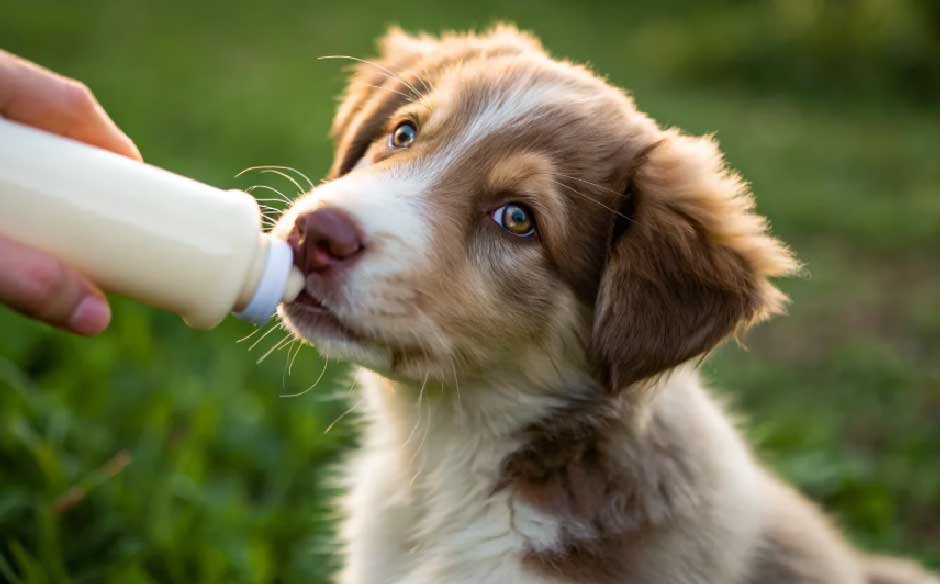
A 3-month-old puppy should usually eat three meals per day. Four smaller meals can help toy breeds, puppies with sensitive stomachs, and puppies that vomit bile when their stomach stays empty too long.
A simple schedule is breakfast, lunch, and early dinner. Keep the last full meal early enough that potty training is not fighting a heavy stomach at bedtime.
Three meals also make training easier because the daily ration can be divided with intention. Set aside part of the kibble for rewards instead of stacking treats on top of the full meal amount.
Sample 3-Meal Schedule
A practical schedule might be 7 a.m., 12:30 p.m., and 5:30 p.m. It does not need to be exact, but the rhythm should be predictable enough that appetite and stool changes stand out.
- Morning: one-third of the daily ration after the first potty trip.
- Midday: one-third of the ration, adjusted for training kibble already used.
- Evening: one-third of the ration, served several hours before bedtime.
If the puppy is ravenous, first check whether training treats, food puzzles, or a slow feeder would help. Hunger behavior is not always proof that the measured amount is too low.
The Weekly Adjustment Loop
The right amount of food for a 3-month-old puppy is the amount that supports steady growth without a round belly, loose stool, or visible boniness. Use weekly weight checks and body condition, then adjust by small steps.
Do not swing the ration up and down every time the puppy begs or skips a few bites. Puppies have noisy appetites, especially during growth spurts, teething, hot weather, and busy training days.
| What you notice | Possible meaning | Reasonable next step |
|---|---|---|
| Ribs are sharp, hip bones obvious, puppy seems low-energy | May be underfed or unwell | Call your veterinarian, especially if appetite is poor |
| No waist, belly looks heavy, stools are soft | May be overfed or food changed too fast | Reduce daily food by about 10% and review treats |
| Firm stool, playful energy, steady weekly gain | Amount is probably close | Keep measuring and reassess after growth changes |
| Morning bile vomit but normal appetite | Stomach may be empty too long | Ask your vet; a small bedtime snack may help some puppies |
I like the 10% rule because it keeps people from making dramatic changes after one weird day. A puppy can have one soft stool from stress, a new chew, or eating grass in the yard.
Track food for a week before deciding the plan failed. Use a kitchen scale if your household scoops generously; fluffy cups and heaped cups are not the same thing.
Small-Breed and Large-Breed Cautions
Breed size changes the feeding decision at 3 months. Tiny puppies may need smaller, more frequent meals, while large-breed puppies need controlled growth, lean body condition, and food suitable for large-size puppy growth.
The American Animal Hospital Association notes that puppies should receive diets appropriate for growth until skeletal maturity, and that some large and giant breeds may not reach skeletal maturity until around 15 to 16 months. Fast growth is not the goal.
If Your Puppy Will Be Large
Large-breed puppy feeding is where “more food equals better growth” can get risky. The aim is slow, steady growth with a lean shape, not the biggest puppy in the waiting room.
Check the nutritional adequacy statement on the bag. For puppies expected to be 70 lb or more as adults, the label should include growth of large-size dogs or otherwise be clearly appropriate for large-breed puppy growth.
If Your Puppy Is Tiny
Small and toy-breed puppies can run through energy quickly, and their meals are physically tiny. Three meals may work, but some do better with four smaller meals during this stage.
Small kibble pieces matter too. A tiny puppy trying to chew oversized pieces may swallow air, slow down, or leave food behind even when hungry.
Wet Food, Treats, and Food Changes
Wet food, toppers, and treats count toward the daily total. If a 3-month-old puppy gets extras during training, subtract those calories from meals instead of adding them on top.
Dry food is easy to measure by cup or gram, while wet food is easier to measure by calories per can or tray. Mixed feeding is fine when the full diet remains complete and balanced for growth.
Food changes deserve patience. A sudden switch can make the stool loose, which owners sometimes misread as “too much food” when the gut is simply reacting to a new formula.
Transition over about a week when possible: mostly old food at first, then half and half, then mostly new. If diarrhea, vomiting, lethargy, blood in stool, or refusal to eat appears, call a veterinarian rather than troubleshooting by internet chart.
FAQ
These quick answers cover the most common 3-month puppy feeding problems, especially when the bag, the breeder, and the puppy’s appetite all seem to be saying different things.
How many cups should a 3-month-old puppy eat?
A 3-month-old puppy may eat about 1/2 to 3 cups of dry food per day, depending on size and food calories. Large puppies can need more, and tiny puppies can need much less.
Should a 3-month-old puppy eat three or four times a day?
Most 3-month-old puppies do well on three meals per day. Four smaller meals can help toy breeds, sensitive stomachs, or puppies that struggle between meals.
Why does my puppy still act hungry after eating?
A puppy can act hungry because food is exciting, not because the ration is too small. Check body condition, weekly weight gain, stool quality, and treat calories before increasing meals.
Can you overfeed a 3-month-old puppy?
Yes, overfeeding a 3-month-old puppy can cause excess weight gain and digestive upset. In large-breed puppies, too-fast growth is a special concern, so keep the body lean.
When should I ask a vet about puppy feeding?
Ask a veterinarian if your puppy is losing weight, has repeated diarrhea or vomiting, refuses food, seems weak, or has a medical condition. Also ask if you are feeding a giant-breed puppy or a homemade diet.
A Better Rule Than a Perfect Scoop
For how much food should a 3 month old puppy eat, the best rule is measured flexibility. Start with the label, convert calories if the cup range feels vague, split the daily amount into three meals, and adjust in small steps.
The puppy in front of you gets the final vote. If growth is steady, stool is firm, ribs are easy to feel, and your veterinarian is happy with the body condition, the scoop is probably doing its job.