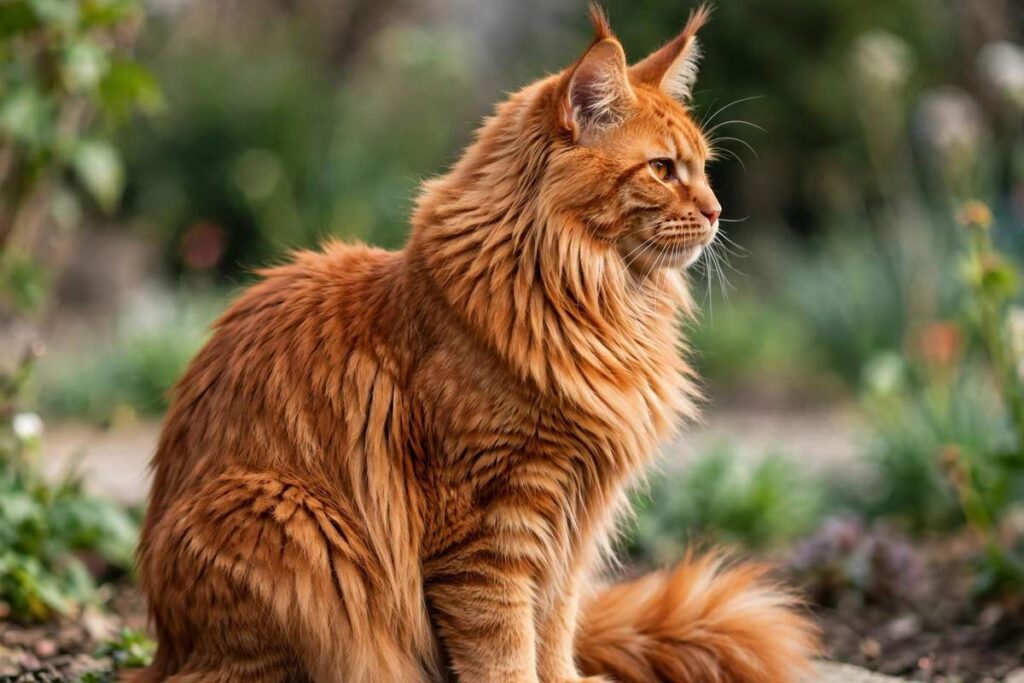
Orange cat breeds are the breeds whose written standard accepts red, the word registries use for orange. The colour sits on the X chromosome, and in 2025 two Current Biology papers traced it to a 5-kilobase deletion that switches on ARHGAP36 in pigment cells.
Most orange cats don’t belong to any of those breeds. The colour turns up far more often in the general cat population than in pedigrees, so a ginger cat from a farm and a red tabby Maine Coon can share a coat and nothing else.
Orange is a colour, and registries call it red
Every major registry files orange under red. The vocabulary splits by audience: breeders and show catalogues say red, owners say orange or ginger, and the pigment underneath is phaeomelanin in all three cases.
- Registry term: red, with red tabby and red-and-white judged as separate classes.
- Locus: the O gene, carried on the X chromosome.
- 2025 finding: a deletion of roughly 5 kilobases at ARHGAP36.
- Males: one copy of O is enough for an orange coat.
- Females: two copies for solid orange, one copy for tortoiseshell patches.
- Pattern: tabby markings stay at least faintly visible on almost every orange coat.
That last point matters for identification. A cat sold as an orange tabby is described twice, once by colour and once by pattern, while a red cat in a show catalogue may carry the same colour with a different pattern or none at all.
Cream is the other colour owners confuse with orange. It’s a dilute red, produced by a separate dilution gene that pales both phaeomelanin and eumelanin, which is why a cream British Shorthair and a red one can be littermates.
What the 2025 papers found: a deletion, not a pigment switch
Orange had no known counterpart in any other mammal, which is why it took decades to locate. Two teams publishing in Current Biology in June 2025 landed on the same address.
Kaelin and colleagues describe a 5-kilobase deletion that drives ectopic, melanocyte-specific expression of ARHGAP36 (Kaelin et al., 2025). Toh and colleagues, working independently, mapped a 5.1-kilobase deletion inside an intron of the same gene. Same locus, different flanking detail. That’s what independent confirmation looks like.
The mechanism runs through a familiar pathway in an unfamiliar place. ARHGAP36 codes for a Rho GTPase activating protein, and when melanocytes express it, levels of the PKA catalytic subunit fall. The melanocortin 1 receptor is intact. It still raises cAMP, so the orange switch sits downstream of the receptor rather than inside it.
That detail is why the finding matters more than the headline. A receptor mutation would have shown up in receptor studies years ago; a gene that suppresses the pathway from below explains why every candidate search came back empty.
Two X chromosomes explain the patchwork. In a female with one O and one non-orange allele, random X inactivation silences one copy per pigment cell, and the result is the black-and-red mosaic of a tortoiseshell or calico. A tom has one X, so he’s orange or he isn’t. A male tortoiseshell needs an extra X chromosome, which is why the pattern is rare in males and usually comes with infertility.
Why almost every orange cat shows tabby stripes
Orange replaces black-brown eumelanin with phaeomelanin, and tabby markings stay legible on that paler ground. Registries still keep solid red and red tabby as separate classes.
The CFA wording for solid red asks for a coat “without shading, markings, or ticking”. On a living cat the difference is often faint, and leftover barring shows on legs, tail and forehead even in cats entered as solid red.
The five patterns are shared with every other colour, and our guide to tabby Maine Coons walks through them on a long coat. In red the visible order runs mackerel, classic, spotted, ticked and patched. Patched red cats are almost always female, for the X-inactivation reason above, and the patchwork can carry a full tabby pattern underneath, which is where the word torbie comes from.
Orange cat breeds that accept red
The eight breeds below are the ones whose CFA standard lists red among its accepted colours. A breed missing from the list isn’t incapable of producing an orange cat; it just doesn’t have red in its written standard. Being listed says nothing about how often the colour appears. In every one of them the odds follow the same rule: an orange tom needs one copy of O and an orange queen needs two, so red males outnumber red females by a wide margin.
| Breed | Origin | Size | Red accepted | Coat | Source |
|---|---|---|---|---|---|
| Maine Coon | United States (Maine) | Large | Yes | Long, shaggy | CFA standard |
| Persian | Iran (Persia) | Medium to large | Yes | Long | CFA standard |
| British Shorthair | United Kingdom | Medium to large | Yes | Short, dense | CFA standard |
| American Shorthair | United States | Medium | Yes | Short | CFA standard |
| Norwegian Forest Cat | Norway | Large | Yes | Long, double | CFA standard |
| Siberian | Russia | Large | Yes | Long, triple | CFA standard |
| Ragdoll | United States (California) | Large | Yes, point only | Long, pointed | CFA standard |
| Japanese Bobtail | Japan | Medium | Yes | Short to medium | CFA standard |
Colour is the last thing to check on any of these cats. Body, head, coat length and ear set decide the breed, and the standard’s colour list only confirms that red is allowed. An orange cat that matches no breed is still an ordinary cat, and a red coat on a cat with no papers says nothing about its ancestry.
Maine Coon
The standard describes red as “deep, rich, clear, brilliant red” without shading, markings or ticking, and the tabby division gives the same colour stripes. The shaggy coat and lynx-tipped ears make an orange Maine Coon easy to spot across a room. Red is one accepted colour among many rather than a breed trait, and an orange queen needs two copies of O, so red toms outnumber red queens here as everywhere.
Persian
Persian red carries the same wording as the Maine Coon standard; the long coat softens the colour into copper. The breed judges red in solid, tabby and patched versions, which is why a Persian can be red, red tabby or a red-and-black tortoiseshell. Long fur hides the body outline. Size has to be judged from the head and legs.
British Shorthair
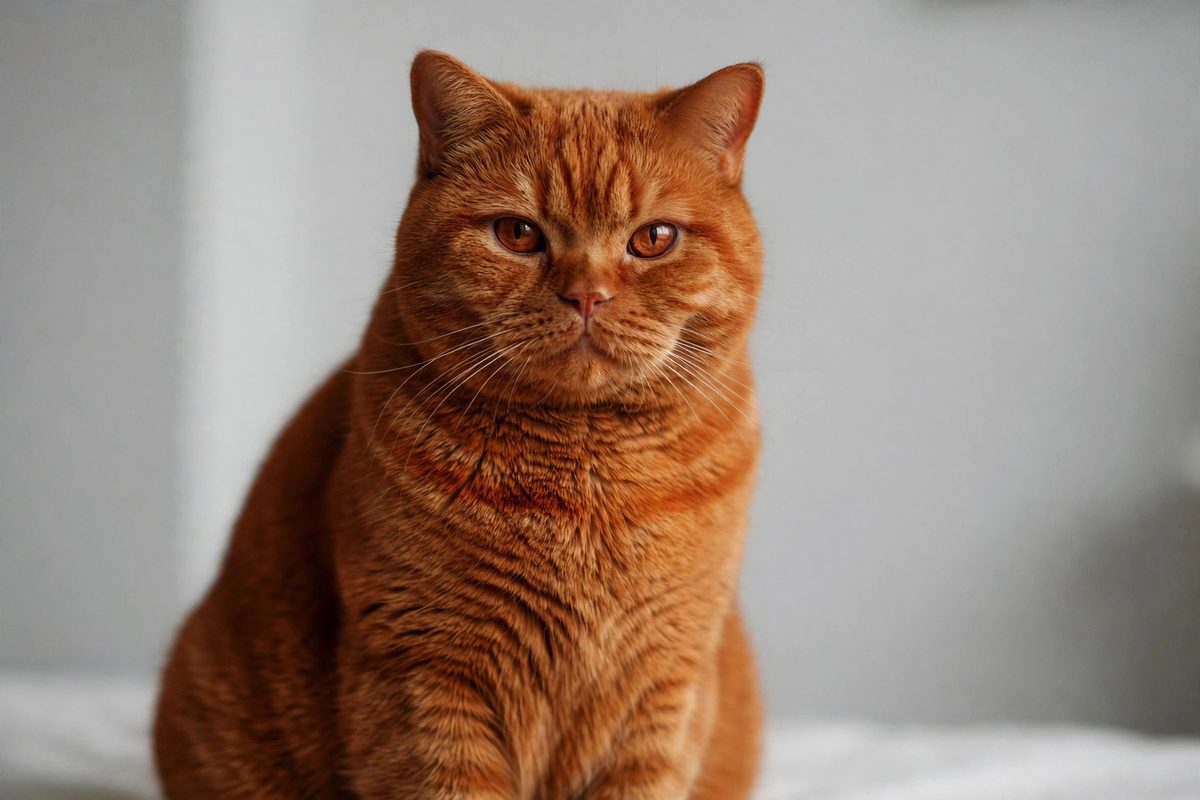
British red is “deep, brilliant red, level in colour, sound to the roots”, and the dense short coat shows the tone more evenly than a long-haired breed does. The standard places red beside cream and tortoiseshell in the same division, so an orange British Shorthair is judged next to cream and blue-cream cats rather than in a class of its own.
American Shorthair
American Shorthair red uses the familiar “deep, rich, clear, brilliant red” wording, with nose leather and paw pads in brick red. The body is muscular and medium-sized, not the heavy frame of a Maine Coon, and the short coat keeps the colour flat and easy to read at a distance.
Norwegian Forest Cat
Norwegian red appears in a double coat built for cold, with a dense undercoat that changes the way the colour reads against the skin. The standard also accepts tortoiseshell, which puts red patches beside black on one cat. The large frame and the straight profile separate the breed from the Siberian on the bench.
Siberian
Siberian red sits in a triple coat, and the standard uses the same red wording as the Norwegian and Maine Coon standards, so colour alone won’t tell the three apart. Body shape does: the Siberian is the roundest of them, with a barrel chest and a coat that stands away from the body instead of lying flat.
Ragdoll
Ragdoll is the one breed here where red is tied to a pattern. The standard lists six point colours, red among them, so an orange Ragdoll is a red point: a white body with points running from bright apricot to deep red, deeper shades preferred. A Ragdoll with an orange body and no points isn’t a Ragdoll colour at all.
Japanese Bobtail
Japanese Bobtail accepts red and red-and-white, with the deeper, more glowing tone preferred, and the standard notes that red areas on a red tabby and white cat keep their tabby markings. The short to medium coat and the curled pom-pom tail are the breed’s signatures, and both are visible at a glance.
Orange Maine Coons: the size question
Maine Coons are the largest common domestic breed, and red doesn’t change that: an orange Maine Coon is a large cat first and a coloured cat second. Red is one of the breed’s accepted classes, not a separate variety, so a red Maine Coon competes in the same rings as a brown tabby. Our orange Maine Coon page covers the red tabby version in detail, and the ranking of the largest domestic breeds puts the size beside the Savannah and the Norwegian Forest Cat.
One thing trips people up. A very large orange cat with a long coat isn’t automatically a Maine Coon, because size and coat length come from several breeds, and only a pedigree settles it.
Are orange cats friendlier? What the evidence supports
Orange cats have a reputation for being friendlier, and nothing in the genetics ties the O gene to temperament. The 2025 papers describe a pigment pathway in melanocytes; behaviour isn’t part of them.
No breed standard says anything about personality either. The reputation is folklore that listicles repeat, helped along by a cartoon cat that has been orange for decades.
What shapes temperament is duller by comparison: early socialisation, breed-typical energy and the individual cat. Two littermates with identical red coats can differ as much as any two cats in the house.
Orange cat breeds: quick answers
What are the different types of orange tabbies?
Five patterns show up in orange: mackerel, classic, spotted, ticked and patched. Mackerel carries narrow stripes, classic broad swirls, spotted a broken stripe pattern, ticked banded hairs with no body stripes, and patched a red tabby with cream or white laid over it.
Is every orange cat a tabby?
Not genetically. Registries judge a solid red class, and the CFA wording asks for a coat without markings. In practice the pattern rarely disappears completely on a red coat, so almost every orange cat shows faint barring somewhere on the body.
What is the rarest cat colour?
No registry publishes how often each colour appears, so any ranking of rare colours is an estimate rather than a count. The genuinely rare outcome is a male tortoiseshell or calico, which needs two X chromosomes and usually comes with infertility.
Are orange cats affectionate?
There’s no evidence that they are, beyond owner impressions. Coat colour is pigment, and the studies that describe it don’t measure temperament, so the friendly-orange-cat claim is a story rather than a finding.
What breed is my orange cat?
Without papers, the answer is usually domestic shorthair or domestic longhair with a red coat, because most cats aren’t pedigreed. Owners ask the question constantly:
“what breed does he look like?”
– r/orangecats, May 2026 (1,070 upvotes)
Papers are the only test that changes the answer. A pedigree names the breed; coat colour, coat length and body shape narrow the guess without settling it. Take a red cat with no papers and the honest label is domestic shorthair with a red tabby coat, which is also the most common label for any cat.
One Comment