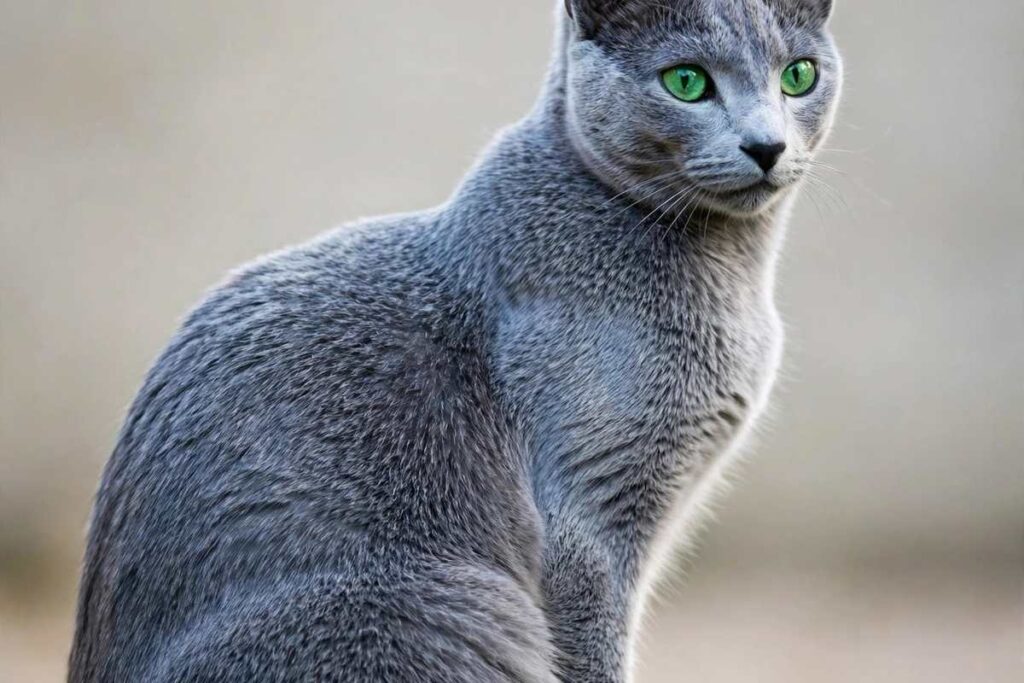
Three breeds come only in blue: the Russian Blue, the Chartreux and the Korat. Registry standards call that coat blue, never grey, and blue is a dilution of black rather than a colour of its own. Every other grey cat is a blue individual of another breed or a mixed-breed cat.
Treat grey cat breeds as two lists and the confusion clears: the blue-only breeds, where the colour is written into the standard, and the breeds that allow blue alongside other colours and patterns. A third group gets left out of most lists, and it is the largest: cats that look grey because of a tabby pattern or a white undercoat.
The Registry Word for Grey Is Blue
Blue is the diluted form of black. The dilution is recessive, so a kitten needs the gene from both parents. CFA’s genetics guide states that “the dilute gene must be present in both the sire and dam’s pedigree in order to produce a dilute offspring”, and that two dilute cats cannot produce a non-dilute kitten such as a black or a red one. Two blues make blue, lilac, fawn or cream kittens, never a black.
That rule explains why blue shows up in so many breeds without belonging to any of them. The colour is a variety, and the name of the cat is whatever the pedigree says. Four coats get called grey in ordinary speech, and only the first is a solid colour:
- Blue: solid diluted black, one level tone from nose to tip of tail in the standards for Persian and Maine Coon.
- Blue tabby: the tabby pattern in diluted black; CFA’s Maine Coon standard gives it a “ground color pale bluish Ivory”. This is what most people mean by a grey tabby.
- Silver tabby: black stripes on a pale silver ground, with an undercoat that is white rather than blue.
- Smoke: a solid-coloured cat whose undercoat is white, so the pigment shows at the tips of the hair and the cat reads as grey in motion.
- Blue and white: a bicolour, blue plus white spotting, which is a pattern rather than a separate colour.
The silver and smoke coats do not come from dilution at all. CFA’s genetics guide groups silver tabby, shaded silver, chinchilla silver, cameo and smoke together: a kitten with any of those coats “must have a parent with a white undercoat”. A silver tabby and a blue tabby can look similar in a photograph and are built from different genes.
Breeds That Only Come in Blue
Three breeds have blue written into the standard as the only colour. All three are shorthairs, and all three carry an origin story older than the cat show.
Russian Blue
CFA describes the Russian Blue as a “short, dense silver tipped blue coat” on a cat with emerald-green eyes. The silver tipping separates it from a plain blue cat, because each hair carries a pale tip that gives the coat a sheen rather than a flat tone. The Russian Blue is believed to have come from the Archangel Isles in northern Russia, and early English shows entered it as the Archangel Cat, in classes with every other solid blue cat.
Chartreux
The Chartreux characteristic line reads “Blue only, well muscled, medium woolly coat”. Wool is the operative word. The coat is dense and slightly coarse, and CFA’s own description does not mention silver tipping. Blue cats appear in French literature as early as the 16th century, and selective breeding in France began in the 1920s from natural colonies of French blue cats. The first Chartreux reached North America in 1970.
Korat
The Korat is a Thai breed with a silver-tipped blue coat, a heart-shaped face and “luminous green eyes” in CFA’s wording. Its record goes back to the Cat-Book of Poems, a Thai manuscript from the Ayudhya period of 1350 to 1767 that illustrates 17 “good luck” cats. The first pair reached the United States in 1959.
Russian Blue or Just a Grey Cat?
A short-haired grey cat with silver-tipped blue fur, emerald-green eyes and registration papers is a Russian Blue. A grey cat with a tabby pattern, a white patch, long fur or no papers is a blue domestic shorthair or longhair, which shares the colour and not the breed.
| Trait | Russian Blue | Other grey cats |
|---|---|---|
| Coat | Short, dense, silver-tipped | Any length; tabby, smoke or bicolour possible |
| Pattern | Solid blue only | Stripes, patches and white are common |
| Eyes | Green | Yellow, copper, green or blue depending on breed |
| Papers | Pedigree registered with CFA or TICA | Usually none; coat length recorded at a clinic |
Papers are the part that cannot be seen. A cat that matches every physical trait but has no registered pedigree is a blue domestic shorthair, and no coat detail changes that. The reverse also holds: a registered Russian Blue with a coat a judge would fault is still a Russian Blue.
Breeds With Blue as One of Several Colours
Most grey pedigree cats belong to breeds that allow blue among many colours. CFA’s British Shorthair page calls blue “very popular” and adds that the cat “also comes in other colors”; the standard asks for “any sound shade of blue, very level in color”. British Shorthairs mature slowly, reaching full size at about three years, and males can reach 17 lb. A blue male was the first Grand Champion of any breed in the UK’s Governing Council of the Cat Fancy.
The Persian standard sets blue as “blue, lighter shade preferred, one level tone from nose to tip of tail”, and the breed is split into seven colour divisions for competition, including a silver and golden division where the undercoat is pure white and the eyes should be green or blue-green. The Maine Coon standard accepts blue, blue tabby, blue-silver tabby and silver tabby among a long colour list, which is why the largest of the pedigreed breeds also has one of the widest grey options. The biggest cat breeds carry long colour lists for the same reason: size and colour are inherited separately.
Long-Haired Grey Cats
Long hair changes the way blue reads. A blue Persian carries the same dilution as a Russian Blue, but the coat length spreads the pigment over more surface and the silver tipping becomes a haze rather than a sheen. The result is a cat that photographs as pale grey in one light and slate in another.
Blue, blue tabby and silver tabby all appear in the grey Maine Coon, and the coat needs combing two or three times a week, five or ten minutes a session, according to CFA’s grooming note. Long fur also holds the white undercoat of a smoke coat, which is why a smoke Maine Coon looks darker at the surface and lighter at the skin.
Grey Tabby, Silver Tabby and Smoke
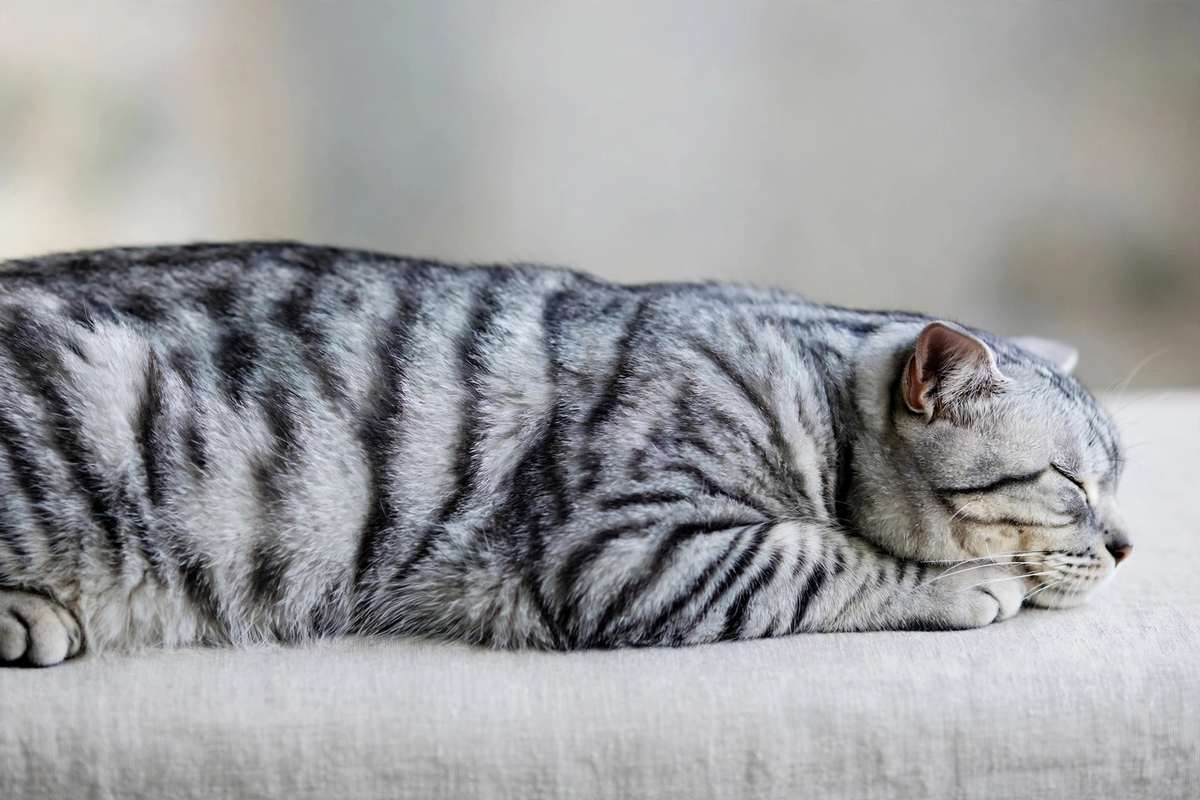
Most grey cats that are not pedigree cats are tabbies. The stripes are diluted black, so the pattern is a blue tabby: the same mackerel or classic stripes as a brown tabby, in a lighter ink. Breed standards treat this as a pattern class, not a colour class, and a blue tabby Maine Coon gets its own line in the standard with a “pale bluish Ivory” ground.
A silver tabby is different in kind. The ground colour is silver because the undercoat is white, and the stripes stay black rather than blue. Put a blue tabby and a silver tabby side by side and the contrast between stripe and ground is the tell: low contrast means diluted stripes, high contrast means silver.
“When getting their vaccines, I put their breed down as grey tabby and the vet corrected it to medium short hair and I don’t know what that means other than referring to its fur length …”
r/TabbyCats, May 2026 (167 upvotes)
The vet’s note is the same answer in miniature. Coat length and coat colour go on the record, and a breed name goes on it only when there is a pedigree. Grey-and-white cats are the same story with white spotting added, a bicolour pattern that any breed can carry.
Where the Maine Coon Fits
Blue is an accepted Maine Coon colour, and the standard also lists blue tabby, blue-silver tabby and silver tabby, so a grey Maine Coon is a colour variety of a breed this site covers rather than a separate breed. The blue Maine Coon page covers the solid form, and the silver Maine Coon page covers the silver and smoke side.
A Maine Coon crossed with a Russian Blue is not a breed, and no registry recognises it as one. CFA registers breeds and their accepted colours; a cross between two breeds is a crossbred cat, whatever it looks like. The colour of the kittens is predictable in one direction only: blue is recessive, so a blue kitten needs the dilution gene from both parents. Pair a blue Russian Blue with a Maine Coon that does not carry dilution and every kitten will be non-dilute, tabby or red or black, with no blue at all.
Grey Cat Breeds: Common Questions
Are grey cats rare?
No. A solid blue coat is common, and CFA calls blue “very popular” in the British Shorthair. What is uncommon is the breed rather than the colour: three breeds come only in blue, and those are the cats a reader is unlikely to meet by accident.
Are grey cats friendly?
No reliable evidence ties coat colour to temperament. Breed descriptions do: CFA calls the Russian Blue “graceful, playful and quiet” and the Chartreux “even-tempered and adaptable”, lines that describe those two cats and not every grey one.
What breed is a grey kitten?
Coat colour is not a breed. A grey kitten without registration papers is a domestic shorthair or longhair, and a clinic records the coat length instead of a breed name. A pedigree kitten arrives with papers that name the breed before the coat is described.
Is a Maine Coon Russian Blue mix a breed?
No. It is a cross between two breeds, and no registry lists it as a breed. Size, coat length and colour all vary with the individual kitten, and the blue coat appears only when both parents carry the dilution gene.
What is a grey cat called?
In registry language a grey cat is blue. The standards cited here use BLUE as a colour class, with silver and smoke for the coats that carry a white undercoat, and none of them lists grey as a colour.
One Comment