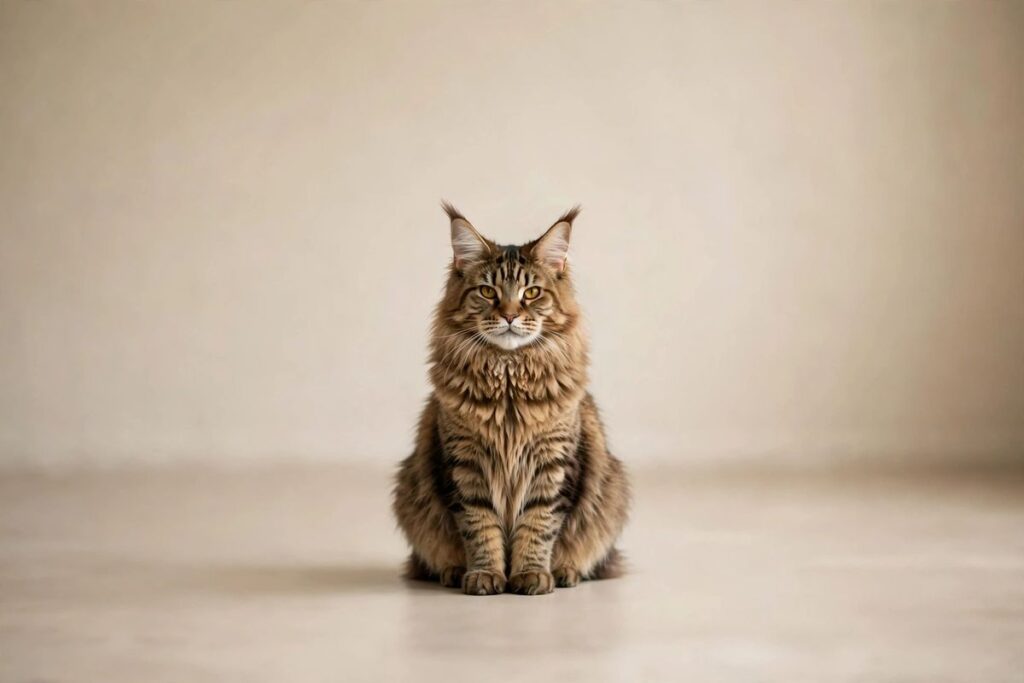
Big cat breeds are the domestic breeds whose mature males reach 12 pounds or more. The heaviest, the Maine Coon, can see a mature male’s weight reach or exceed 20 pounds, according to the Cat Fanciers’ Association, and none of the breeds below is a wildcat or a hybrid.
Two questions bring readers here: which breed is genuinely the biggest, and why one particular cat on the sofa weighs far more than its breed chart predicts. Weight by sex, the age a breed stops growing, and the registry document behind each number answer both. Every figure below comes from CFA breed pages or standards checked on 22 November 2026.
The Short Answer: The Five Largest Domestic Cat Breeds
The five largest CFA-recognised domestic breeds are the Maine Coon, Ragdoll, RagaMuffin, Norwegian Forest Cat and Siberian. Mature males of the first three can reach 20 pounds or more; the two forest breeds sit at 12 to 18 pounds and take longer to finish growing.
- Heaviest documented males: 20 pounds or more, shared by the Maine Coon, Ragdoll and RagaMuffin.
- Lightest mature adult in this group: a Siberian female at roughly 8 pounds.
- Slowest to finish: the Norwegian Forest Cat, up to five years.
- Fastest of the five: the Siberian, around three years on CFA’s breed page.
Breed, sex and the age at which growth stops decide the ranking. The chart below sets the three side by side.
| Breed | Male, mature | Female, mature | Full size | CFA source |
|---|---|---|---|---|
| Maine Coon | 20 lb or more | Smaller; no figure given | Up to 3 years | Breed page |
| Ragdoll | 20 lb or more | Smaller; no figure given | 4 years (page); about 3 (standard) | Page and standard |
| RagaMuffin | Up to 20 lb | Close to 15 lb | About 4 years | Breed page |
| Norwegian Forest Cat | 12 to 16 lb | 9 to 12 lb | Up to 5 years | Breed page |
| Siberian | 12 to 18 lb | 8 to 12 lb | About 3 years (page); up to 5 (standard) | Page and standard |
CFA publishes no separate female figure for the Maine Coon or the Ragdoll beyond “females are usually smaller”, so those cells stay descriptive instead of numeric. Where a breed page and its standard disagree, both numbers appear, because the difference is between two documents from the same registry.
Size alone does not settle a breed. Shelters and rescues label coat type when the history is unknown, and owners often hear a guess rather than a pedigree.
“He is 16lb and 2-3 years old estimated (rescue that was in foster home for over 5 months) They put down domestic longhair but the 2 people who own the nonprofit told me they just put that and did not really know at all.”
– r/catbreeds (29 upvotes)
A 16-pound cat without papers is a large domestic longhair; the weight is real, the breed label is a guess.
Maine Coon: The Biggest Purebred Cat
The Maine Coon is the heaviest purebred cat CFA recognises, with a mature male’s weight often at or past 20 pounds and a growth period that can run to three years.
CFA’s breed page is direct about both points: it is “not unusual for a mature male’s weight to reach or exceed 20 pounds”, with females smaller, and the breed “can take up to three years to reach full growth”. A cat that looks undersized at 18 months may still be filling out.
Temperament is where the Maine Coon answers another common question. CFA describes the breed as “friendly, sweet-tempered and easy to train”, and calls the cats “sociable, loyal” companions that move from one family member to the next. That is a registry description of the breed as a whole, not a guarantee for an individual cat, and early handling still shapes how outgoing an adult becomes.
For the month-by-month growth figures and the weight bands owners report, the site’s guide to how big Maine Coons get goes deeper than this list needs to.
Ragdoll: Twenty Pounds on a Four-Year Clock
Ragdoll males can also reach or exceed 20 pounds, and CFA’s breed page puts full size and weight at four years, two years after the coat colour settles.
The same page calls the Ragdoll “one of the larger breeds” and describes it as slow-maturing, “reaching full coat color at two years, and full size and weight at four”. Its weight sentence repeats the Maine Coon formula: a mature male may reach or exceed 20 pounds, females are usually smaller.
The breed standard adds a third date. It says Ragdolls are “slow maturing, reaching full coat and color at about three years of age”. Read together, the two documents point to colour settling between two and three years and the body still gaining to four. A buyer who wants a finished adult should plan on the longer number.
Ragdolls also carry a practical warning that the biggest breeds share: CFA notes the breed’s love of food and its risk of obesity, and asks owners to monitor portion sizes. A 20-pound frame can hide a weight problem until the cat is well past its healthy range. The Maine Coon and Ragdoll comparison sets the two side by side on size and coat.
Norwegian Forest Cat and Siberian: The Forest Pair
The Norwegian Forest Cat reaches 12 to 16 pounds for males over as long as five years, the slowest of the five, while the Siberian reaches 12 to 18 pounds with most cats full size by three years.
CFA’s Norwegian Forest Cat page gives the clearest maturation statement of any breed here: “This slow-maturing breed can take up to five years to reach full growth; at that stage, a male will weigh from 12 to 16 pounds, and females from 9 to 12 pounds.” The same page traces the breed back some 4,000 years as a farm and rodent-control cat in Norway, which explains the double coat and the heavy ruff rather than the weight.
The Siberian’s two documents are less tidy. The breed page says the Siberian is “one of the slowest-maturing cat breeds, most reaching full size by three years”, with mature males between 12 and 18 pounds and females between 8 and 12. The standard allows “as long as 5 years”. Most cats finish around three; the standard leaves room for the slow ones, and a Siberian that keeps growing into its fourth year is inside the breed’s own description.
Both breeds sit below the 20-pound ceiling of the Maine Coon, Ragdoll and RagaMuffin, and both finish later than the Maine Coon. The Maine Coon and Norwegian Forest Cat comparison covers the head, coat and body differences, and the Siberian size guide handles that breed’s growth curve.
Other Large Breeds With Registry Numbers
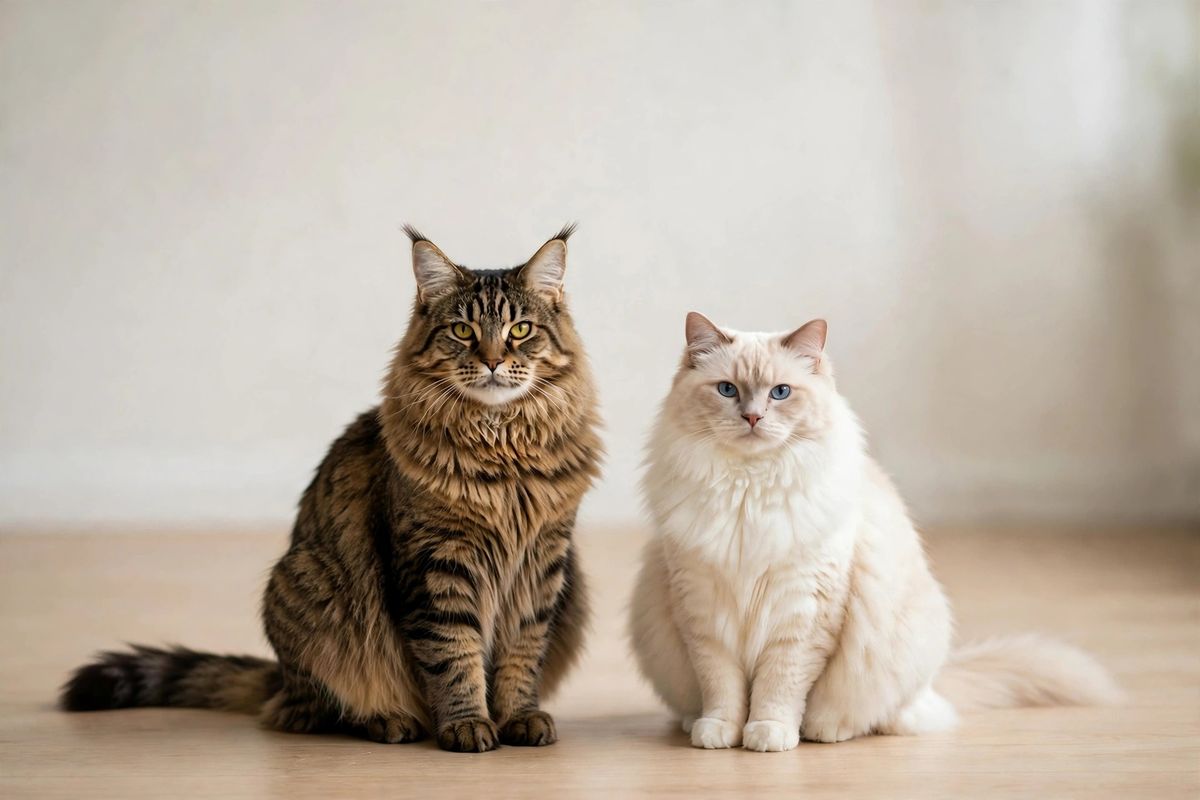
Four more CFA breeds carry usable figures: the British Shorthair at up to 17 pounds for males, the RagaMuffin at up to 20, the Turkish Van at 20 for mature males, and the American Bobtail, which matures over three years without a published weight.
The British Shorthair is the shortest of the group and still substantial. CFA says it “does not reach its full size until approximately three years of age; males may grow as large as 17 pounds while females are somewhat smaller”, while the standard stretches maturity to “3-5 years”. A male at 17 pounds is at the top of the breed, not the middle.
The RagaMuffin is the Ragdoll’s heavier relative in CFA’s own numbers: “up to four years to reach full growth”, with “a mature male’s weight may reach up to 20 pounds, with females peak at closer to 15 pounds”. That 15-pound female figure is one of the few real female numbers in this group, and it makes the RagaMuffin the easier breed to plan around if the household wants a large cat of either sex.
The Turkish Van is the surprise on the list. CFA describes it as large and strong, with “mature males may weigh 20 pounds; females are somewhat smaller”, and gives “3 to 5 years” to full maturity. It belongs beside the longhaired giants on weight even though its single coat looks nothing like a Maine Coon’s.
The American Bobtail shows the limit of a weight chart. Its standard says the breed “matures over a period of three years” and never publishes a weight, so no responsible ranking can place it. Growth time and size are different measurements, and plenty of breed standards supply only one of them.
Savannah and Other Hybrids: Big for a Different Reason
A Savannah is a cross between a domestic cat and an African serval, so its size comes from wildcat ancestry and varies by generation rather than from a breed standard.
CFA has no Savannah breed page, and no Chausie page either; both are absent from the registry’s breed list, which is why neither appears in the chart above. Breeders describe litters by filial generation, from F1 for the first serval cross down to F5 and beyond. Early generations carry the most serval influence, and with it more size and less predictable temperament; later generations settle closer to a domestic range.
That is a different kind of claim from “the Maine Coon reaches 20 pounds”. A Savannah’s adult size depends on which generation it is, and in many places on local wildlife rules as well. Placing one in a table beside purebreds would compare a generation to a standard.
The same logic covers the Chausie, a jungle cat cross. For anyone deciding between the two, the Maine Coon and Savannah comparison works through the practical differences in size, energy and housing.
Where the Maine Coon Fits Among Big Cat Breeds
The Maine Coon tops the weight chart but not the calendar: at about three years to full size it finishes faster than the Ragdoll, RagaMuffin and Norwegian Forest Cat, and only ties the 20-pound male ceiling.
Three breeds share that ceiling in CFA’s wording: Maine Coon, Ragdoll and RagaMuffin. The Maine Coon is the one CFA also describes as friendly and sociable, which is why it leads most lists of large family cats. Size and temperament are separate qualities, and the registry documents treat them that way.
For a household choosing between the leaders, the useful split is time rather than pounds. A Maine Coon is close to adult size by three; a Ragdoll or RagaMuffin keeps growing to four; a Norwegian Forest Cat can run to five. Anyone who wants a big cat but not a long wait should weigh that difference as heavily as the final number.
Living With a Big Cat: Litter Box, Carrier and Food Portions
A big cat needs equipment sized for its adult weight: a litter box long enough to turn around in, a carrier rated above the cat’s full-grown weight, and measured meals, because CFA warns that Ragdolls are prone to obesity.
Litter boxes built for an average cat leave a 20-pound cat no room to turn, and a long coat makes a high-sided box more useful than a deep layer of litter. Buy the box for the adult size, not the kitten.
Carriers follow the same rule. A carrier rated for 15 pounds is the wrong purchase for a breed whose males reach 20, because the cat will outgrow it within two years. Airline cabins add their own weight and height limits, which are worth checking before the carrier is bought.
Food is the part owners underestimate. CFA’s Ragdoll page asks owners to monitor portions specifically because the breed loves food, and the same caution applies to any cat built on a heavy frame. Weighing the cat monthly and checking body condition by hand catches a slow gain earlier than a glance across the room.
“My cat weighs 23lbs and he may be a little over weight, but mostly he’s just big.”
– r/catbreeds (15 upvotes)
Owner reports like that one are a useful reality check on breed charts, and a poor substitute for a scale and a vet. A domestic longhair at 23 pounds may be a big cat, an overweight cat, or both.
For a cat still under three years old, the number on the scale is a waypoint. CFA’s breed pages give the age at which each of these breeds stops growing, and that age, not today’s weight, decides how big the cat will be.