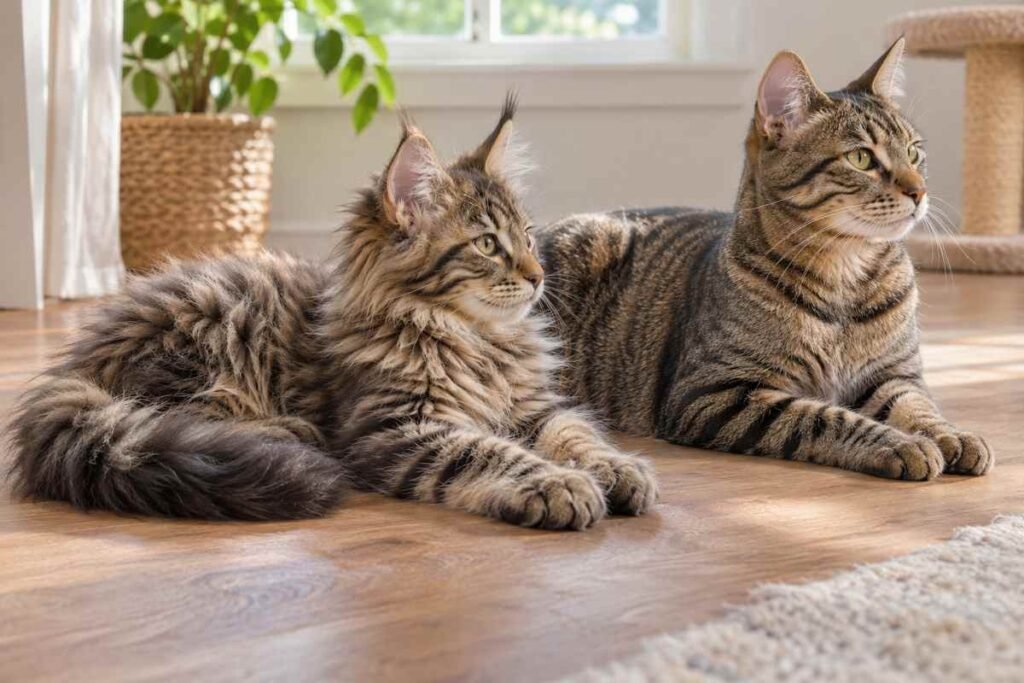
Yes, a cat can be half Maine Coon: one parent is a purebred Maine Coon and the other is something else. When that other parent is a domestic shorthair, you’re dealing with a non-pedigreed cat, not a second breed. So the kitten’s coat, size and health can’t be read off any breed standard.
That’s the catch with this mix. “Domestic shorthair” only means the cat has a short coat and no registered breed behind it. Two litters from the same Maine Coon father can look nothing alike.
What does half Maine Coon with a domestic shorthair mean?
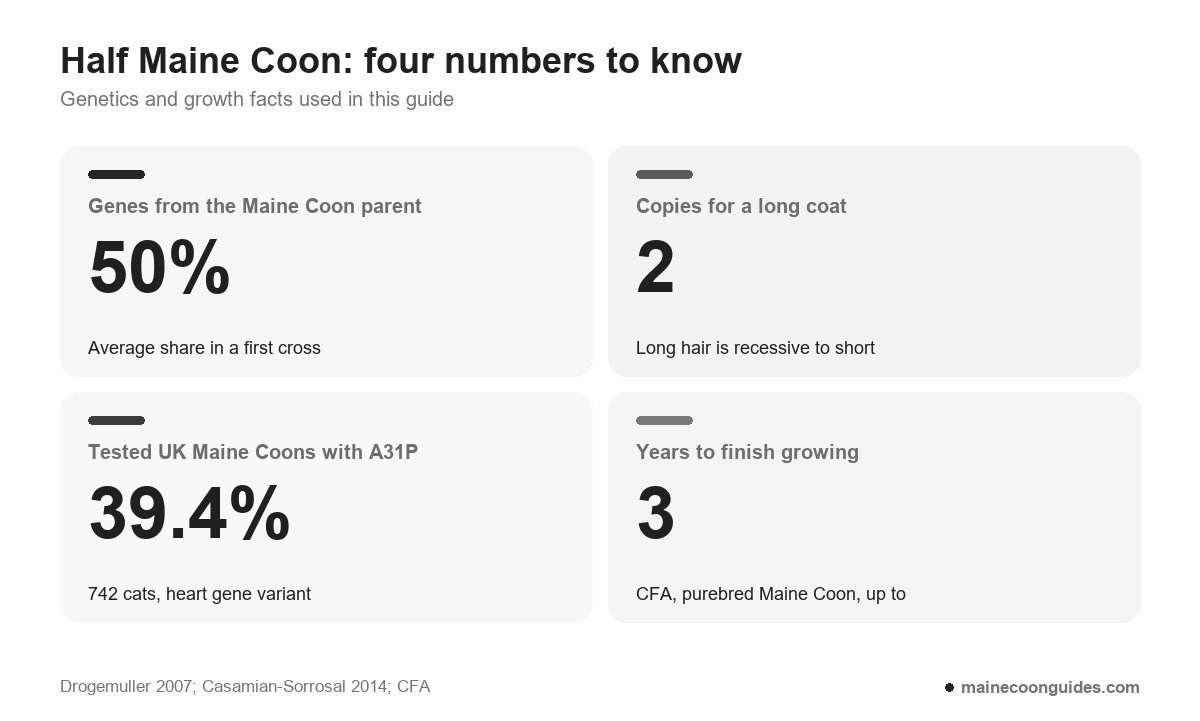
A half Maine Coon kitten has a Maine Coon mother or father and a non-Maine Coon parent. On average, a kitten receives half its DNA from each parent. That 50% is an average across genes, though. It doesn’t tell you which half you got.
Nobody knows the domestic shorthair side. It could be a tabby from next door, a shelter cat or a barn cat. Nobody has a standard for it, and nobody has a weight chart for it.
If the other parent is a registered shorthair breed instead, that’s a different cross with its own page: American Shorthair Maine Coon mix or British Shorthair Maine Coon mix. If the other parent is a long-haired non-pedigree cat, the question is mostly about telling the two apart, which is covered in Maine Coon vs domestic long hair.
Which coat will a half Maine Coon kitten have?
A half Maine Coon’s coat depends on whether the shorthair parent hides a long-hair gene. Long hair is recessive to short hair in cats, so a kitten needs two copies of the long-hair variant to grow a long coat. A Maine Coon parent can only pass on one copy.
Coat is the one part of this mix you can reason about. A 2007 study in Animal Genetics by Drögemüller and colleagues, working on the cat FGF5 gene, found one variant (c.194C>A) in two copies in 25 long-haired Somali, Persian, Maine Coon, Ragdoll and crossbred cats. The 55 short-haired cats it tested had zero or one copy. The authors describe long hair as recessive to short (PubMed record).
Put that together with a long-coated Maine Coon parent, and you get a decoder. It assumes the Maine Coon parent’s long coat comes from two copies of a long-hair variant. The ratios are expectations from simple inheritance, not measured results for Maine Coon crosses.
| The other parent | What each kitten inherits | Likely coats in the litter |
|---|---|---|
| Short-coated, no hidden long-hair copy | One long-hair copy from the Maine Coon, none from the other parent | All short-coated, every kitten carrying one hidden copy |
| Short-coated, one hidden long-hair copy | One copy from the Maine Coon, and a coin flip from the other parent | About half long, half short, on average |
| Long-coated | One copy from each parent | All long-coated |
You can’t see a hidden copy. The only clue is the shorthair parent’s history: has she or he ever had long-coated kittens? If so, she or he carries at least one copy.
Forum posters keep getting surprised by something the decoder explains. A short-coated cat can have a Maine Coon parent, and a fluffy cat can have none. Hair length alone says very little about ancestry, a point the Maine Coon mix identification guide takes further.
How big does a half Maine Coon get?
Bigger than an average domestic cat is a fair guess. A precise adult weight isn’t, because the sources checked here held no published weight series for half Maine Coons.
Purebred figures are the ceiling, not the target. The Cat Fanciers’ Association says a Maine Coon is slow-maturing and can take up to three years to reach full growth, and that it isn’t unusual for a mature male to reach or exceed 20 pounds, while females are usually smaller. A cross with a shorthair of ordinary size has no reason to follow that curve.
A Reddit owner of a half Maine Coon kitten describes the early weeks like this:
“We got lucky to find this half maine coon striped tuxedo from a local lady. Her pure bred Maine coon got a local cat pregnant and here we are. This guy is a bottomless pit and eats twice as much as any kitten I’ve ever had.”
– r/TuxedoCats, May 2026 (2,185 upvotes)
One kitten proves nothing about the mix, and the owner’s “twice as much” is a feeling, not a measurement. It does show where these cats usually come from: an unplanned or informal litter with a Maine Coon father or mother and a local cat.
Weigh the kitten on a kitchen scale instead of guessing. Track it every week against the weights on the Maine Coon growth chart, which uses purebred data, and treat it as a rate check, not a goal. If growth is steady, you’re fine. If the kitten gains fast and gets round, check the body shape with the body condition checker and the portions with the cat feeding calculator.
How can you tell a kitten is half Maine Coon?
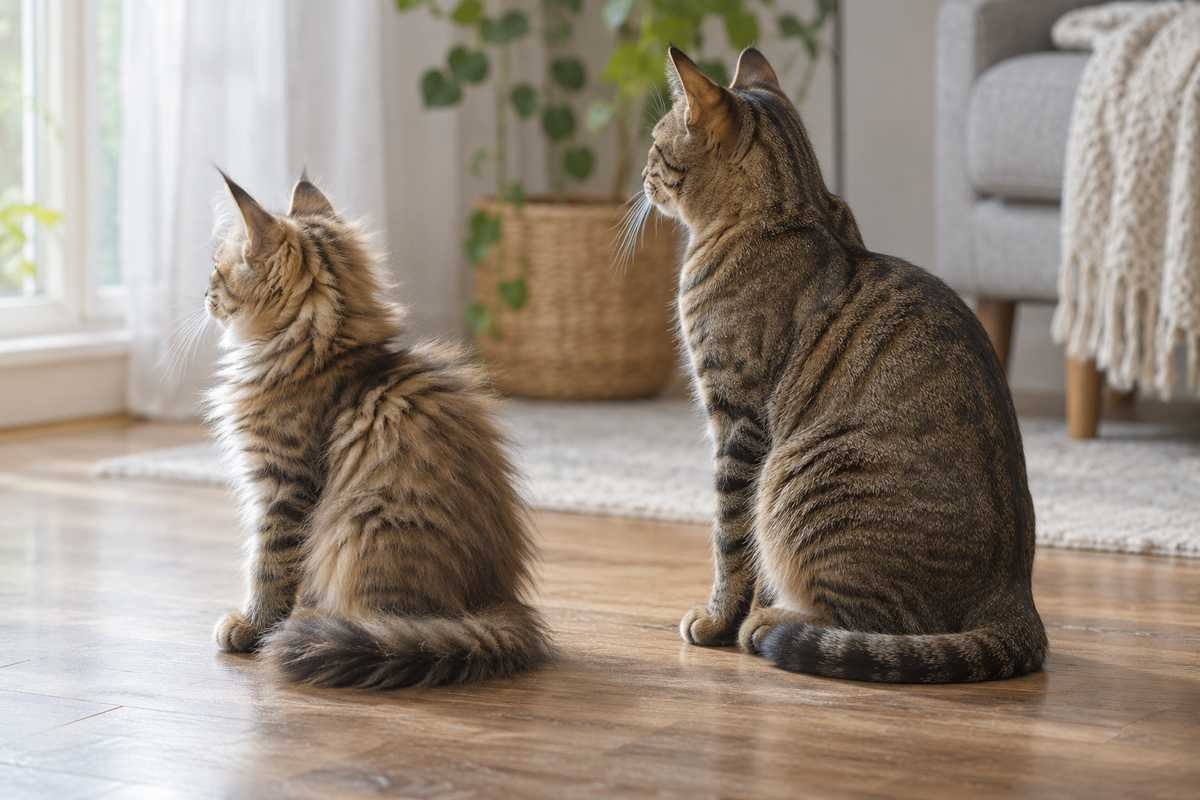
You can’t be sure by looking, and a DNA test only helps if the lab has Maine Coon in its breed database. What you can do is check how many Maine Coon traits show up together and, more importantly, ask for facts about the parents.
CFA’s breed description lists the traits: a coat shorter at the shoulders and longer on the sides, stomach and back legs; a long plumed tail; a rectangular head with a square muzzle; and large ears with prominent tufts. A cross may show some of them and miss others. One feature on its own, like a thick tail, is common in many ordinary cats. Our Maine Coon traits checklist scores the full set.
One commenter spelled out the honest limit in a long r/MaineCoon thread about a cat that “looks like a fluffy cat”:
“You can’t tell the difference between a pure bred maine coon and a DLH just by looking at it. You NEED the paperwork to call it a pure maine coon. Anything else is just a guessing game.”
– r/MaineCoon, March 2026 (24 upvotes)
Swap “pure bred” for “half” and the same logic applies. Without a registered Maine Coon parent you’ve seen, that label is a seller’s description. It’s worth treating that way.
Health and lifespan of a Maine Coon domestic shorthair mix
Hypertrophic cardiomyopathy (HCM), a thickening of the heart muscle, is the one inherited condition worth asking about. In 2005, Meurs and colleagues reported a mutation in the MYBPC3 gene in Maine Coons with familial HCM, now called A31P.
How common is it? In a 2014 study in the Journal of Small Animal Practice, 39.4% of 742 Maine Coons tested through a genetic laboratory in the British Isles carried the A31P variant (PubMed record). Those were cats that owners or breeders chose to test, so it isn’t a random sample of the breed. A 2019 study in the Journal of Feline Medicine and Surgery sequenced Maine Coon and Maine Coon cross cats with HCM and found the same variant segregating with the disease.
Genetics arithmetic follows from that. If the Maine Coon parent carries two copies of A31P, every kitten inherits one. If the parent carries one copy, about half the kittens will. What one copy means for a kitten’s heart is a question for a veterinary cardiologist, and no source found here answers it.
On lifespan, Petfinder lists a purebred Maine Coon at 9 to 15 years. No lifespan figures specific to this cross turned up, so any number you see for the mix is a guess. For the purebred picture, see Maine Coon lifespan.
What should you ask before you take one home?
Start with the parents, because they’re the only evidence there is. Ask which parent is the Maine Coon and whether you can meet that cat. Ask what coat the other parent has and whether it has had long-coated kittens. Ask whether the Maine Coon parent was heart-checked or tested for A31P.
If the answers are “the dad was a Maine Coon, we never saw him,” the kitten may still be a lovely pet. It just isn’t a cross you can plan around. Plan for a medium-to-large cat with a coat you’ll only learn at about the time it grows in. A Ragdoll Maine Coon mix comes with at least two documented breeds to read; this one doesn’t.
Whatever the genetics turn out to be, groom for the coat you actually have. CFA’s advice for the purebred is combing two or three times a week, and a half-long coat is a reasonable place to start.