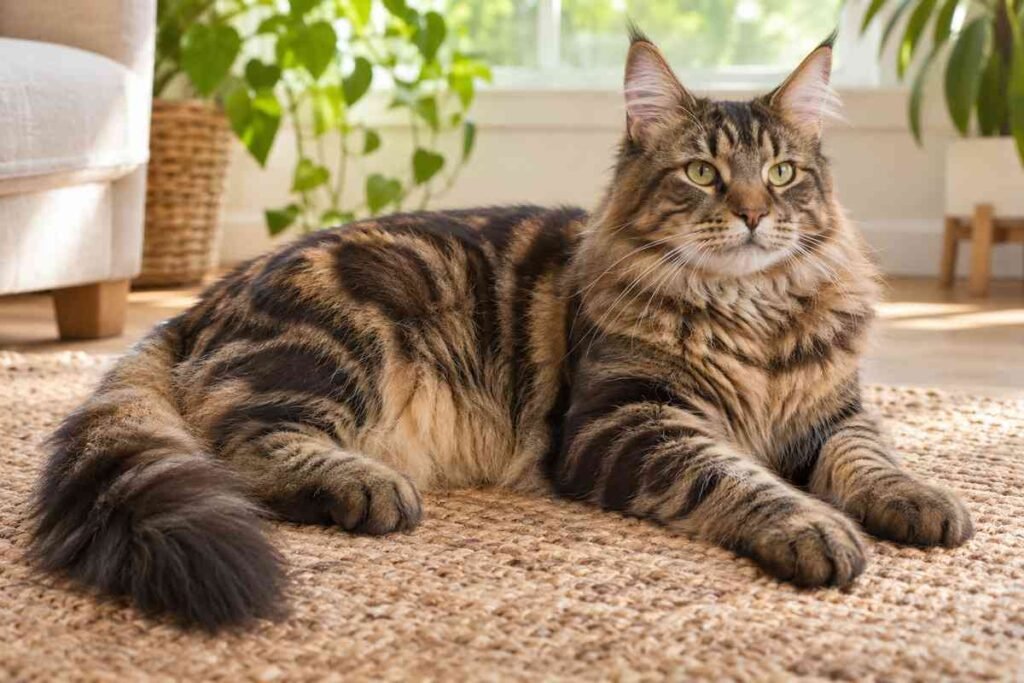
An American Shorthair Maine Coon mix is a cross between an American Shorthair and a Maine Coon, and it is not a breed any major registry recognizes. The two parents are both sturdy, even-tempered working cats, so this is one of the more predictable Maine Coon crosses: you can count on a muscular, sociable cat, and the open questions are how big it gets and how long the coat grows.
In practice, a cross of the two produces a balanced, hardy cat. The result can lean more or less toward either parent, because no breed standard pins anything down. The label describes the two likely parents instead of promising anything about the individual cat. If a kitten or adult was listed that way, the parents themselves and their paperwork are what actually matter. For the wider family, start with our Maine Coon mix overview.
What an American Shorthair Maine Coon Mix Actually Is
The Cat Fanciers’ Association (CFA) recognizes the American Shorthair and the Maine Coon as separate breeds, each with its own standard, but it recognizes no cross between them. The cross is a mixed-breed cat, and nothing about its size, coat, or temperament is fixed by a standard.
The two parents are less different than most Maine Coon pairs, which is what makes this cross interesting. Both are solid, muscular, even-tempered cats with a working background: the American Shorthair descends from ships’ cats and farm cats kept to hunt rodents, and the Maine Coon descends from the barn cats of New England. A cross of the two usually produces a sturdy, good-natured cat, with the main uncertainty in the numbers instead of the personality.
Most cats carrying this label come from rescues and informal sellers, not from registered breeders, and the label is a best-effort guess based on looks. Treat it as a description of what the parents might have been, not a promise about what the cat will become.
Where the Parents Agree (and Where They Don’t)
The quickest way to predict this cross is to split the traits the two parents share from the traits they do not. What they share comes out reliably; what they differ on is a coin flip.
On build and temperament, the parents agree. The CFA describes the American Shorthair as a stocky, working breed with an even temperament, and the Maine Coon is a large, big-boned, people-oriented cat. A cross of the two inherits a muscular frame and a steady, sociable nature either way.
| Trait | American Shorthair | Maine Coon | For the mix |
|---|---|---|---|
| Build | Sturdy, muscular, medium | Big-boned, rectangular, large | Sturdy either way (predictable) |
| Temperament | Even, adaptable, sociable | Sociable, people-oriented | Friendly either way (predictable) |
| Weight | 8-12 lb typical | Males 13-18 lb, females 8-12 lb | 8-18 lb (lottery) |
| Coat | Short, dense, glossy | Semi-long, shaggy | Short to semi-long (lottery) |
| Lifespan | 15-20 years | 12-15 years | 12-18 years (lottery) |
The pattern is worth stating plainly: this mix is predictably sturdy and friendly, and the size, coat, and lifespan land somewhere in the ranges above. If a listing quotes a specific weight or coat length, it is a prediction, not a fact about the cat.
Size and Weight: The Main Variable
Expect a medium-to-large cat, most often somewhere between 8 and 18 lb at maturity, with the American Shorthair side pulling the size down and the Maine Coon side pulling it up. VCA lists the American Shorthair at 8 to 12 lb, while the Maine Coon standard puts males at 13 to 18 lb. A kitten that leans Maine Coon will be longer and taller and can keep filling out for three or four years; one that leans American Shorthair finishes sooner and stays more compact.
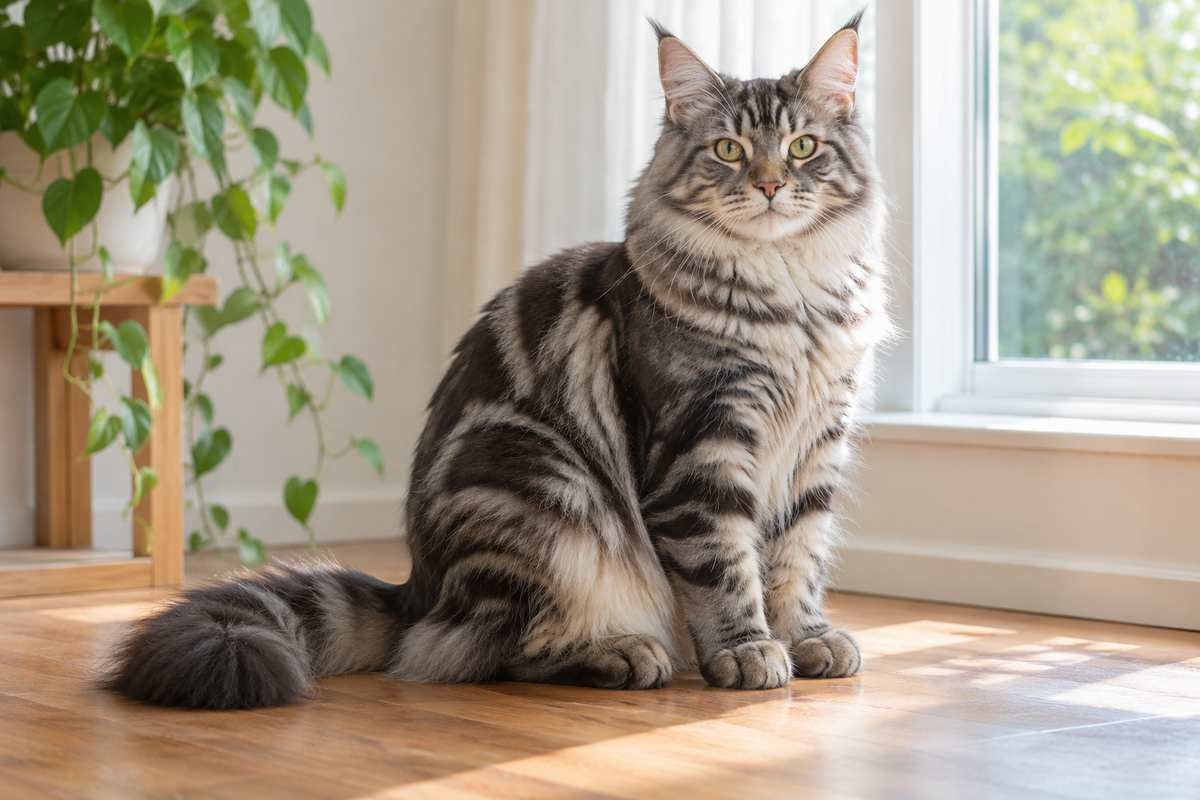
Frame matters as much as the number on the scale. A long, rectangular Maine Coon-shaped body reads as much bigger than a stockier American Shorthair frame at the same weight, so two cats of identical scale weight can look completely different. Because there is no standard, treat any exact figure a seller quotes as an estimate: a healthy adult can land below or above the typical range depending on which parent dominates, the cat’s sex, and how it was fed as a kitten.
Coat: Short, Medium, or Semi-Long
Coat is the second coin flip. The American Shorthair brings a short, dense, weather-resistant coat, and the Maine Coon brings a semi-long, shaggy coat with a soft undercoat. A kitten can show a short glossy coat, a medium coat with a ruff and britches, or anything between.
A short coat does not mean the cat is not part Maine Coon, and a longer coat does not mean it is not part American Shorthair. The Maine Coon’s fuller coat often fills in slowly, and some pedigreed Maine Coons keep a shorter, flatter coat for life.
Groom for the coat your cat actually has. A short, dense coat still sheds, often heavily at the change of seasons, and benefits from a weekly brush. A semi-long coat needs brushing a few times a week to stop the undercoat matting, with extra attention behind the ears and under the legs. Both parents shed, so neither version is low-maintenance.
Temperament: The Predictable Part
This is the part you can count on. The American Shorthair is even-tempered, adaptable, and easygoing; the Maine Coon is sociable, people-oriented, and often described as dog-like. A cross of the two is likely to be friendly, tolerant, and comfortable in a busy home, whether it leans toward lounging nearby or following you from room to room.
Real owners describe the same blend. One adopter of a kitten they believed was part Maine Coon put it this way:
“I’ve always wanted a Maine coon but I prefer to adopt, and I think my new guy must be at least part! He’s 4 months and 7 pounds already and he has the chillest personality. Nothing phases him. What do you guys think?”
— from the r/catbreeds community (source)
The instinct behind that is right: early socialization and the parents’ own temperaments matter at least as much as the breed mix, so if you can meet the parents, watch how they behave. Both parent breeds are generally tolerant, so this is a cross that usually fits a busy household without much fuss.
Health: One Condition Worth Screening For
The American Shorthair side is a healthy starting point. The CFA calls the breed a hardy cat not currently known for any breed-specific health problems, and notes that hypertrophic cardiomyopathy, seen in some cats decades ago, has largely disappeared through preventive testing and selective breeding.
The Maine Coon side is where the main watch-item sits. Hypertrophic cardiomyopathy (HCM), a thickening of the heart muscle and the most common heart disease in cats, has a genetic component in several breeds, and the Cornell Feline Health Center lists the Maine Coon among them. Because one parent can carry a form of it, a responsible cross should come from parents screened by a veterinary cardiologist, and periodic heart checks are worth keeping up as the cat ages.
On lifespan, expect somewhere in the 12 to 18 year range, between the American Shorthair’s longer span and the Maine Coon’s shorter one. Regular veterinary care, a weight-appropriate diet, and early heart screening do more for this cat than the label ever will.
Finding One: Breeders, Rescues, and Price
Deliberately bred crosses of the two are uncommon, because most registered breeders work within one breed. Most cats carrying this label turn up through rescues, shelters, or informal rehoming, where the label is a best-effort description.
That changes what “price” means. An adoption fee at a shelter, often a hundred dollars or so, is the realistic entry point for a cat listed this way. If a seller wants a large sum for an “American Shorthair Maine Coon mix” kitten, the price deserves scrutiny: there is no registry backing the label and no standard defining what you are paying for.
“Our vet told us that so many people come in and say their cats are Maine Coons that they’re surprised when actual Maine Coons come in. Maine Coon or not though, cats are great.”
— from the r/mainecoons community (source)
Before you pay anyone, get three things in writing: the parents themselves and whether they are registered, proof that both parents were screened for HCM, and the kitten’s health records along with any registration documents. A seller who cannot show these is selling a mixed-breed cat with an unknown background. The price should reflect that. For a closer look at reading a cat’s body, see our guide to how to tell if your cat is a Maine Coon mix. For another large cross with a similarly wide outcome, see our piece on the Maine Coon Bengal mix.
American Shorthair Maine Coon Mix FAQ
How big does an American Shorthair Maine Coon mix get?
Most land between 8 and 18 lb at maturity, with females usually smaller than males, and the frame matters as much as the weight. A kitten that leans Maine Coon can keep growing slowly for three or four years.
Does an American Shorthair Maine Coon mix have short or long hair?
It can have either, or a medium coat in between. One parent is short-coated and the other semi-long, so the coat is the most unpredictable part of this cross and can keep filling in over the first year or two.
Is an American Shorthair Maine Coon mix recognized by any registry?
No. CFA recognizes the two parent breeds but not the cross, so there is no breed standard and no registration papers for it. Without papers, any “mix” label is a guess.
Do American Shorthair Maine Coon mixes have health problems?
The American Shorthair side is a hardy starting point with no current breed-specific problems, but the Maine Coon side can pass on hypertrophic cardiomyopathy. Parent heart screening and regular veterinary checks are the best protection.