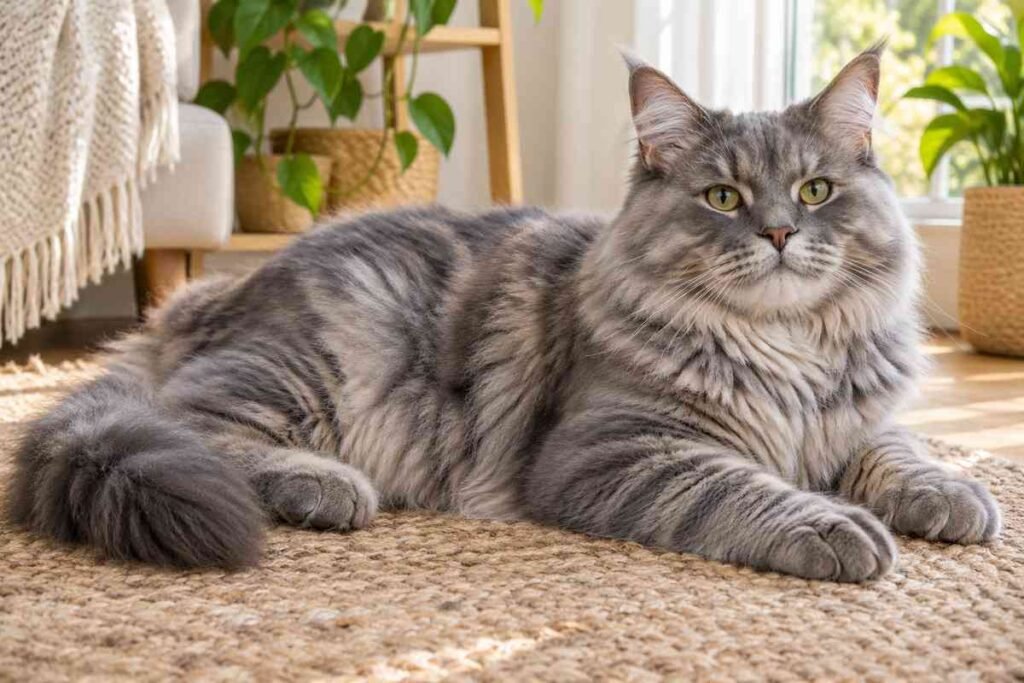
A British Shorthair Maine Coon mix is a cross between a British Shorthair and a Maine Coon, and it is not a recognized breed in any major registry. The two parents sit at opposite ends of the body-type spectrum, so the cross can inherit a cobby, round frame or a long, rectangular one, a dense short coat or a semi-long shaggy one, and a calm or an outgoing temperament. There is no breed standard, so every kitten lands somewhere different on that spectrum.
Owners sometimes shorten the name to “BritCoon,” though no registry uses that term. Pay attention to the parents instead. If you are weighing this cross because a kitten or adult cat was listed that way, what actually matters is whether the parents are known and whether papers exist at all. For a sense of the wider family of these crosses, start with our Maine Coon mix overview.
What a British Shorthair Maine Coon Mix Actually Is
The Cat Fanciers’ Association (CFA) and The International Cat Association (TICA) recognize the two parent breeds and maintain standards for each, but neither registry recognizes a cross between them. A British Shorthair Maine Coon mix is a mixed-breed cat, not a breed with a predictable standard.
The reason the outcome is so hard to pin down is how different the parents are. Opposite body plans are the whole story. The British Shorthair is a medium-to-large cat built on a cobby, round frame with a dense plush coat, while the Maine Coon is a large cat built long and rectangular with a shaggy, semi-long coat. Put those two shapes together and the kitten can pull from either end of the spectrum. A first-generation cross (one parent of each breed) shows the widest range, and later generations stay just as hard to predict because the mix is not being bred to a standard.
In practice, the label is used more often by rescues and informal sellers than by registries. The honest way to approach it is as a description of what two parents might have been, not as a promise about what the cat will become.
The Two Parent Breeds at a Glance
The quickest way to understand this cross is to look at the two parents side by side. They are close in weight, but they differ in almost everything that shapes how a cat looks and acts.
The Maine Coon is the largest domestic cat breed in common terms. It has a long, rectangular body, a square muzzle, high cheekbones, large tufted ears, and a heavy, shaggy, water-resistant coat. It matures slowly, sometimes taking three to four years to reach full size. The breed standard places males between 13 and 18 lb and females between 8 and 12 lb, though well-bred males can run larger.
The British Shorthair is a medium-to-large cat with a cobby, broad, muscular body, a round head with full cheeks, small rounded ears, and a dense, plush, short coat that feels crisp to the touch. It is usually described as calm, quiet, and somewhat independent. Males typically run between 12 and 17 lb and females between 7 and 12 lb.
What the numbers hide is the shape. A British Shorthair carries its weight in a compact, round package, while a Maine Coon stretches the same weight across a long frame. That is why two cats of the same scale weight can look completely different, and it is the single biggest variable in a cross.
| Trait | British Shorthair | Maine Coon | Where the mix can land |
|---|---|---|---|
| Body | Cobby, broad, muscular | Long, rectangular, big-boned | Medium to large, often in between |
| Coat | Dense, short, plush | Semi-long, shaggy, water-resistant | Short to semi-long, the most variable trait |
| Head and face | Round head, full cheeks | Square muzzle, high cheekbones | Somewhere in between |
| Ears | Small and rounded | Large, often tufted | Variable; tufts may or may not appear |
| Temperament | Calm, quiet, independent | Sociable, people-oriented, playful | Either, or a blend of both |
| Male weight | Between 12 and 17 lb | Between 13 and 18 lb | Between 10 and 18 lb |
| Female weight | Between 7 and 12 lb | Between 8 and 12 lb | Between 8 and 14 lb |
Size and Weight: What to Expect
Plan for a medium-to-large cat, most often between 10 and 18 lb at maturity, and understand that the range is wide because the parents pull in different directions. A kitten that takes after the Maine Coon side will be longer, taller, and slower to finish growing, while one that takes after the British Shorthair side will be more compact and reach full size sooner.
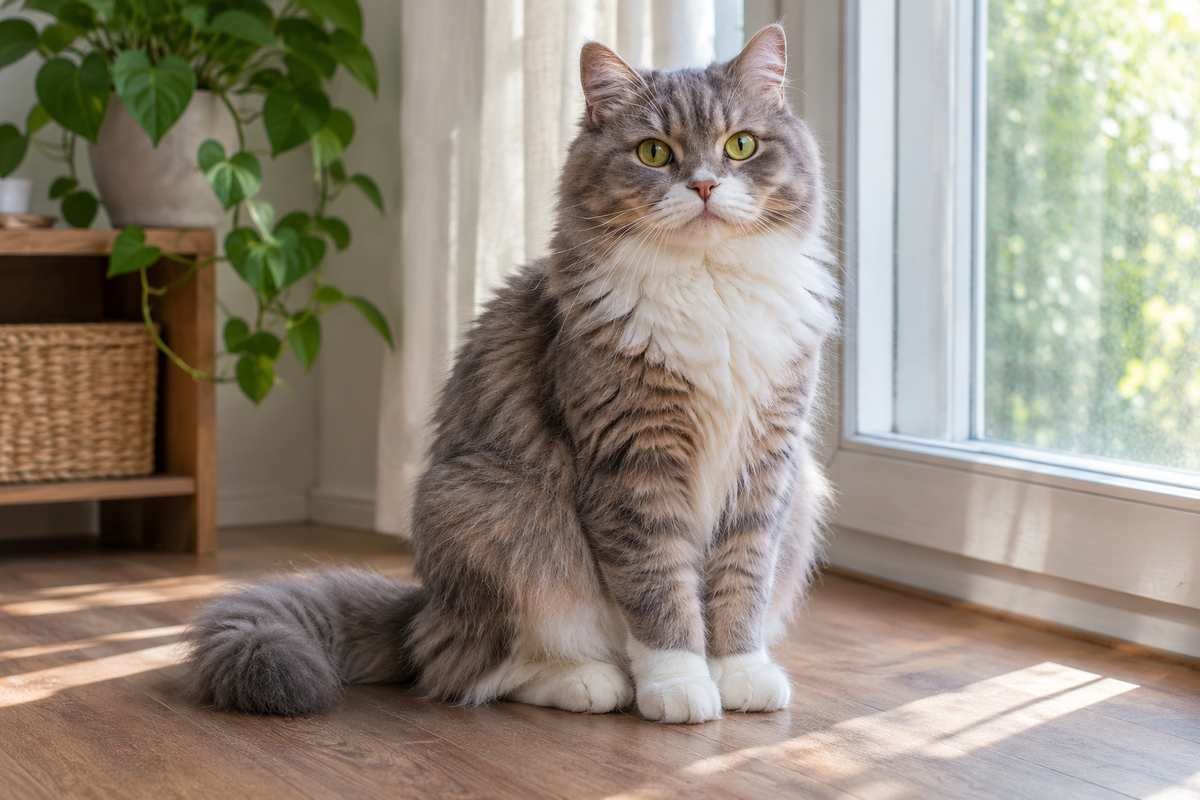
Two things matter more than the number on the scale. The first is frame: a long, rectangular body reads as much bigger than a cobby one at the same weight. The second is time: if the Maine Coon influence is strong, the cat can keep filling out for three or four years, so a “small” two-year-old is not the final size.
Because there is no standard, treat any specific weight a seller quotes as an estimate. A healthy adult of this cross can land below or above the typical range depending on which parent dominates, the cat’s sex, and how it was fed as a kitten.
Coat and Grooming
Coat is the most unpredictable part of this cross. The British Shorthair contributes a short, dense, plush coat, and the Maine Coon contributes a semi-long, shaggy coat with a soft undercoat. A kitten can show a short plush coat, a medium coat with a ruff and britches, or anything in between.
One confusion worth clearing up early: a short coat does not mean the cat is not part Maine Coon, and a long coat does not mean it is not part British Shorthair. Some purebred Maine Coons are born with a shorter, flatter coat, and the longer, shaggier coat often fills in slowly. Owners of one short-haired pedigree Maine Coon put it this way:
“Not all MCs are going to exhibit every MC trait. My guess is his mane and longer coat will come in over the next year to two years. And his tips may grow in also, or he may not ever get them. He’s a beautiful boy 🩶 Congratulations”
— from the r/MaineCoon community (source)
Grooming follows the coat it actually has. A short, dense coat still sheds, often heavily during seasonal changes, and benefits from a weekly brush. A semi-long coat needs brushing a few times a week to keep the undercoat from matting, with extra attention behind the ears and under the legs. Both parent breeds shed, so neither version is low-maintenance.
Temperament: Calm Lap Cat or Sociable Giant
Temperament is the second coin flip. The British Shorthair is famously calm and undemanding: it is happy to lounge nearby and tends to be reserved with new people. The Maine Coon is sociable and people-oriented, often described as dog-like, and it usually wants to be in the middle of whatever is happening.
A cross can take after either parent, and it can blend them: a cat that is calm with family but greets guests at the door, or one that follows you from room to room but does not demand to be held. Early socialization and the parents’ own temperaments matter at least as much as the breed mix, so if you meet the parents, watch how they behave.
Both parent breeds are generally tolerant and even-tempered, so this is a cross that usually does fine in a busy home. If you are wondering how it will get along with other pets, the British Shorthair side is one of the more easygoing breeds with other cats, and the Maine Coon side is sociable enough to adjust. Slow, supervised introductions are still the right approach.
The Mix Label: Usually a Guess
Here is the part most listings will not tell you: without pedigree papers, the “British Shorthair Maine Coon mix” label is a guess based on how the cat looks. Rescues and shelters assign breed labels from appearance, and appearance is a poor guide because so many traits overlap across breeds and with ordinary domestic cats.
This is a real problem for this specific cross. A grey-blue cat with a plush coat gets called a British Shorthair mix, and a large brown tabby with a ruff gets called a Maine Coon mix, whether or not either breed is actually in the line. Cat owners who have been through this are blunt about it:
“Still a domestic shorthair like the other sub told you, mixes don’t exist in cats”
— from the r/catbreeds community (source)
The comment is a bit overstated, since crosses between two purebred cats do exist, but it captures the right instinct: most cats carrying a breed label are ordinary domestic cats, not verified crosses. If the label matters to you, the only way to confirm it is paperwork from a registered breeder, and that paperwork is rare for this pair. For a closer look at what you can actually read from a cat’s body, see our guide to how to tell if your cat is a Maine Coon mix.
Health and Lifespan
As a cross, this cat has no single documented health profile, so the sensible approach is to look at the conditions the two parent breeds carry and screen for the ones they share.
The condition that deserves the most attention is hypertrophic cardiomyopathy (HCM), a thickening of the heart muscle that is the most common heart disease in cats. The Cornell Feline Health Center notes that HCM has a genetic component in several breeds, including the Maine Coon, and the British Shorthair is also listed among the breeds affected. Because both parents can carry a form of it, a responsible cross should come from parents screened by a veterinary cardiologist, and any cat with this background is worth periodic heart checks as it ages.
The British Shorthair side adds polycystic kidney disease (PKD) to the watchlist, a genetic condition that forms fluid-filled cysts in the kidneys and slowly reduces kidney function over time. The Maine Coon side adds hip dysplasia, a malformation of the hip joint that causes stiffness in large, fast-growing cats. Joints can also struggle simply from carrying Maine Coon size on a shorter, stockier frame.
Mixed-breed cats sometimes get a health boost called hybrid vigor, a reduced risk of breed-specific recessives, but it is not a guarantee here. HCM appears in both parents, which weakens that argument. Expect a lifespan somewhere between 12 and 15 years, matching the Maine Coon average, with the upper end of the British Shorthair’s range possible in a healthy cat. Regular veterinary care, a weight-appropriate diet, and early screening for heart and kidney issues do more for this cat than the label ever will.
Finding One: Breeders, Rescues, and Price
Deliberately bred British Shorthair Maine Coon crosses are rare, because most registered breeders work within one breed, not across two. Most cats carrying this label will be found through rescues, shelters, or informal rehoming listings, where the label is a best-effort description rather than a documented pedigree.
That changes what “price” means. An adoption fee at a shelter, often a hundred dollars or so, is the realistic entry point for a cat listed this way. If a seller is asking a large sum for a “British Shorthair Maine Coon mix” kitten, that price deserves scrutiny, because there is no registry backing the label and no standard defining what you are paying for.
Before you pay anyone, three things are worth asking for: the parents themselves (and whether they are registered), proof that both parents were screened for HCM and, on the British Shorthair side, PKD, and the kitten’s health records along with any registration documents. A seller who cannot show these is selling a mixed-breed cat with an unknown background, and the price should reflect that. For another large cross with the same kind of wide, variable outcome, see our piece on the Maine Coon Bengal mix.
British Shorthair Maine Coon Mix FAQ
How big does a British Shorthair Maine Coon mix get?
Most land between 10 and 18 lb at maturity, with females usually smaller than males, and the frame matters as much as the weight. A kitten that takes after the Maine Coon side can keep growing slowly for three or four years.
Does a British Shorthair Maine Coon mix have long or short hair?
It can have either, or a medium coat in between, because one parent is short-coated and the other semi-long. The coat is the most unpredictable trait of this cross and can keep filling in over the first year or two.
Are British Shorthair Maine Coon mixes recognized by any registry?
No. CFA and TICA recognize the two parent breeds but not the cross, so there is no breed standard and no papers for it. Without registration documents, any “mix” label is an educated guess.
Do British Shorthair Maine Coon mixes have health problems?
They can inherit hypertrophic cardiomyopathy from either parent, plus polycystic kidney disease from the British Shorthair side and hip dysplasia from the Maine Coon side. Parent health screening and regular veterinary checks are the best protection.