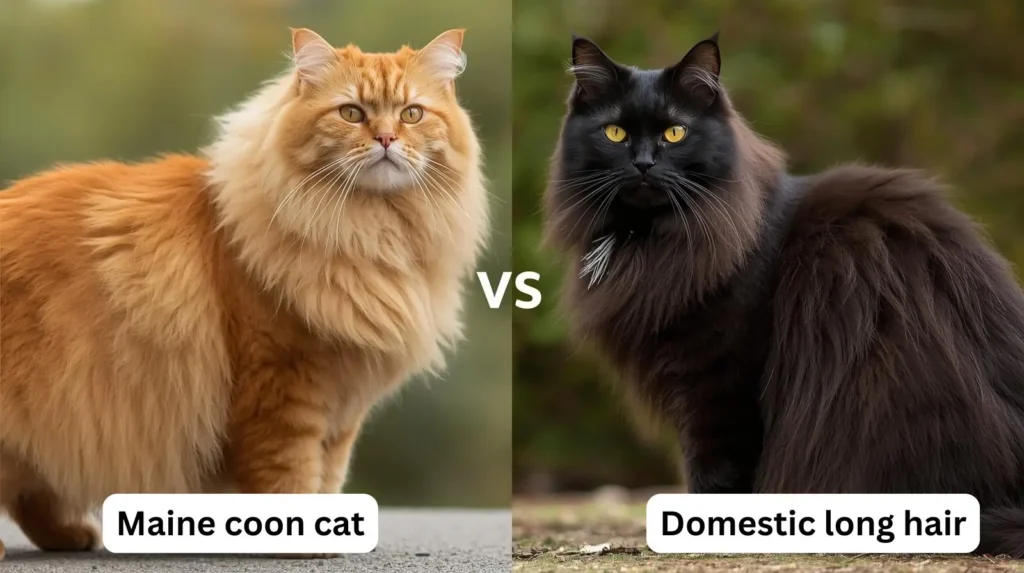
I still remember the moment I stood in the shelter aisle, staring between a massive, tufted-eared cat with a lion-like mane and a quieter, silky-coated beauty stretched lazily across a blanket. One was labeled “Maine Coon mix.” The other simply read “Domestic Long Hair.” At the time, I had no idea how different those two labels truly were. If you’ve ever found yourself in a similar situation, this guide is for you.
The debate around Maine Coon vs Domestic Long Hair is more common than most people realize. Millions of cat owners across the world from first-time adopters to seasoned feline enthusiasts confuse these two types of cats every day. And honestly? That confusion is completely understandable.
Both are fluffy. Both are beautiful. But beneath those luxurious coats lies a world of difference. Let’s break it all down.
What Exactly Is a Maine Coon?
The Maine Coon vs Domestic Long Hair distinction starts with pedigree. The Maine Coon is one of the oldest and most recognized purebred cat breeds in North America. Native to the U.S. state of Maine where it holds the title of official state cat this breed developed naturally over centuries, adapting its thick coat and sturdy frame to survive harsh New England winters.
According to the Cat Fanciers’ Association, the Maine Coon was crowned the #1 most popular pedigreed cat breed in 2025 (based on 2024 registrations), a dramatic rise from relative obscurity just decades ago. Even more staggering: Maine Coon registrations surged from 9,513 to over 24,000 between 2015 and 2024 more than doubling in under a decade.
When I first read those numbers, I genuinely wasn’t surprised. There’s something about a Maine Coon that pulls you in. They look like a wild creature, but behave like your most loyal friend.
What Is a Domestic Long Hair Cat?
On the other side of the Maine Coon vs Domestic Long Hair debate sits a category that is far less defined and far more common. The Domestic Long Hair (DLH) is not a breed at all. It’s a classification. Think of it like “mutt” in the dog world, except instead of a shortcoming, it’s actually a superpower of genetic diversity.
Domestic Long Hairs are the result of generations of mixed-breed cats naturally producing long-haired offspring. Since the long-hair gene is recessive, roughly only one in ten kittens born to random-bred cats will carry a long coat. This means your fluffy shelter cat is statistically rare and genetically unique.
Remarkably, about 97% of all cats in the world are domestic cats (not purebreds), according to data from Mountain Peak Maine Coons, citing Smithsonian research showing that over 90 million domesticated cats live in U.S. homes. That puts the Domestic Long Hair in an entirely different tier when it comes to availability, price, and predictability.
Maine Coon vs Domestic Long Hair: Size and Appearance
This is where the Maine Coon vs Domestic Long Hair comparison gets visually dramatic.
| Feature | Maine Coon | Domestic Long Hair |
|---|---|---|
| Weight (Male) | 18–21 lbs (avg) | 10–15 lbs (avg) |
| Weight (Female) | 12–15 lbs | 8–12 lbs |
| Body Length | 36–40 inches (with tail) | 15–20 inches (avg) |
| Growth Period | 3–5 years to full size | 12–18 months |
| Coat Type | Double coat, water-resistant | Single or double coat, varies |
| Ear Tufts | Yes, prominent lynx tips | Rarely |
| Tail | Long, bushy plume | Shorter, less voluminous |
| Paw Tufts | Yes, acts as natural snowshoes | Rarely |
Maine Coons are among the largest domestic cat breeds in the world, with males regularly tipping the scales at 18 to 21 pounds. Some exceptional specimens exceed 25 pounds. In length, they can stretch to an impressive 36 to 40 inches nearly the size of a small dog.
The Maine Coon vs Domestic Long Hair size gap is not subtle. Stand them side by side and it becomes instantly clear. Maine Coons have a rectangular body structure, a pronounced chest ruff, high cheekbones, a square muzzle, and unusually large, tufted ears. Every feature is bold and intentional.
Domestic Long Hairs, by contrast, range wildly. Some may look vaguely Maine Coon-like especially if they carry some of that lineage but their build, coat texture, and facial features are unpredictable by nature.
Maine Coon vs Domestic Long Hair: Personality and Temperament
One of the most searched questions when it comes to Maine Coon vs Domestic Long Hair is: Which one has a better personality?
The honest answer is that both can be wonderful. But the Maine Coon brings something almost uniquely special to the table.
Maine Coons are often called the “dogs of the cat world” and for good reason. They are interactive, social, and deeply loyal to their families. They tend to follow owners from room to room, engage in play fetch, and even respond to their names being called. Unlike many cats, Maine Coons crave human interaction without being clingy or demanding.
Domestic Long Hairs, being a mixed-breed category, come with far more personality variation. Some are deeply affectionate. Others are more independent. Because their temperament is shaped by a complex genetic cocktail, there’s an element of delightful surprise involved. If you’ve adopted a DLH, you’ve likely noticed they develop their personality over time and that journey is part of the joy.
From my own experience, I’ve seen DLH cats match and sometimes exceed the affection of purebreds. Genetics aren’t destiny. But if you’re seeking consistency, the Maine Coon vs Domestic Long Hair decision leans firmly toward the Maine Coon for predictable behavior.
Maine Coon vs Domestic Long Hair: Grooming and Coat Care
When comparing Maine Coon vs Domestic Long Hair in terms of grooming, the difference lies in coat structure.
Maine Coons have a double coat a soft, insulating undercoat and a water-resistant guard layer. This coat was designed for survival in icy Maine winters. It forms a stunning neck ruff, a dense tail plume, and tufted paws. But with great beauty comes great responsibility: Maine Coons need brushing three to four times per week to prevent mats and tangles, especially behind the ears and under the armpits.
Domestic Long Hairs have variable coats. Some carry single coats that are silky and relatively tangle-resistant. Others have denser, cottony coats that mat more easily than even a Maine Coon’s fur. Grooming frequency for a DLH can range from once a week to daily, depending entirely on the individual cat.
In the Maine Coon vs Domestic Long Hair grooming showdown, neither is inherently “easier.” But the Maine Coon’s needs are at least predictable, while the DLH’s needs remain a variable.
Maine Coon vs Domestic Long Hair: Health and Lifespan
Both cats typically live between 12 and 15 years with proper care, which puts them on equal footing in the Maine Coon vs Domestic Long Hair longevity discussion.
However, their health vulnerabilities differ:
Maine Coons are prone to:
- Hypertrophic Cardiomyopathy (HCM) a serious heart condition. Annual cardiac ultrasounds are recommended.
- Hip Dysplasia especially relevant given their large frame.
- Spinal Muscular Atrophy (SMA) detectable through DNA testing.
Domestic Long Hairs benefit from:
- Hybrid vigor the genetic diversity of mixed ancestry often results in fewer breed-specific conditions.
- However, unknown lineage means surprise health issues can arise without warning.
Responsible Maine Coon vs Domestic Long Hair ownership means staying proactive with vet care regardless of which you choose. For Maine Coons specifically, working with a reputable breeder who DNA tests both parents is strongly recommended.
Maine Coon vs Domestic Long Hair: Cost Comparison
This is where Maine Coon vs Domestic Long Hair diverges most sharply.
Purchasing a pet-quality Maine Coon kitten from a reputable breeder typically costs $2,800 to $4,500 in the United States. Show-quality kittens or rare colorings can push well beyond that range.
A Domestic Long Hair, on the other hand, can be adopted from a shelter for as little as $50 to $150, or purchased from a casual breeder for under $500. There’s no registry, no lineage documentation, and no breed-specific pricing structure.
For budget-conscious cat lovers, the Maine Coon vs Domestic Long Hair financial comparison is clear. But price is also a reflection of predictability with a Maine Coon, you know roughly what you’re getting in terms of size, coat, and temperament. With a DLH, every cat is a beautiful mystery.
Can a Domestic Long Hair Be a Maine Coon Mix?
This question fuels endless debate in the Maine Coon vs Domestic Long Hair world. The short answer: it’s possible but statistically rare.
For a true Maine Coon mix to exist, an unaltered purebred Maine Coon would need to have bred with a domestic cat. Since only about 3% of cats are purebreds, and many of those are spayed or neutered, the mathematical probability of a random-bred DLH carrying significant Maine Coon genetics is remarkably low.
Still, visual similarities tufted ears, bushy tails, large paws cause many cat owners to claim their DLH is “definitely part Maine Coon.” Unless you have a pedigree or a DNA test, it’s a fun theory but rarely a fact. For comprehensive breed identification and lineage resources, visit MaineCoon Guides for detailed tools and expert articles on recognizing true Maine Coon traits.
Maine Coon vs Domestic Long Hair: Which Is Right for You?
Here’s the honest breakdown for the Maine Coon vs Domestic Long Hair decision:
Choose a Maine Coon if you want:
- A predictable, dog-like personality
- A strikingly large, majestic cat with show-stopping looks
- A loyal, interactive companion who loves family life
- A cat you can participate in showing or breeding programs
Choose a Domestic Long Hair if you want:
- A more budget-friendly option
- The joy of a one-of-a-kind personality
- A loving companion without the premium price
- To give a shelter cat a loving forever home
There’s no wrong answer in the Maine Coon vs Domestic Long Hair conversation. Both cats are capable of profound companionship. Both deserve excellent care. The right choice depends entirely on your lifestyle, budget, and what kind of relationship you’re hoping to build.
Frequently Asked Questions: Maine Coon vs Domestic Long Hair
Q1: How can I tell if my cat is a Maine Coon or a Domestic Long Hair?
The most reliable way is a pedigree certificate from a registered breeder. Visual clues like tufted ears, a rectangular body, and a prominent neck ruff are suggestive but not definitive. A DNA test can offer more clarity, though it won’t confirm pedigree status.
Q2: Are Maine Coons more affectionate than Domestic Long Hairs?
Maine Coons are consistently described as dog-like in loyalty and social engagement. Domestic Long Hairs vary widely in temperament since their personalities depend on their individual genetic mix. Neither is universally “better,” but Maine Coons offer more predictability.
Q3: Do Maine Coon vs Domestic Long Hair cats require the same grooming?
Not exactly. Maine Coons have a structured double coat that requires brushing three to four times per week. Domestic Long Hairs can range from low-maintenance to high-maintenance coats depending on their individual fur type.
Q4: Is a Maine Coon worth the higher price compared to a Domestic Long Hair?
That depends on your priorities. If you’re seeking a specific look, temperament, and pedigree, a Maine Coon is a worthy investment. If you’re open to surprise and want to give a shelter animal a home, a Domestic Long Hair offers equal love at a fraction of the cost.
Q5: Which lives longer a Maine Coon or a Domestic Long Hair?
Both breeds typically live 12 to 15 years with proper care. Domestic Long Hairs may benefit from hybrid vigor, potentially reducing certain genetic conditions, but Maine Coons from health-tested breeding programs can be equally long-lived. The real question is: which of these two remarkable cats are you ready to welcome into your home for the next decade and a half?