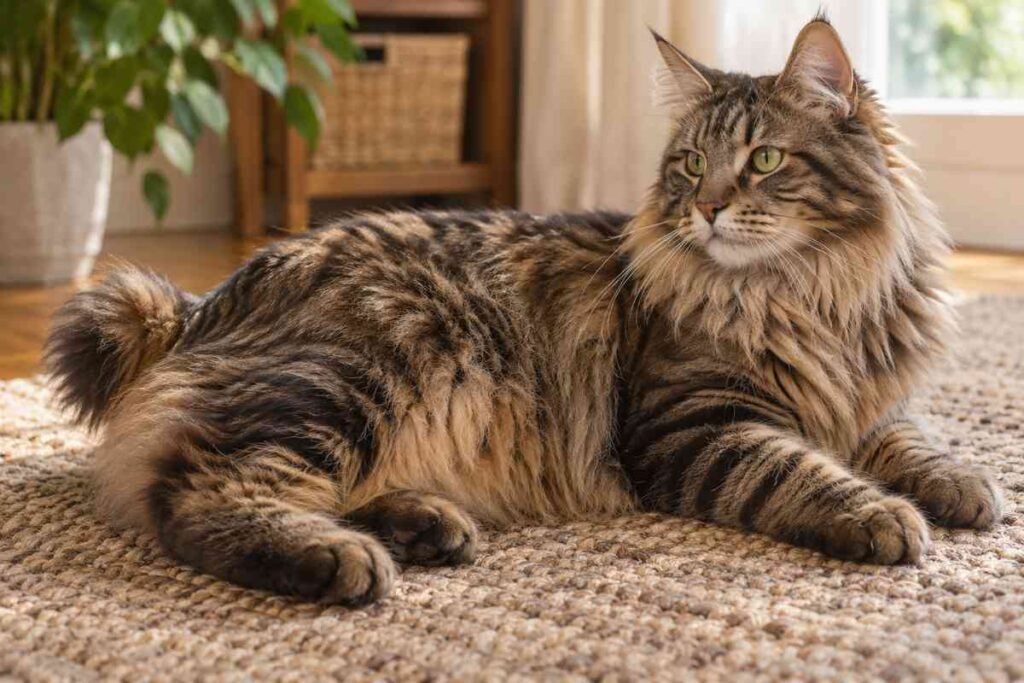
An American Bobtail Maine Coon mix is a cross between an American Bobtail and a Maine Coon. No major registry recognizes it as a breed. Because the Bobtail’s short tail comes from a dominant gene, some kittens from this cross can still be born with a bobbed tail even though the Maine Coon parent has a full, plumed one.
Everything else about the cross is a range rather than a promise. Both parents are big, slow-maturing, muscular cats that chirp more than they meow, so size and temperament are fairly predictable. Tail length, coat length and how much grooming you face vary from kitten to kitten, and the health question worth asking a seller is about hips.
What an American Bobtail Maine Coon Mix Is
The cross has no breed standard, so the label describes the likely parents and nothing more, and a kitten from a registered American Bobtail and a registered Maine Coon still cannot be shown or registered as either breed. Shelter cats usually get the label for their looks.
The two parents come from different places. The CFA American Bobtail standard describes a medium to large, naturally occurring bobtailed cat with a wild look and a hunting gaze, and VCA Animal Hospitals notes the CFA first accepted the breed for registration in 2000. The Maine Coon is a much older American breed, known for its size, ruff and long tail.
Neither one has anything to do with a bobcat. The Cat Fanciers’ Association states plainly that domestic cats cannot breed with raccoons or bobcats, which is the same reason the Maine Coon bobcat mix rumour falls apart. A short-tailed, tufted, heavy cat looks wild because both domestic parents were bred for that look.
Will an American Bobtail Maine Coon Mix Have a Short Tail?
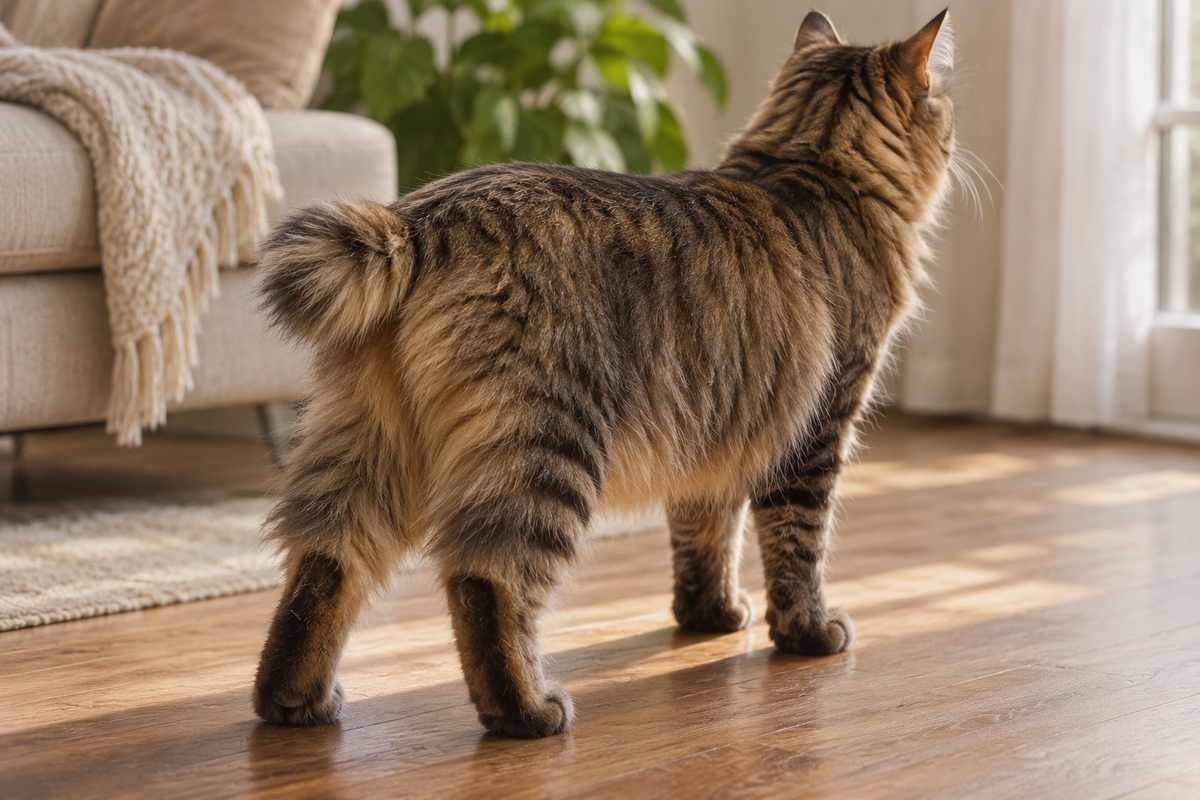
Often, yes. The American Bobtail’s short tail is caused by a dominant gene, so a kitten needs only one copy, from the Bobtail parent, to show it. A Bobtail carrying a single copy would pass it to about half the litter in textbook Mendelian terms, and the rest get a full tail.
The evidence for dominance goes back to the breed’s founder. PetPlace and Mental Floss both describe a short-tailed tabby found in Arizona in the late 1960s and bred to a Siamese female in Iowa. Some of the kittens had bobbed tails, and since only one parent was bobtailed, only one copy of the gene could have been needed.
That half-the-litter figure is an expectation, not a count. A Bobtail with two copies would pass the gene to every kitten, while CFA notes that tailed kittens turn up even in purebred Bobtail litters and remain an ordinary part of ethical breeding programs. Small litters also stray from any ratio, so a litter of four can easily come out three to one either way.
Length varies too. VCA puts the American Bobtail tail at roughly one to four inches, and Mental Floss describes it as usually a third to half the length of a normal tail. The CFA standard wants it long enough to be seen above the back when the cat is alert. A Maine Coon cross that inherits the gene may land anywhere in that span, and the Maine Coon side tends to add heavy fur to whatever tail there is.
How Big Does an American Bobtail Maine Coon Mix Get?
Expect a large cat, roughly 9 to 16 pounds as an adult, with males at the heavier end. Wisdom Panel lists the American Bobtail at 7 to 16 pounds, and the Cat Fanciers’ Association puts Maine Coon males at an average of around 12 to 15 pounds and females at 9 to 12 pounds.
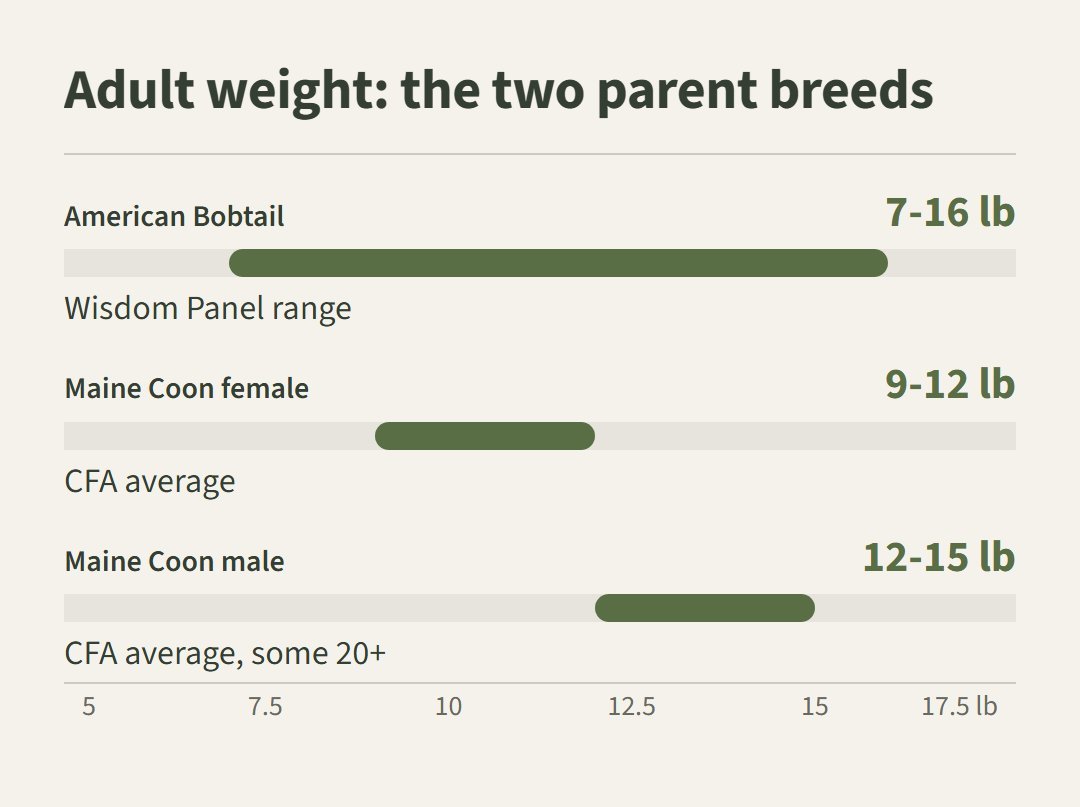
CFA adds that some Maine Coon males reach 20 pounds or more, so a big tom from a large Maine Coon line could top the Bobtail range.
Growth is slow on both sides, which matters more than the final number. VCA says the American Bobtail can take up to three years to reach physical maturity, and CFA says the Maine Coon often does not reach full development until three to four years of age. A one-year-old mix that looks lanky is usually still growing. For month-by-month Maine Coon numbers to compare against, our Maine Coon growth chart collects published kitten and adult weights.
Weight alone will not tell you whether a big mix is healthy. If yours is past its second birthday and still gaining, the body condition check in our is my cat overweight tool gives a better read than the scale.
Coat, Grooming, and Temperament
The coat can come out medium or long. American Bobtails exist in both a shorthair division, which CFA describes as medium length, semi-dense and double, and a longhair division that is slightly shaggy with a longer ruff and britches. The Maine Coon brings a long, silky coat that is shorter on the shoulders and longer on the belly. Most crosses end up somewhere from a dense medium coat to a full shaggy one, with a double undercoat either way.
Grooming follows the coat you get. VCA advises weekly brushing for longhaired Bobtails and twice a month for medium-haired ones, and Wisdom Panel suggests once or twice a week with more during seasonal sheds. A mix with the full Maine Coon ruff and britches needs the weekly session, especially behind the legs where mats form first.
Temperament is where the two parents overlap most. CFA describes the American Bobtail as easily leash trained, tolerant of children and dogs, and given to trilling, chirping and clicking rather than loud meowing. It describes the Maine Coon as sociable, good with children and dogs, and vocal in the same trills and chirps. You can reasonably expect a people-oriented cat that follows you around and talks in small sounds. Both breeds are also athletic and hunt-driven, so play matters. CFA notes Bobtails invent their own stalk-and-pounce games and carry captured toys around, and a bored large cat finds its own entertainment on counters and shelves.
Health: Hips, Spine, and the Heart
Hips are the one health check both parent breeds point to. CFA notes the Bobtail tail mutation could make a cat susceptible to spine and hip problems, some heritable, and lists hip dysplasia x-rays among the screening Maine Coon breeders use. A seller of this cross should be able to show hip results for both parents.
The spine question is tied to the tail itself. CFA says completely tailless cats, which occasionally occur, may have trouble with incontinence, and Mental Floss reports that Bobtails born with a too-short tail can sometimes struggle to control defecation. A kitten with a very short or absent tail is worth a vet exam before you take it home, with attention to its back end and litter habits.
The Maine Coon side adds the heart. CFA lists saliva tests and echocardiograms for hypertrophic cardiomyopathy (HCM) among the screens Maine Coon breeders rely on. Screened parents lower the odds without ruling HCM out, so periodic heart checks with your vet still make sense as your cat ages.
Wisdom Panel gives the American Bobtail a lifespan of 13 to 15 years, and a healthy cross from screened parents can reasonably be expected to land near that range.
Is a Bobtailed Fluffy Cat Really This Mix?
Not necessarily. A long-haired cat with a short tail fits the description, but tail kinks, old injuries and other natural tail mutations produce the same look in ordinary domestic cats. Without known parents, the label is a guess, and a feline DNA breed test is the only way to put numbers on it.
Plenty of owners ask exactly this about a fluffy stray, and the most common answer from experienced owners is caution. One reply on a “Manx or American Bobtail?” question in r/catbreeds put it from the rescue side:
“Domestic short hair with a bobtail 🥹 Tail abnormalities are not super uncommon. I see it a lot in feral colonies”
— from the r/catbreeds community (source)
Other bobtail genes muddy the picture further. Mental Floss explains that the Manx tail comes from an incomplete dominant gene that can produce anything from a full tail to none, while American Bobtails are almost never completely tailless.
A stray with no tail at all is more likely carrying Manx-type genetics than Bobtail ones.
The fur side is just as hard to call. Ear tufts, a ruff and big paws show up in many long-haired domestic cats, and a separate r/cats reply about a Maine Coon-looking stray noted that cat breeds do not work like dog breeds without a pedigree. Our guide on how to tell if your cat is a Maine Coon mix walks through which traits carry weight and which do not.
A DNA test is the honest next step if you want an answer. Wisdom Panel and similar feline panels compare your cat against breed reference groups. Expect a percentage breakdown rather than a clean label, and treat a small Maine Coon or Bobtail share as ancestry, not proof of a deliberate cross.
FAQ
Can an American Bobtail Maine Coon mix be registered?
No. A Bobtail and Maine Coon cross cannot be registered or shown as either parent breed, because registries such as the CFA only accept cats that meet one breed’s pedigree rules. Pet-quality papers, if offered, describe the parents rather than the kitten.
Do American Bobtail Maine Coon mix kittens all have short tails?
No. Kittens from an American Bobtail and Maine Coon pairing inherit the short tail only if they receive the dominant bobtail gene, so a litter often includes both bobbed and full-tailed kittens. Even purebred Bobtail litters produce tailed kittens, according to CFA.
Does the mix get along with dogs?
Usually. The CFA describes both the American Bobtail and the Maine Coon as compatible with dogs and tolerant of children, so a cross from either line tends to be social. Early introductions and the individual dog’s temperament still decide how well it goes.