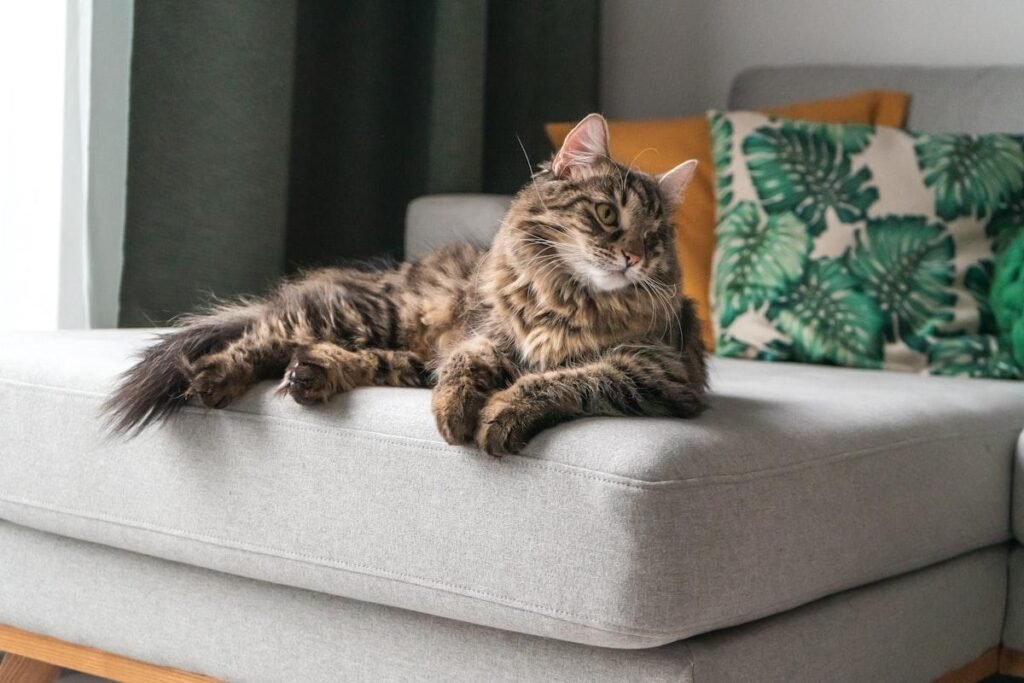
Rub the couch with dry rubber first, then vacuum. That single change in order does more than any gadget you can buy, because a vacuum alone glides over hair that static and friction have worked into the weave.
Most guides hand you a list of nine tools and let you figure out the sequence yourself. The sequence is the whole trick. A rubber glove, a squeegee, or a silicone brush drags embedded hair to the surface and balls it into rolls; the vacuum then earns its keep on what’s left in the seams.
If you share your home with a heavy shedder, a Maine Coon or a Lab, you already know the guest-panic moment: someone texts “be there in 20” and the sofa looks felted. This is the routine for exactly that moment, plus the boring weekly habit that keeps you out of it.
Why vacuuming first is the mistake almost everyone makes
Vacuum suction pulls straight up, but shed hair doesn’t sit straight up. It lies flat, hooked into the fabric by its scales and pinned there by static charge, so the airflow slides right over it.
Watch what happens after a vacuum-only pass on a woven sofa. The loose surface fluff disappears, the couch looks better for about a day, and the embedded layer underneath stays exactly where it was.
That embedded layer is the real problem. Hair has a scaled outer surface that acts like a one-way barb, and every time someone sits down, the pressure works it deeper into the weave.
Friction breaks that grip in a way suction can’t. Rubber dragged across fabric generates a static charge that attracts hair while the physical drag unhooks the barbs, which is why a static-generating rubber edge outperforms a motor.
The fastest way to remove pet hair from couch fabric
Work in four steps: a dry rubber pass in one direction, gather the rolls by hand, vacuum the seams and deck, then finish with a barely damp cloth. On a three-seat sofa this takes around ten minutes.
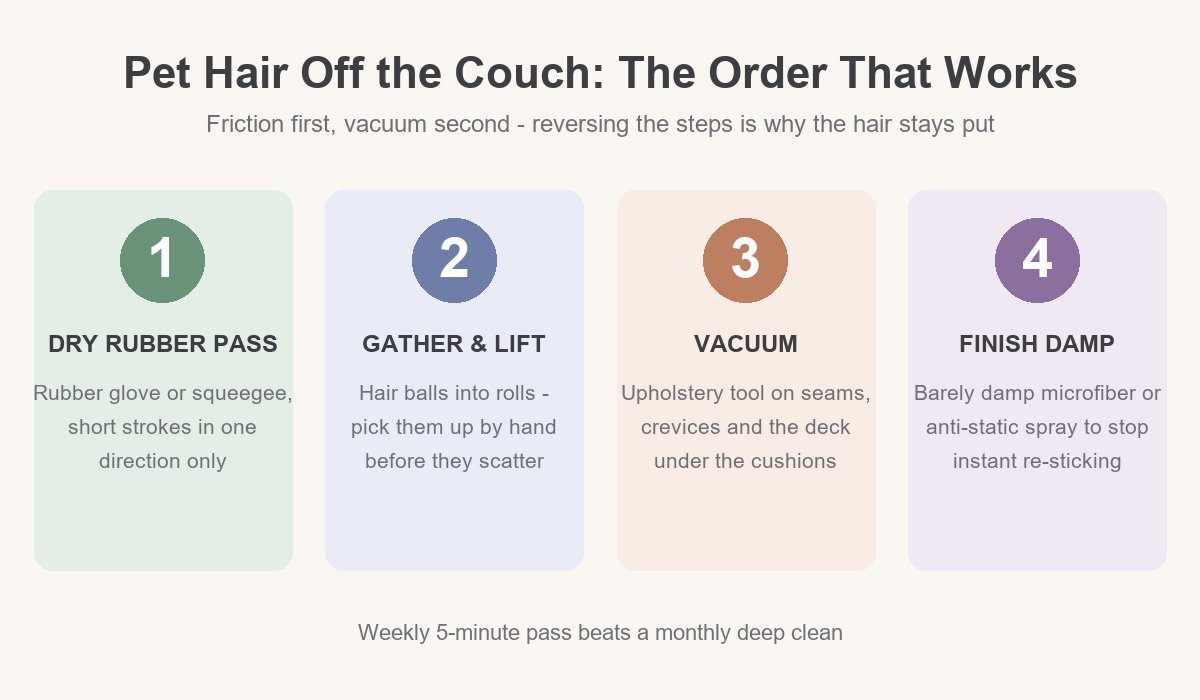
Step 1: the dry rubber pass. Put on a clean rubber dishwashing glove, or grab a window squeegee, and pull it across the fabric in short strokes, always in the same direction. Hair will ball up ahead of the edge into gray felty rolls.
Step 2: gather and lift. Pick the rolls up by hand as they form, before they scatter or re-stick. Herding everything toward one corner of the cushion makes this faster.
Step 3: vacuum what friction can’t reach. Now the upholstery tool matters: run it along seams, piping, tufting buttons, and the deck under the cushions, where treats and hair collect in equal measure. This is also when you flip the cushions.
Step 4: finish damp. Wipe the surface with a microfiber cloth that’s wrung out almost dry, or mist lightly with an anti-static spray. This kills the charge you just created, so airborne hair doesn’t land and stick within the hour.
No anti-static spray in the house? Mix about a cup of water with a teaspoon of liquid fabric softener in a spray bottle, shake, and mist from roughly a foot away. It does the same job for pennies, though skip it on velvet and anything with an S-only cleaning code.
Dampen the glove slightly for round two if your first pass leaves stragglers. Wet rubber grips finer undercoat fuzz that a dry pass misses, though it can streak some fabrics, so test a hidden spot first.
Match the tool to your couch fabric
The right tool depends on the weave, not the brand. Tight microfiber releases hair easily and needs almost nothing; loose linen weaves and boucle hold hair like Velcro and punish anything abrasive.
| Couch fabric | Best first pass | Avoid | Why |
|---|---|---|---|
| Microfiber / microsuede | Rubber glove or dry sponge | Stiff brushes | Hair sits on the surface; light friction lifts it in seconds |
| Tight cotton or poly weave | Squeegee or silicone brush | Pumice stones | Barbs hook into the weave; a firm rubber edge unhooks them without wear |
| Linen and loose weaves | Damp rubber glove, gentle strokes | Squeegees, lint shavers | Aggressive edges pull threads and pill the surface |
| Velvet / chenille | Lint roller, then glove with the nap | Anything against the nap | Crushed pile shows every stroke direction permanently |
| Leather / faux leather | Damp microfiber cloth | Rubber friction tools | Hair doesn’t embed; static tools just push it around |
Not sure what your weave is? Check the tag under the seat cushion: a W or W/S cleaning code usually means a sturdy synthetic weave that tolerates a squeegee, while an S code (solvent-only) points to delicate fibers that deserve the gentle-glove treatment.
One warning from the loose-weave column: pumice stones show up in cleaning listicles because they work fast on carpet stairs. On upholstery they shave fibers along with hair, and the damage doesn’t show until the third or fourth session.
When the hair is already embedded deep
Embedded hair needs more contact pressure and repetition, not a stronger vacuum. Work small sections with a damp rubber edge, stroke the same patch several times, and accept that a badly felted couch takes two sessions.
This is the situation people land in after months of vacuum-only cleaning. One r/housekeeping poster described it exactly:
“How would i go about removing dog hair from my sofa. It was way worse I vaccumed it with a shop vac and went over it with a lint roller this is the best i could get. The rest is embedded.”
– r/housekeeping, July 2025 (6 upvotes)
A shop vac plus a lint roller is a lot of effort aimed at the wrong layer. For that couch, the fix is a damp nitrile or rubber glove worked in overlapping strokes, section by section, with the hair rolls lifted off between passes.
For removable cushion covers there’s a shortcut: ten minutes in the dryer on air-only or the coldest setting, with a dryer sheet. The tumbling loosens embedded hair into the lint trap, and the sheet cuts the static so less of it re-attaches when the cover goes back on.
Clean the lint filter immediately after, because it will be shocking. Do this before washing covers, not after; a wet wash sets loose hair into the fabric and coats your washing machine drum with it.
Lint rollers, the ChomChom, and the gadget question
Reusable rubber-and-bristle rollers like the ChomChom are the one gadget category that genuinely earns space in the living room, because they combine the friction pass and the pickup step into a single motion.
Sticky lint rollers still have a place, but it’s a small one: velvet naps, last-second touch-ups, the arm of the sofa before a photo. As an everyday tool they lose on cost and on sheer waste, and plenty of pet owners have soured on them for exactly that reason:
“I have been using lint rollers and I kind of hate it because of the waste. I have one of these things but it just doesn’t seem like it could compete with the lint roller”
– r/Catownerhacks, April 2026 (12 upvotes)
That second sentence is worth taking seriously, though. Reusable rollers reward a specific technique: short, brisk back-and-forth strokes with real downward pressure. Used in long lazy sweeps they underperform a $2 sticky roller, which is how they end up abandoned in a drawer.
Do you need one if you already own rubber gloves? No. The roller is more pleasant to use and traps hair in a chamber instead of leaving rolls to pick up, but the glove you already own does the same physics for free. Buy the roller when the habit sticks, not before.
Skip the mini lint shavers and battery-powered fur wands for upholstery. Shavers are built for pilled sweaters, and on a couch they remove fabric surface along with hair.
Keeping hair off between cleanings
Prevention comes down to two boring moves: a washable blanket on the favorite spot, and brushing the animal a few times a week so the undercoat lands in a brush instead of the cushions.
Neither is glamorous, and neither will make the couch hair-free. They just shift most of the problem onto a piece of fabric you can shake outside and throw in the wash.
Wash the pet’s own bed on the same schedule. A saturated pet bed sheds hair into the air of the whole room, and a fair share of it drifts back down onto the sofa you just cleaned.
Winter makes everything worse, and it isn’t your imagination. Heated indoor air drops the humidity, dry air builds static, and static is the glue that bonds hair to upholstery; running a humidifier to around 40 to 50 percent noticeably slows how fast the couch re-coats itself.
I keep a rubber glove in the coffee-table drawer for exactly this reason. The tool you can grab during a commercial break gets used; the fancy roller in the hall closet does not.
FAQ
How do you remove pet hair from a couch without a vacuum?
Drag a dry rubber dishwashing glove or window squeegee across the fabric in one direction until the hair balls into rolls, pick the rolls up by hand, then wipe with a damp microfiber cloth. A vacuum only speeds up the seams, not the surface.
Do dryer sheets really get pet hair off a couch?
A used dryer sheet rubbed over the fabric picks up light surface hair and reduces the static that makes new hair stick, but it won’t lift embedded hair. Treat it as a finishing wipe after a rubber pass, not a standalone method. Some sheets leave residue, so test a hidden spot on delicate fabric first.
How often should I de-hair the couch with a heavy shedder?
Once a week for most pets, twice during spring and fall coat-blow season for double-coated breeds and long-haired cats. A weekly five-minute rubber pass stays a five-minute job; skipping a month turns it into a two-session recovery project because sitting pressure keeps driving hair deeper.
Do robot vacuums or air purifiers reduce hair on the couch?
Indirectly, yes: both cut the amount of loose hair floating around the room, which is where much of the couch layer comes from. Neither touches the upholstery itself, so they shrink the weekly job rather than replace it. An air purifier near the sofa helps most in dry winter months when static pulls airborne hair straight onto fabric.
Is long cat hair harder to get off a couch than short dog hair?
Long hair is easier to lift but far more visible, while short coarse hair, like a Lab’s, weaves into fabric like tiny needles and clings hardest. Long-haired cats also drop fine undercoat fuzz that dry rubber misses, which is where the slightly damp second pass earns its place.
The honest answer to couch hair isn’t a better product, it’s proximity. Whichever tool you pick, a glove, a squeegee, or a roller, keep it within arm’s reach of the sofa; the five-minute pass you’ll actually do every week beats the deep clean you keep postponing.