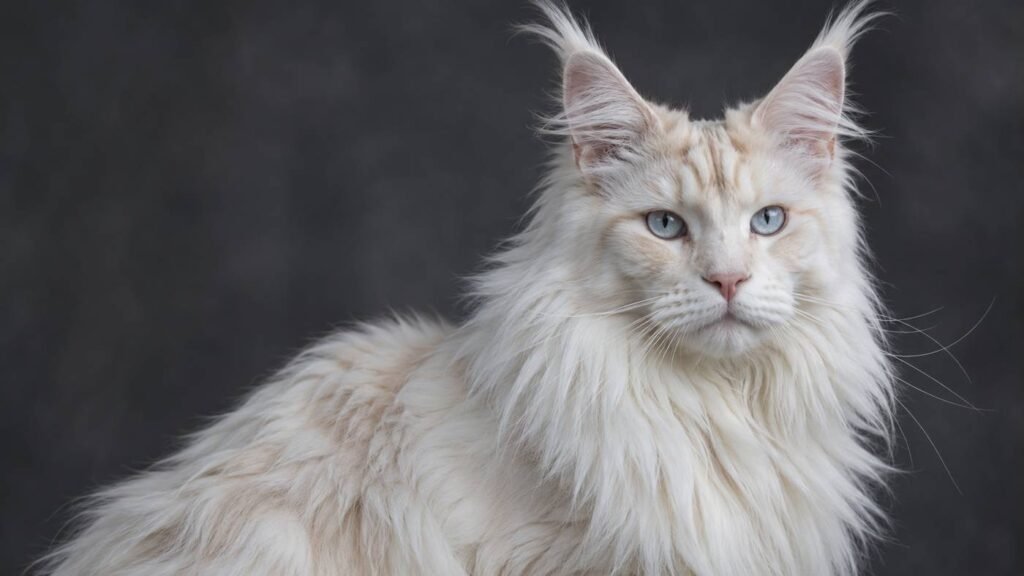
A blue eyed Maine Coon is either a cat with white in its coat, where the breed standard permits blue, or a cat carrying a dominant PAX3 variant that registries now treat as a breeding concern. Which of the two you are looking at decides what the eye colour means for the cat’s hearing and for its price.
The distinction is invisible in a photograph. A blue eyed Maine Coon photographed against a dark background can be a solid white kitten from an ordinary litter or a non-standard cat from a line built specifically for the trait. The coat, the pedigree and one hearing test separate them.
Do Blue Eyed Maine Coons Meet the Breed Standard?
Partly. The CFA Maine Coon standard lists eye colour as green, gold, green-gold or copper, and permits blue or odd eyes only on white cats and cats with white. A blue-eyed cat in a solid or non-white colour therefore falls outside the standard by definition.
The exact wording of the CFA standard reads: “eye color can be shades of green, gold, green-gold or copper. White cats and all cats with white may have blue or odd eyes.” The second sentence does a lot of work. It covers solid whites, bicolours, vans, and any cat with enough white on the face or body to qualify, and it covers odd eyes, where one iris is blue and the other green or gold. The full CFA scoring breakdown for the Maine Coon shows how small the eye line is within the 100-point total, which explains why breeders with a blue-eyed line can keep showing cats that lose nothing else.
What the clause does not do is make every blue eye acceptable. A blue-eyed black Maine Coon, a blue-eyed tabby, or a blue-eyed smoke has no route to the standard through coat colour, because the standard attaches the blue permission to white markings rather than to the eye itself.
Why a White Coat Usually Comes With the Blue
White markings stop pigment from reaching the coat, and the same pigment cells feed the inner ear. A cat that inherits enough white to mask its coat colour often inherits blue irises as well, so the two arrive together without a separate eye-colour gene being involved.
That shared origin is why a white Maine Coon with blue eyes carries a hearing risk its colour-sighted siblings do not. FIFe’s Maine Coon breed council names deafness and Waardenburg syndrome among the risks it wants blue-eyed cats screened for, and it added DBE testing to the recommended health panel for blue-eyed Maine Coons at the start of 2025. The clause in the CFA standard that permits blue on white cats is a colour allowance, not a health clearance.
Waardenburg syndrome appears in searches beside this topic often enough to be worth separating. FIFe names it, together with deafness, among the risks it wants blue-eyed Maine Coons screened for. In cats the term describes a set of signs arriving together, a white or white-marked coat, blue irises and hearing loss, so it describes the pigment route rather than offering a single test of its own. A genetic test tells you which PAX3 variant a cat carries. A hearing test tells you whether that cat can hear.
Owners of white cats describe the practical side of this better than a breed standard can.
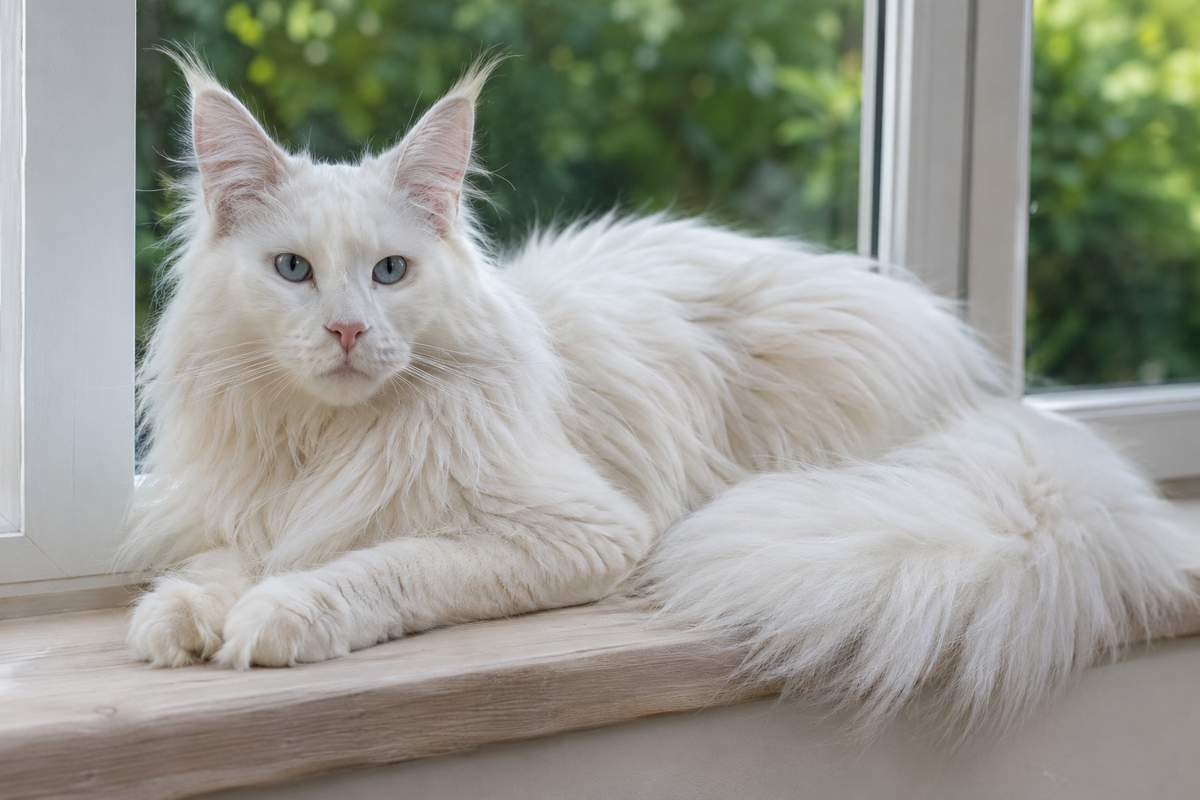
“Vet tech here- I wouldn’t let the eye color deter you from getting a cat. White cats are indeed known to be prone to deafness if they have blue eyes (but even then, not always), but there aren’t any confirmed links in other cats with blue eyes.”
– r/MaineCoon, 31 upvotes
When Blue Eyes Appear Without White: Dominant Blue Eyes
Dominant blue eyes is a PAX3 variant that produces blue irises in cats with little or no white, and it passes to roughly half of a carrier’s kittens. Five separate Maine Coon lines have been identified so far, which is the fact that changes how a test result should be read.
The most recent genetic study of the trait, published in 2025, names the lines as Rociri Elvis, Pillowtalk-Foreigner, Topaz, Nahal, and a fifth, the Agostino line, described there for the first time. In that last line the researchers found a new variant, a deletion called PAX3:c.160del, and confirmed that it segregated as an autosomal dominant trait: thirteen carriers, fourteen cats from the same line without the deletion, no ambiguity. The same deletion did not appear in 348 genomes from the 99 Lives dataset, including 26 Maine Coons, so its presence in a cat points to a specific line rather than to the breed as a whole.
Registries treat the trait as a health matter rather than a colour. FIFe’s Maine Coon breed council states that it “resolutely recommends for all time not to use any DBE cats in breeding programs”, and asks breeders to consider the trait when planning around lines that have carried it in the past. The veterinarian quoted in FIFe’s paper, Leslie Lyons, identified PAX3:c.937C>T as the most likely variant behind the trait in the line she studied, and tied it to deafness and minimal white spotting in the same sentence.
Fife has not banned these cats from the show bench. The recommendation is aimed at breeding, and the distinction matters if you are buying a pet rather than a queen.
“Non standard blue eyed Maine Coons are more and more popular, despite what one can think about it, it is a reality, like or not. I personally don´t but it is what it is. If you like them eyes blue, make sure you receive a legit BAER test of the kitten you wan…”
– r/mainecoons, 16 upvotes
Does a Blue Eye Mean a Maine Coon Will Go Deaf?
Not by itself. Deafness tracks the specific PAX3 variant and the line behind the cat rather than the iris colour, and the same study records a line where eight blue-eyed cats tested deaf and ten later cats from that line, six of them blue-eyed, heard normally.
Every one of those first cats carried PAX3:c.937C>T, and all eight failed a BAER test. That test measures whether the ear actually signals the brain, and it is the only routine check that can. The result then spread through breeder forums as a rule about blue eyes in general, which it was never meant to be. When researchers returned to the same line and tested again, nothing changed for the cats that heard: six more DBE cats and four cats without the trait all passed. Two of them were carriers with no blue eyes at all, which is the part most useful to a buyer, because it means the eye marks the trait without always showing it.
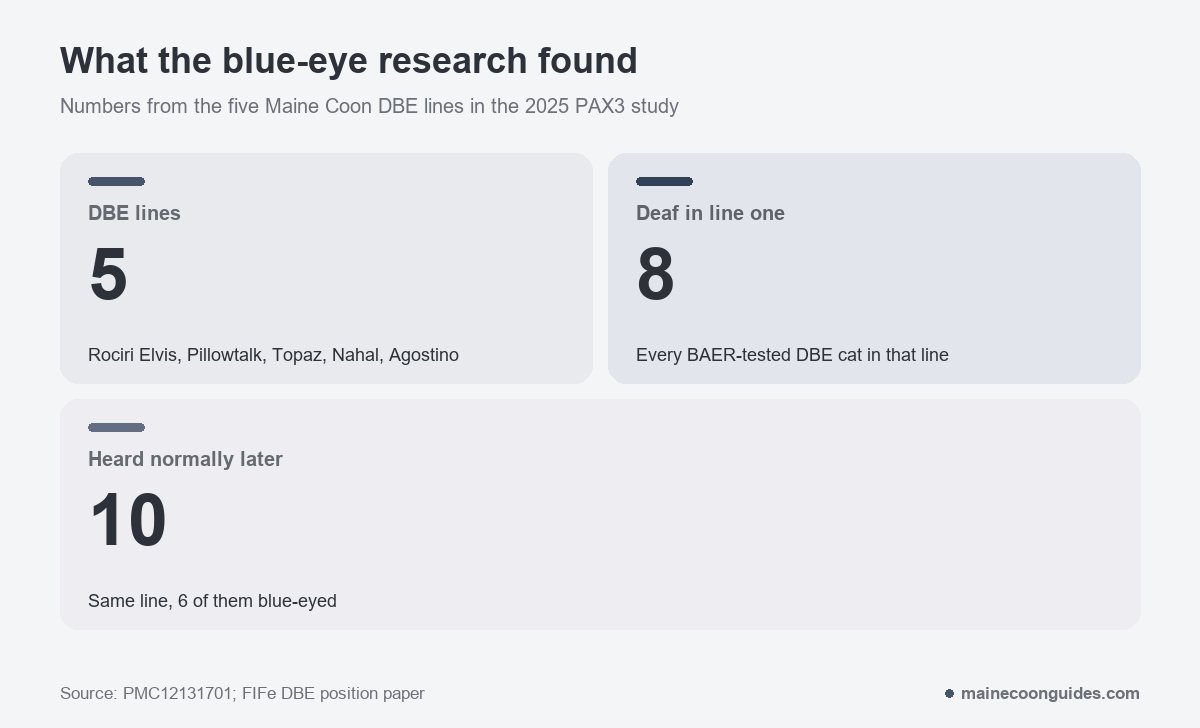
The five lines do not behave identically. No deafness has been reported in the Agostino cats, but the study also records that none of them had BAER testing, so the absence of a report is not the absence of risk. Heterozygotes in the Celestial and Altai variants have not shown deafness, while cats carrying two copies, or carrying more than one variant, have.
What that means in practice depends on which of the four situations you are in.
| What you are looking at | Within the CFA standard | What the eye usually signals | What to ask for |
|---|---|---|---|
| White or heavily white kitten, blue or odd eyes | Yes | Pigment-suppressing white, with the hearing risk that goes with it | A BAER test result, not a verbal assurance |
| Solid, tabby, smoke or tortie kitten with blue eyes | No | A dominant PAX3 variant, from one of the five known lines | The variant name, the line, and a BAER result |
| Kitten under about two months old | Depends on coat | Nothing yet, since iris colour has not settled | Wait, then look again at the colour |
| Adult cat with one blue eye | Yes if white is present | Odd eyes, or pigment loss in one iris | A vet check if the change is recent |
A kitten that flinches at a door slamming is not proof of normal hearing, because one working ear produces the same startle as two.
The BAER test is the only routine check that separates partial from complete hearing loss, and it is the one question worth insisting on when a litter is priced on its eyes.
Blue Coat, Blue Eyes: Two Different Things
In cat terminology, blue means a diluted grey coat and has nothing to do with the iris. A listing that calls a kitten a blue Maine Coon is describing its fur, so a blue Maine Coon and a blue eyed Maine Coon can be different cats, with different prices, sold under the same four words.
The grey coat is a standard colour and behaves like any other accepted colour. Blue eyes are the exception, allowed in narrow circumstances and doubted in others. Buyers who compare a “blue Maine Coon” listing against a “blue eyed Maine Coon” listing are comparing a coat with an eye, and the premium attached to the second one is a premium for a trait the breed council advises against breeding for. What a Maine Coon kitten actually costs in a given market is a separate question, and the price ranges from named catteries move for reasons that have little to do with iris colour. If the coat is what you are after, the grey coat has its own colour genetics and its own range of shades, from pale silver to a slate that reads almost charcoal.
Blue Eyed Maine Coon FAQs
Are blue eyes rare in Maine Coon cats?
Yes, blue eyes are unusual in this breed because the standard allows them only on white or white-marked cats. A blue eye on a solid or tabby Maine Coon comes from a dominant variant that appeared in a handful of lines, not from the breed’s normal colour range.
Are there any Maine Coon cats with blue eyes?
Yes. White Maine Coons and cats with substantial white markings can have blue or odd eyes and stay within the standard. Cats in other colours can have blue eyes too, but those carry a PAX3 variant that registries now advise against breeding from.
What is the rarest colour of Maine Coon?
No registry publishes a rarity ranking, so the honest answer is that nobody keeps the count. Eye colour gets confused with coat colour in this query, and the two are decided by different genes, which is why a rare-looking eye and a rare coat are separate questions.
How much does a blue Maine Coon cost?
A grey kitten from a named cattery sells in the same band as other accepted colours, and the figure moves with the cattery and the region rather than the shade. Sellers do charge more for a dominant blue eye, which is a premium for a trait under breeding advice.
Before the eye colour, ask what it is attached to: a coat that earns it, a line that explains it, and a test that measures it.