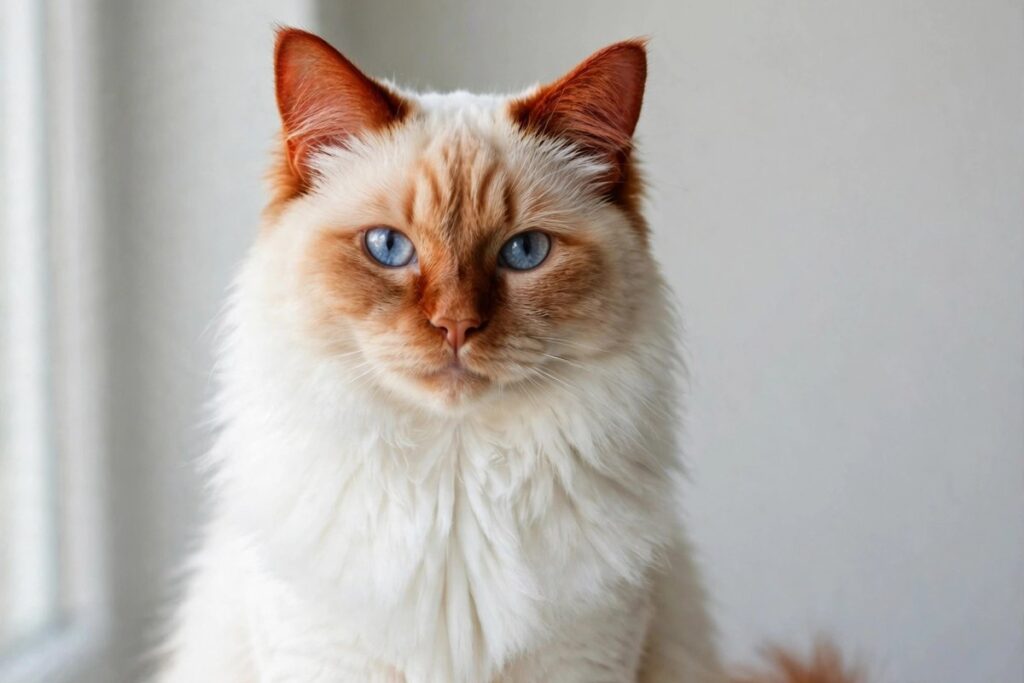
A flame point Ragdoll is a red point Ragdoll. CFA lists red as one of six accepted point colors for the breed, with seal, blue, chocolate, lilac and cream. The body is white, the points run from apricot to deep red, and the eyes are blue.
Flame point is the red point in the breed standard
The CFA Ragdoll standard does not use the word flame. Its color clause names “the six point colors … seal, blue, chocolate, lilac, red and cream,” then allows each as a solid point, a lynx point (including tortie-lynx) or a parti-colored point. Red is not a fault, a cross-breed accident or a designer label. It is one of the six colors the breed is judged in.
The everyday term comes from the Siamese world, where red points were compared with a flame. Both words point at the same cat. Red names the pigment; flame names what the pigment looks like against white.
Red sits inside the same four patterns as every other Ragdoll: colorpoint, mitted, bicolor and van. The pattern decides how much red survives the white overlay.
What a flame point Ragdoll looks like
CFA’s red point clause is compact and specific. “Body clear white with any shading in the same tone as points. Points: bright apricot to deep red, deeper shades preferred, with lack of barring desirable. Eye color: blue. Nose leather and paw pads: flesh or coral pink.”
Four details separate a good flame point from a near miss: depth of the point color, the absence of dark pigment, a clean white body and blue eyes. Deeper red is preferred, and faint barring is tolerated in kittens. An adult whose points carry clear stripes is a red lynx point, not a red point.
Kittens arrive white or nearly white. Color develops on the cooler extremities first, and CFA states that full color is achieved after two years of age. The same standard notes that Ragdolls generally darken with age, a line that matters to anyone buying an eight-week-old kitten photographed under warm light.
“share pictures of your fully grown flame points!! my little guy is 7 months”
A pale ten-month-old is not necessarily a cream point, and a twelve-month-old with sharp contrast is not finished.
Why flame is X-linked: the 2025 finding
A 2025 study in Current Biology traced the orange coat to ARHGAP36, a gene on the X chromosome. A 5.1-kilobase deletion inside one of its introns is “closely and exclusively associated with orange coloration.” That location is why flame inherits differently in males and females.
For decades the orange locus had been mapped to the X chromosome without a gene attached to it. The study (Toh et al.) adds that the deleted segment holds a conserved regulatory element, and that ARHGAP36 expression in cat skin is linked to suppression of many melanogenesis genes, which would shift pigment production from black-brown eumelanin toward red-yellow pheomelanin.
The tortoiseshell detail is what makes the finding convincing. In a female cat, one of the two X chromosomes is switched off at random in each skin cell. Where the orange copy stays active the patch grows red; where it is silenced the patch grows dark. The paper ties ARHGAP36 to that inactivation pattern in female cats. A tortie is not a blend. It is a mosaic.
The inheritance rule follows from the chromosome count, and it answers the question that sends people to forums: do both parents need to carry the flame gene? A male kitten has one X, from his mother. He is flame if that X carries the deletion, and he cannot carry it unseen. A female kitten has two X chromosomes, one from each parent. She is flame only when both carry it; with one copy she is a tortie, and with none she is seal, blue, chocolate or lilac.
The father’s color therefore reaches his daughters and never his sons. That asymmetry produces the table below.
| Parents | Sons | Daughters |
|---|---|---|
| Flame male x any female | Not flame, unless the mother passes orange | Flame if the mother passes orange; otherwise tortie |
| Flame male x tortie female | Half flame, half not | Half flame, half tortie |
| Flame male x flame female | All flame | All flame |
| Non-orange male x flame female | All flame | All tortie |
| Non-orange male x tortie female | Half flame, half not | Half tortie, half non-orange |
Read the middle column: a flame father passes a Y to his sons, so his color stops there. A flame male can be born to a mother who is not flame herself. She only has to carry one copy, and in a pointed breed that copy usually shows as a tortie point rather than hiding. The gene is not Ragdoll-specific: the same locus underlies orange coats across the orange cat breeds, from tabby Maine Coons to flame point Siamese.
One qualification sits outside the table. Every Ragdoll is pointed, so the orange locus produces flame points rather than a solid red cat. The orange gene decides which pigment; the pointed gene decides where it lands.
Flame vs cream vs tortie point
Three names, three different cats. Flame is red at full strength: apricot to deep red, no dark patches. Cream is the dilute version of the same pigment. CFA calls cream points “pale buff cream to light pinkish cream,” and the two are easy to confuse in a young kitten, which is why point depth and the parents’ colors matter more than a single photo.
A tortie point has both red and a darker color, usually seal or blue, in separate patches on the same cat. The boundary is usually ragged rather than blended. A red lynx point adds tabby bars inside the red. None is a flame point with a flaw; CFA judges them under separate clauses.
The commonest mislabel is a dark-pointed cat sold as flame because of warm brown patches. Solid dark areas mean a tortie point; stripes mean a red lynx point. A flame point may fade, but it has no dark islands.
Flame point in each of the four patterns
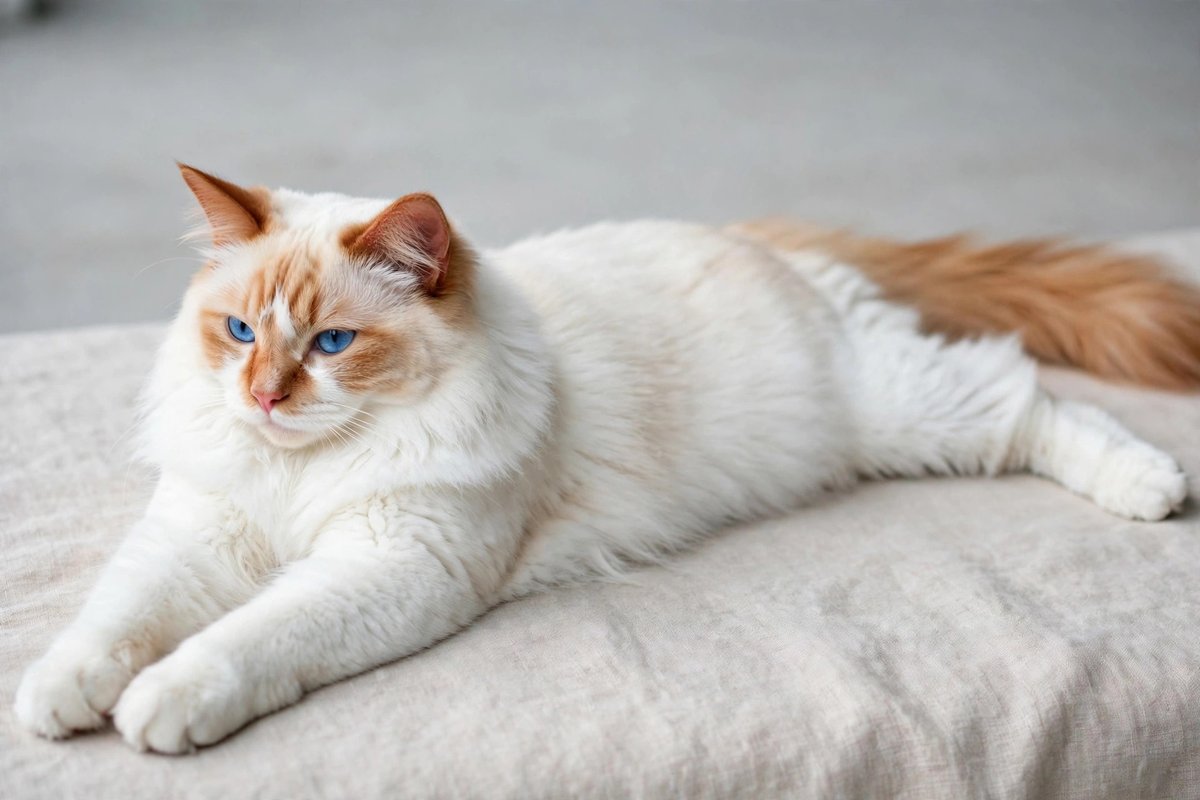
Colorpoint is the plainest version: no white anywhere, with the red restricted to mask, ears, legs and tail, and any white spot a disqualification. Mitted adds white mittens on the front feet, white boots behind and a white chin that must extend into the belly stripe. Bicolor adds an inverted white V on the face, white legs and a white underside, and can leave only the ears, tail and part of the mask red. Van pushes the white further, leaving color mostly on the head and tail.
Flame point Siamese and Maine Coon mixes
The flame point Siamese carries the same orange locus in a different breed. Siamese and Ragdoll share the pointed pattern, so a red point cat of either breed looks similar at a glance: white body, red extremities, blue eyes. A Ragdoll-Siamese mix can inherit the pointed pattern from both sides, which is why flame point kittens turn up in that cross with some regularity.
Maine Coon crosses are a different matter. Red is an accepted Maine Coon color, but the Maine Coon is not a pointed breed: its red appears over the body, usually with tabby pattern, rather than on the extremities alone. A kitten sold as a flame point Maine Coon is usually a mix with a pointed breed, or a red tabby given a marketing name. Neither is a CFA color variety of the Maine Coon.
Where the Maine Coon fits
The orange locus works the same way in a Maine Coon, and red females still need two copies. What differs is distribution and scale.
Readers usually arrive at flame points from the other direction: they have a red Maine Coon, or they are choosing between the two breeds. A red Maine Coon is a large, square-jawed cat wearing red across the body; a flame point Ragdoll is a softer, longer cat wearing it only at the edges. The Maine Coon vs Ragdoll comparison sets the two side by side, and the Maine Coon colors guide explains what red looks like once tabby pattern is involved.
Is a flame point Ragdoll rare? What sets the price
Flame is one of six standard colors, so the color itself is not rare. What people usually mean is the flame female, which needs an orange X from each parent: a flame father and a mother with at least one copy. A flame son needs one orange X, from his mother.
No registry publishes a color census, so any ranking of the rarest Ragdoll color is a breeder’s impression rather than a standard. What can be said with evidence is narrower: among the six accepted colors a flame female is the hardest to produce deliberately, and a tortie female is the by-product of the same pairing.
“Does anyone have flame point female ragdoll ? I heard that it’s very rare?”
Price follows supply, but supply is only one input. Registration and pedigree, health testing for HCM, PKD and FeLV/FIV, pattern (a well-marked bicolor takes more selective breeding than a colorpoint), show quality, breeder reputation and waiting lists, and the local market all move the number. A flame point is not automatically dearer than a seal point; a well-bred one is dearer than a poorly bred one in any color.
Flame point Ragdoll: FAQ
Is a flame point Ragdoll rare?
The color is not rare; flame females are uncommon because a female needs two copies of the orange gene. Flame males need one, so they appear more often in litters. CFA recognizes red as one of six standard point colors.
How much does a flame point Ragdoll cost?
There is no registry price. Cost depends on pedigree and registration, health testing, pattern and show quality, breeder reputation, waiting list and region. A flame point is not inherently more expensive than another standard color.
What is the rarest color Ragdoll cat?
No registry ranks colors by frequency, so no evidence-based rarest color exists. The claim usually refers to a flame female, the hardest of the standard combinations to produce on purpose.
How can you tell a flame point Ragdoll?
White body, apricot-to-red points on mask, ears, legs and tail, blue eyes, and pink nose leather and paw pads. No dark patches and no clear barring separate it from a tortie point and a red lynx point.
Do both parents need to carry the flame gene?
For a flame daughter, yes: she needs an orange X from each parent. For a flame son, only the mother matters. A male cannot carry the gene without being flame, and a father passes his X only to daughters.