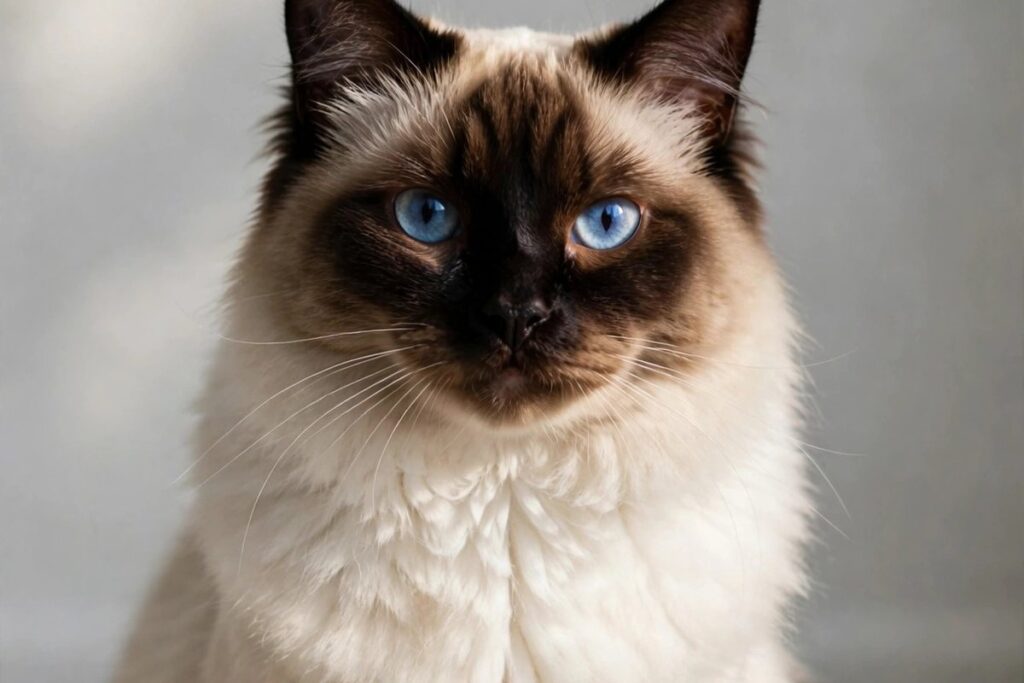
The CFA Ragdoll standard lists six point colors (seal, blue, chocolate, lilac, red and cream) and four patterns: colorpoint, mitted, bicolor and van. Points can be solid, lynx or tortie, and every Ragdoll is a pointed cat with blue eyes.
Ragdoll colors and patterns work in two layers. The point color sets what the ears, mask, legs and tail look like; the pattern sets how much white sits on top. Read them in that order, and a cat that looks like an unfamiliar type usually turns out to be a familiar color in a different pattern.
The rule every Ragdoll follows: pointed coat, blue eyes
The CFA Ragdoll standard describes the breed as “a medium to large, moderately longhaired, blue-eyed pointed cat” and notes that “the point markings may be covered by a range of white overlay patterns.” The pointed part is not optional. A Ragdoll carries the colorpoint gene, so the body stays lighter than the face, ears, legs and tail, and the eyes are blue at every age.
The disqualification list makes the boundary plain: “body and point color other than those listed; eyes other than blue.” A solid black cat cannot meet it. Black points on a black body leave no contrast, and black is not one of the six colors. Cats sold as black Ragdolls are usually very dark seal points, which the standard expects older Ragdolls to become, or cats with mink or sepia coloring that sits outside the breed standard. Black Ragdoll cats are a real search topic and a common mislabel; they are not a CFA variety.
- Point colors: six, from seal to cream
- Patterns: four, from colorpoint to van
- Point variations: solid, lynx, tortie, including tortie-lynx
- Eye color: blue only; any other color disqualifies
- Coat: moderately long, with minimal woolly undercoat
The 6 point colors, and what each one looks like
The standard settles the list in one sentence: “the six point colors are seal, blue, chocolate, lilac, red and cream.” Each entry also describes the body tone and the nose leather, which is often the fastest way to tell two similar colors apart.
Seal is the darkest of the six, with deep seal-brown points on a body that runs from pale fawn to cream. Blue is the dilute of seal: deep blue points on a bluish-white body, with slate nose leather and paw pads. The two are the pair buyers most often mix up in photographs.
Chocolate has warm milk-chocolate points on an ivory body, with cinnamon-pink nose leather. Lilac is its dilute, frosty grey with a pinkish tinge on a white body, and its nose leather is lavender-pink. Lilac and blue Ragdolls can look close in a photo, and the nose and paw pads settle it more reliably than the coat does.
Red is bright apricot to deep red on a clear white body, with flesh or coral-pink nose leather; the standard prefers deeper shades and dislikes heavy barring. Cream is the dilute, pale buff to light pinkish cream, again on white. Both are warmer and lighter than the four brown-based colors, and both show barring more readily.
Colors outside that list, such as cinnamon and fawn, appear in breeder listings but not in the CFA standard. The standard disqualifies any body or point color “other than those listed,” so a cinnamon Ragdoll falls outside the six, however real the cat is as a pet.
The 4 patterns: how much white, and where
Pattern is the white overlay, and the CFA breed page notes that “three of the four Ragdoll patterns also have the bicolor gene,” while the four patterns themselves differ in where white is allowed and how much of the body it may take.
Colorpoint has no white at all. The ears, mask, feet and tail carry the point color against a contrasting body, and the nose leather and paw pads are fully pigmented. The standard disqualifies “presence of any locket or white spot anywhere on cat’s body,” which makes this the easiest pattern to confirm and the easiest to misjudge in a bad photo.
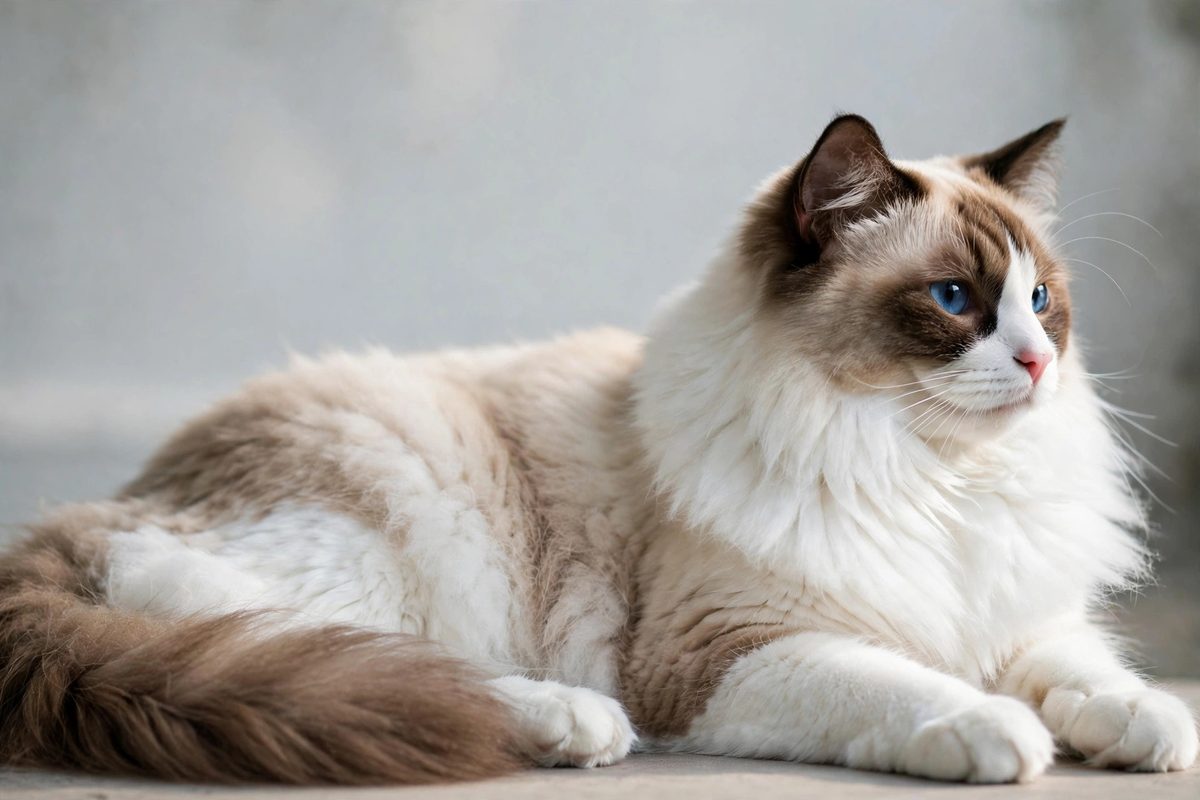
Mitted adds white feet plus a white chin. Front feet carry white mittens that match each other and reach about the wrist; back legs carry white up to the hocks, no higher than mid-thigh. The chin must be white and continue into a belly stripe, and a symmetrical blaze from nose to forehead is allowed. A mitted Ragdoll with no white chin is disqualified, so the chin is the check that matters.
Bicolor puts a white inverted V on the face. The V must stay inside the outer edge of the eyes, the nose leather is pink, and the chin, chest and underside are white. Legs and feet are white, preferably all the way, and minor dark spots are tolerated. A V that runs past the eyes or is badly asymmetrical is penalized; a missing V, or dark spotting inside it, is a disqualification, as is a large dark area on any leg.
Van is the highest-white pattern: point color restricted to the ears, tail and mask, with the body, legs and feet pure white. More than twenty percent color on the body is penalized, and total absence of point color on the head or tail is a disqualification. Van is the pattern most often confused with a mismarked bicolor in casual listings.
Lynx and tortie: the point variations
Solid, lynx and tortie are variations on the points, not extra colors or a fifth pattern. The standard allows point colors that are “solid, lynx (including tortie-lynx); and parti-colored (or tortie).”
Lynx points carry tabby barring: distinct bars separated by a lighter background, with a paler thumbprint in the center of each ear. The barring reads on the mask, legs and tail, and a lynx point still needs the same blue eyes and body contrast as a solid point.
Tortie points are mottled, with red or cream mixed into the base color. The standard names seal-tortie, chocolate-tortie, blue-cream and lilac-cream, matching each to its solid base. Tortie-lynx adds both at once, barring under mottling, and the standard notes that these cats “resemble lynx points more than tortie points.”
The full matrix: 6 colors x 4 patterns
Put the two lists together and the naming rule falls out: color first, pattern second. Six colors across four patterns produce 24 base combinations, and each one takes a lynx or tortie modifier in front of the pattern name.
| Point color | Colorpoint | Mitted | Bicolor | Van |
|---|---|---|---|---|
| Seal | Seal colorpoint | Seal mitted | Seal bicolor | Seal van |
| Blue | Blue colorpoint | Blue mitted | Blue bicolor | Blue van |
| Chocolate | Chocolate colorpoint | Chocolate mitted | Chocolate bicolor | Chocolate van |
| Lilac | Lilac colorpoint | Lilac mitted | Lilac bicolor | Lilac van |
| Red | Red colorpoint | Red mitted | Red bicolor | Red van |
| Cream | Cream colorpoint | Cream mitted | Cream bicolor | Cream van |
With the three point variations, the standard’s own categories allow up to 72 named combinations, from seal colorpoint to cream tortie-lynx van. Not every combination appears often, and tortie cats are almost always female, but the naming logic holds across the matrix.
CFA show classes group the results differently: seal point and white, blue point and white, lynx point and white, all other pointed and white, mitted point colors, and colorpoint colors. The grouping is administrative, not a separate set of colors.
When a Ragdoll’s color is final
Ragdoll color is not final at eight weeks. The CFA standard puts full coat and color at about three years, the breed page puts full coat color at two, and the standard allows older Ragdolls to darken.
Two CFA pages give slightly different benchmarks. The standard says Ragdolls are “slow maturing, reaching full coat and color at about three years of age.” The breed page gives the shorter number most owners repeat: “reaching full coat color at two years, and full size and weight at four.” The standard’s mitted section repeats the two-year mark, with “full color achieved after 2 years of age.”
Read together, the three statements describe one curve. Point color is visible within the first weeks, deepens through the first two years, and keeps developing in coat and density until about three. The standard also allows “darker color in older cats as Ragdolls generally darken with age,” so a mature seal point is expected to look toastier than a two-year-old.
“What will my ragdoll look like when older!? Color development. Anyone have one that looked exactly the same as mine lol”
– r/ragdolls, December 2025 (399 upvotes)
That timeline changes how a kitten should be judged. An eight-week-old chocolate or lilac can still read almost white, and a bicolor’s V can be faint at that age. The honest check is the point color at the ears, the nose leather and the paw pads, not the body shade in a phone photo.
Ragdoll vs Maine Coon colours
The Maine Coon is not a pointed breed, so its colors do not translate into Ragdoll terms, and blue eyes are not part of its standard. The Maine Coon standard accepts solids, tabbies, torties, calicos, smokes, shaded and bicolor cats across a wide palette that has no colorpoint category at all. A Maine Coon and a Ragdoll can share a color word without sharing the pattern underneath it.
A Ragdoll and Maine Coon mix inherits the pointed pattern only if both sides pass the colorpoint gene. That gene is recessive. Many mixes come out solid, tabby or bicolor, with no points at all, and their eye color can be anything the parent breeds allow. The Ragdoll Maine Coon mix is a pet population, not a color variety, and neither registry standard covers it.
The Maine Coon side of the palette follows the same registry-first method in the Maine Coon colors reference.
Ragdoll colors and patterns: FAQ
These are the questions that remain once the naming rule is clear.
What is the rarest Ragdoll color?
CFA does not rank its six colors by rarity, so “rarest” is a breeder and market label rather than a standard one. Chocolate and lilac are recessive, so a litter needs both parents to carry them, which makes them less common in listings. Tortie-lynx combinations are less common again. None of that changes a cat’s status under the standard.
Can a Ragdoll be grey and white?
Yes. Grey is the everyday word for blue in cat registries, so a blue point mitted or blue point bicolor is a grey and white Ragdoll. The points stay blue-grey, the white follows the pattern rules above, and the eyes remain blue.
What is the difference between a mitted and a bicolor Ragdoll?
Mitted keeps the dark mask and adds white mittens, white boots, a white chin and a belly stripe. Bicolor replaces much of the mask with a white inverted V and carries white up the legs. The standard’s disqualifications separate them cleanly: no white chin for mitted, no V or dark spots inside the V for bicolor.
Do Ragdoll kittens change color?
Ragdoll kittens are born with the point color still faint, because the colorpoint gene responds to body temperature, and the points darken as the kitten grows. CFA puts full coat color at two years and full coat and color at about three. A kitten’s color at eight weeks is a preview, not the final coat.
How many Ragdoll color and pattern combinations are there?
Six colors across four patterns make 24 base combinations. Adding solid, lynx and tortie as point variations brings the count to 72 named combinations, though some are rare and tortie cats are almost always female. CFA judges them in grouped color classes rather than as 72 separate varieties.