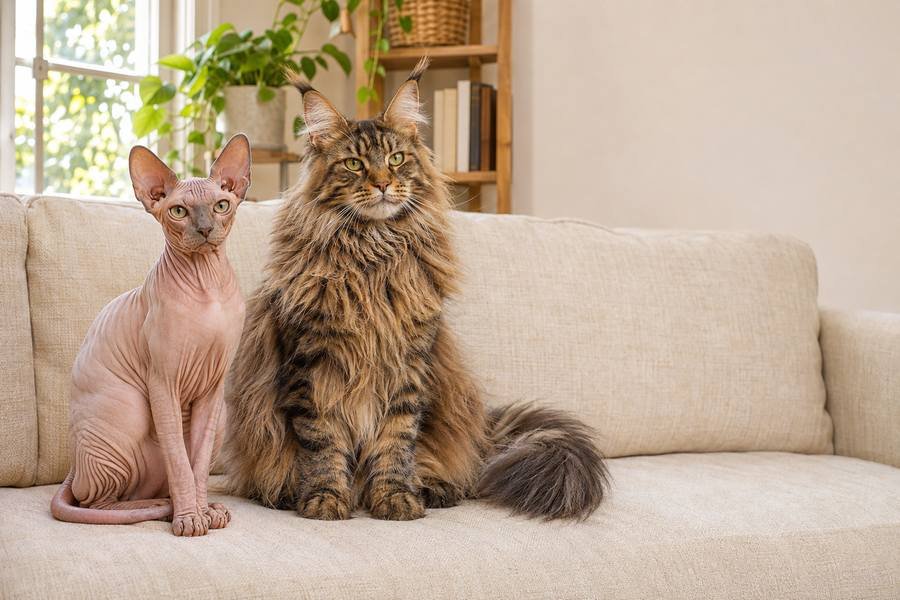
A Sphynx Maine Coon mix is almost never hairless. Hairlessness in the Sphynx is a recessive trait, so a first-generation kitten gets one normal coat gene from its Maine Coon parent and carries the hairless version without showing it. Expect a coated cat with a Sphynx somewhere in its family tree.
No cat registry recognises the cross, and it has no breed standard. That leaves you with the published records of the two parent breeds and some inheritance arithmetic to work from.
Why a Sphynx Maine Coon mix is usually coated
Sphynx hairlessness needs two copies of the same KRT71 variant, one from each parent. A Maine Coon is expected to pass on a working copy, so first-generation kittens carry a single hairless copy, and the UC Davis Veterinary Genetics Laboratory lists cats with one copy as having normal coats.
The variant is a splice-site change, written c.816+1G>A, in a keratin gene that works in the hair follicle. Gandolfi and colleagues described it in 2010 and found it only in Sphynx and Kohana cats among the breeds they tested, which is why a Maine Coon parent is expected to bring the normal version. The same study genotyped 34 Sphynx: 26 carried two copies of the hairless variant and 8 carried one.
| Situation | What each kitten receives | Hairless outcome |
|---|---|---|
| A Sphynx is bred to a Maine Coon | One hairless copy and one normal copy | Normal coat, carrier of the hairless variant |
| Two kittens from that litter are bred together | Each parent passes the hairless copy to 50 percent of its kittens | 25 percent hairless |
| A kitten from that litter is bred back to a Sphynx | Every kitten gets a hairless copy from the Sphynx, and half also get one from the carrier | About 1 in 2 hairless |
The first two rows come straight from the UC Davis description of carriers: a carrier passes the hairless copy to half of its offspring, and two carriers produce 25 percent hairless kittens. The third row follows from the same arithmetic.
The rule is not airtight. In the 2010 study, two hairless Sphynx carried only one copy of the variant and none of the other variants the team tested for, and the authors raised the possibility of other causes. That is why “almost never” is the accurate phrase and “never” is not.
The breed’s own history shows the same split. When the first hairless kitten, Prune, was born in Ontario in 1966 and bred onward, TICA records that some of the resulting kittens had hair and others did not.
Coat and skin: what a coated or sparse-coated kitten needs
The KRT71 test speaks only to hairlessness and the Devon Rex curl. How long, thick or curly a coated kitten turns out is outside what it predicts, and neither the TICA nor the CFA pages describe this cross, so any description of the adult coat is inference from the parents.
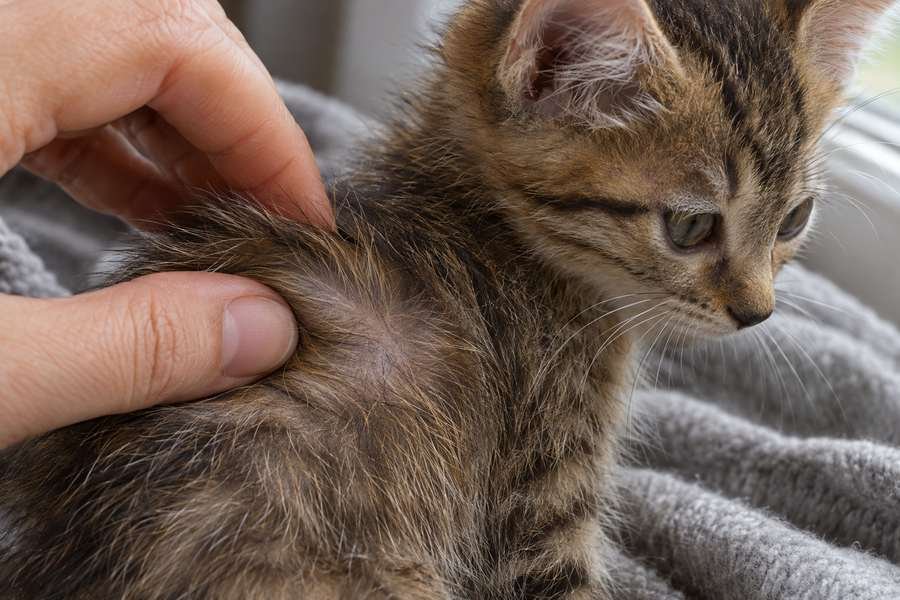
The Maine Coon side offers one real data point. TICA says a young Maine Coon kitten has a thinner and shorter coat than an adult, and that texture varies with colour and lineage, from cottony coats that need daily combing to silky ones that need less. Because a Maine Coon’s own coat changes between kitten and adult, judging a hybrid’s final coat at ten weeks is a guess. For the Maine Coon half of the coat, the Maine Coon shedding page is the place to start.
Skin care depends on how much coat there is. TICA notes that Sphynx tend to get oily because they have no absorbent coat, and it warns that over-bathing can push the skin to make more sebum, so a gentle shampoo every few months is its advice in place of the weekly baths many owners assume. A fully coated kitten has fur to take up its own skin oils. If bare skin shows through on yours, the Sphynx routine TICA describes is the closest published guide: weekly ear cleaning where the ears lack hair, protection from sunburn, and warmth in cool weather.
Where the two weight ranges meet
TICA lists adult Sphynx females at 7 to 10 pounds and males at 8 to 12 pounds. Its Maine Coon page gives 12 to 15 pounds for females and 18 to 22 for males, while the breed description lower on that page quotes 9 to 13 and 13 to 18 pounds.
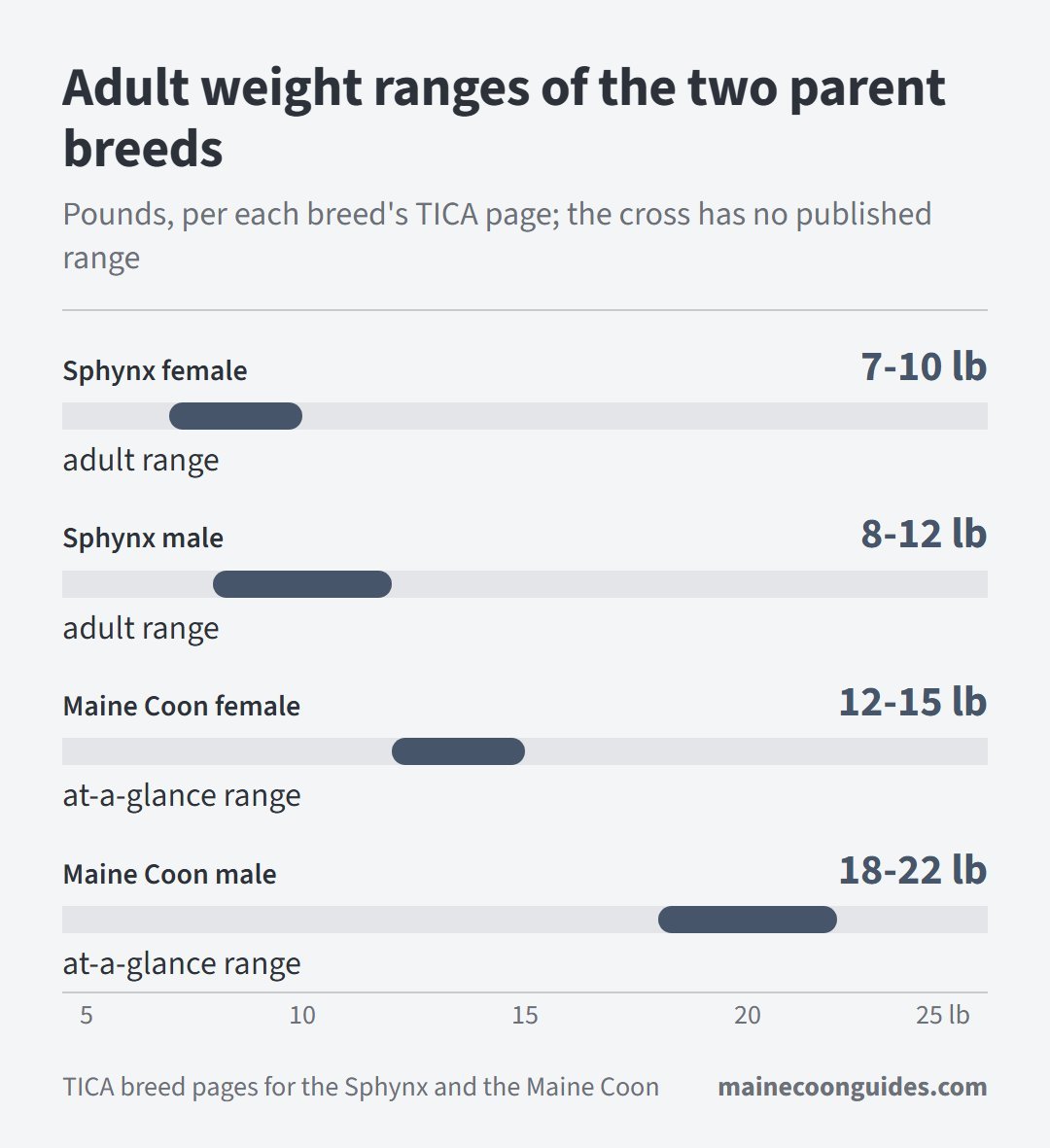
Neither registry publishes weights for the cross, so the parents’ ranges are the only data. They touch at 12 pounds, the top of a Sphynx male’s range and the bottom of a Maine Coon female’s. That gives you a plausible span from a light Sphynx-sized cat to a mid-sized Maine Coon, and the span is arithmetic, not a measured outcome.
Sex and age move the number on both sides. TICA says Sphynx males may be up to 25 percent larger than females, and Maine Coon females run smaller than males, so a male kitten is the likelier candidate for the heavy end. TICA also says Maine Coons do not typically reach full maturity until about 4 years of age, so a weight at one year says little. The Maine Coon growth chart shows the weight-by-age curve for the Maine Coon half of the family tree.
Heart and joint screening for both parent breeds
Hypertrophic cardiomyopathy (HCM) is the main health question on the Sphynx side. In a 2024 screening of 55 Sphynx in New Zealand published in Animals, 22 cats had HCM, or 40 percent. An earlier French screening reported 20 percent, and the same paper puts HCM at roughly 15 percent of domestic cats overall.
The ALMS1 variant had a frequency of 70.9 percent in the New Zealand group but was not associated with the HCM diagnoses there. A DNA result alone therefore does not clear a Sphynx parent. TICA asks breeders to screen by echocardiogram performed by a veterinary cardiologist and points out that HCM does not always show up in the first years of life.
On the Maine Coon side, the MYBPC3 A31P variant is inherited as a dominant trait with incomplete penetrance. UC Davis puts the relative risk of HCM at about 1.8 times with one copy and about 18 times with two copies, and roughly two thirds of Maine Coons carry no copy at all. HCM also occurs in cats without A31P, so a negative result is not a clean bill of health. Because the variant is dominant, a kitten can inherit it from a Maine Coon parent, and TICA says only Maine Coons proven free of heart disease by echocardiogram and negative for A31P should be bred.
Joints matter on the Maine Coon side too. TICA says breeders often test for hip dysplasia and luxating patella by x-ray, and CFA names hip dysplasia and HCM as the checks it mentions. CFA’s Sphynx page adds hereditary myopathy, respiratory problems in kittens, sensitive digestion, urticaria pigmentosa and periodontal disease to the list of Sphynx health issues.
No registry recognises the cross
CFA allows only American Shorthair, Devon Rex and Domestic Shorthair or Domestic Sphynx outcrosses in Sphynx breeding, and says Sphynx born on or after December 31, 2033 may have only Sphynx parents. Its Maine Coon standard lists no allowable outcross breeds at all. A Sphynx and Maine Coon kitten therefore fits neither breed’s registration rules, and TICA’s Maine Coon page lists the Sphynx among its “opposite breeds”.
No registry keeps a breeder directory for the cross, which leaves private sellers, hobby litters and rescues. In a thread about Maine Coon Ragdoll mixes, one reply put the ethics argument bluntly:
“Mixed breeds are not ethical in general. Please look for tica registered breeders so you don’t get scammed by backyard breeders.”
– r/cats (1 upvote)
That is one commenter’s view, and it earned a single upvote. TICA-registered breeders exist for each parent breed, not for the cross, so the practical question is what a seller can document: both parents’ veterinary records, their HCM results, and the size gap between the dam and the sire. Meet the dam if you can. Rules on breeding and selling differ by country and state, so look up yours before you buy.
Appearance alone will not confirm a seller’s claim that a cat is a Sphynx cross. If you are weighing a cat described that way, how to tell if your cat is a Maine Coon mix shows what to look for in a cat said to have a Maine Coon parent. Other crosses, such as the Ragdoll Maine Coon mix, carry their own health questions, and mixed breed Maine Coon cats gathers the rest in one place.
Sphynx Maine Coon mix questions
Can you breed a Sphynx and a Maine Coon?
Yes, both are domestic cats and can produce kittens, but neither CFA nor TICA registers the result, and CFA’s list of Sphynx outcrosses does not include the Maine Coon. Expect coated kittens in the first generation.
Can a Sphynx breed with other cats?
Yes. CFA permits American Shorthair, Devon Rex and Domestic Shorthair or Domestic Sphynx outcrosses in Sphynx breeding. Those pairings stay inside the registry, which a Maine Coon pairing does not.
How much does a Sphynx Maine Coon mix cost?
No registry or price guide covers the cross, so any figure comes from an individual seller. Ask for the paperwork the parent breeds’ breeders provide, an echocardiogram report and DNA results for both parents, before you discuss the price.