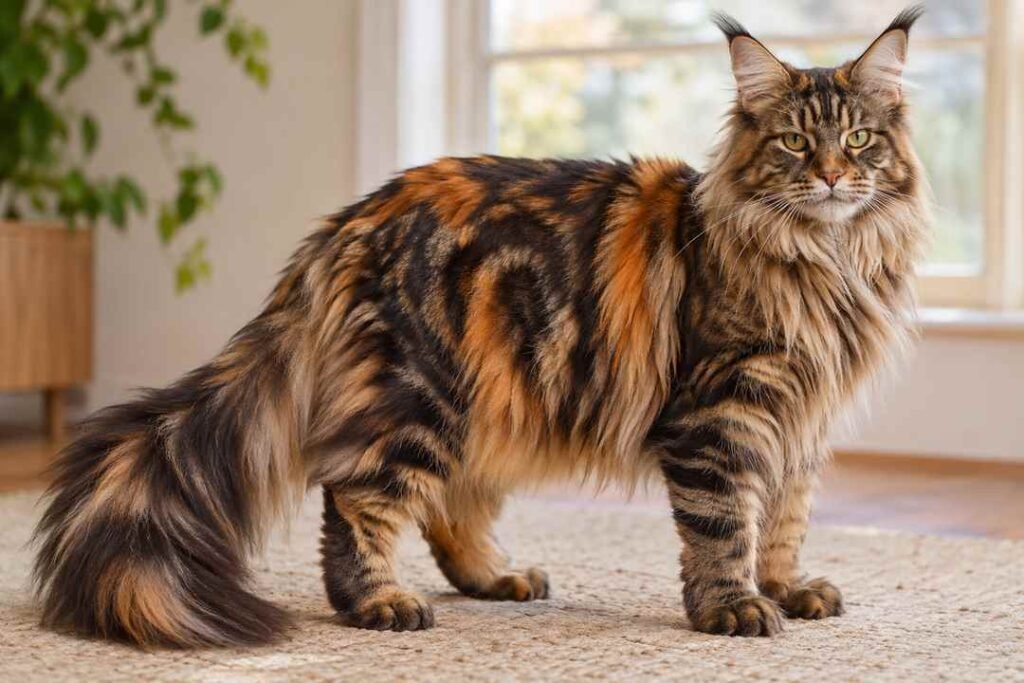
A Maine Coon torbie is a tortoiseshell cat with tabby markings on top: patches of black and red (or their dilute versions) with stripes, swirls or ticking running through the dark areas. The Cat Fanciers’ Association breed standard files this coat as a “patched tabby” and puts the word torbie in brackets beside it.
So the name is a nickname, built from tortie plus tabby, and the coat is a color class inside the breed. A Maine Coon torbie grows, sheds and behaves like any other Maine Coon. What sets her apart is how her coat is put together, and why that coat almost never turns up on a male.
What CFA Means by a Patched Tabby
CFA defines a patched tabby as a tabby coat in one of the accepted ground colors with patches of red or cream added. The CFA Maine Coon standard lists four of them by name, and each reads like a recipe.
| CFA class | Ground color | Markings and patches |
|---|---|---|
| Brown patched tabby | “brilliant coppery brown” | “dense black with patches of red” |
| Silver patched tabby | “pale, clear silver” | “dense black with patches of red and/or cream” |
| Blue patched tabby | “pale bluish Ivory” | “a very deep blue with patches of cream”, with warm fawn overtones |
| Blue-silver patched tabby | “pale, clear silver” | “a deep blue with patches of cream”, white undercoat |
Every one of those classes is written “classic, mackerel, ticked,” which means the tabby part can be any of the three patterns the tabby Maine Coon standard allows: bullseye swirls, thin vertical stripes, or a ticked coat with banded hairs. A torbie with big classic swirls and one with fine mackerel stripes sit in the same class.
Paw pads and nose leather follow the patches. CFA gives brown, black or brick red as desirable for the brown patched tabby, and black and/or pink for the silver version, so a torbie with mismatched toe beans is doing exactly what the standard expects.
White can be added. The tabby-and-white classes describe the color “as described for patched tabby (torbie) with or without white on face” and then require white on the bib, belly and all four paws. On paper that cat is a brown or silver patched tabby and white, whatever nickname the seller uses.
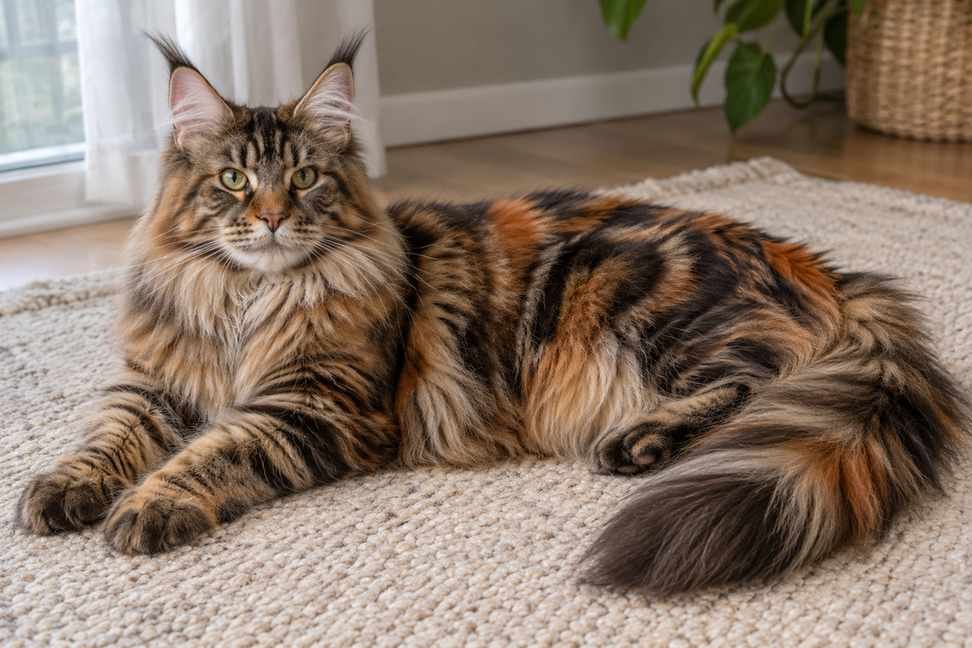
One small line in CFA’s class-number table carries a lot of meaning. Brown tabby has two class numbers, 1744 and 1745. Brown patched tabby has a dash and a single number, 1787. Silver patched tabby, both patched-and-white classes and the tortoiseshell class follow the same dash-and-one-number pattern. CFA marks the table as reference only and does not explain it, but the gap sits exactly where a male class would be expected.
Telling a Torbie From a Tortie, Calico or Tabby
Look for two things at once: red or cream patches, and tabby markings inside the dark color. Patches without tabby markings point to a tortie, tabby markings with no patches point to a plain tabby, and a coat that is mostly white with clean color blocks is a calico.
| What you see on the cat | Most likely coat | CFA wording to compare against |
|---|---|---|
| Black and red mixed together, no visible stripes or M | Tortoiseshell | “black with patches of red or softly intermingled areas of red” |
| Black and red patches, stripes or swirls visible in the black, M on the forehead | Torbie (brown or silver patched tabby) | “Markings dense black with patches of red” |
| Mostly white underneath, separate black and red blocks | Calico | “white with unbrindled patches of black and red. White predominant on underparts” |
| Torbie coat plus white bib, belly and four paws | Patched tabby and white | “Must have white on bib, belly, and all four paws” |
The black areas do the work. Judge the tabby pattern from the black or blue fur, the legs and the tail rings, not from the orange bits. If those are clearly barred and the forehead carries an M, she is a torbie even when the red patches look plain.
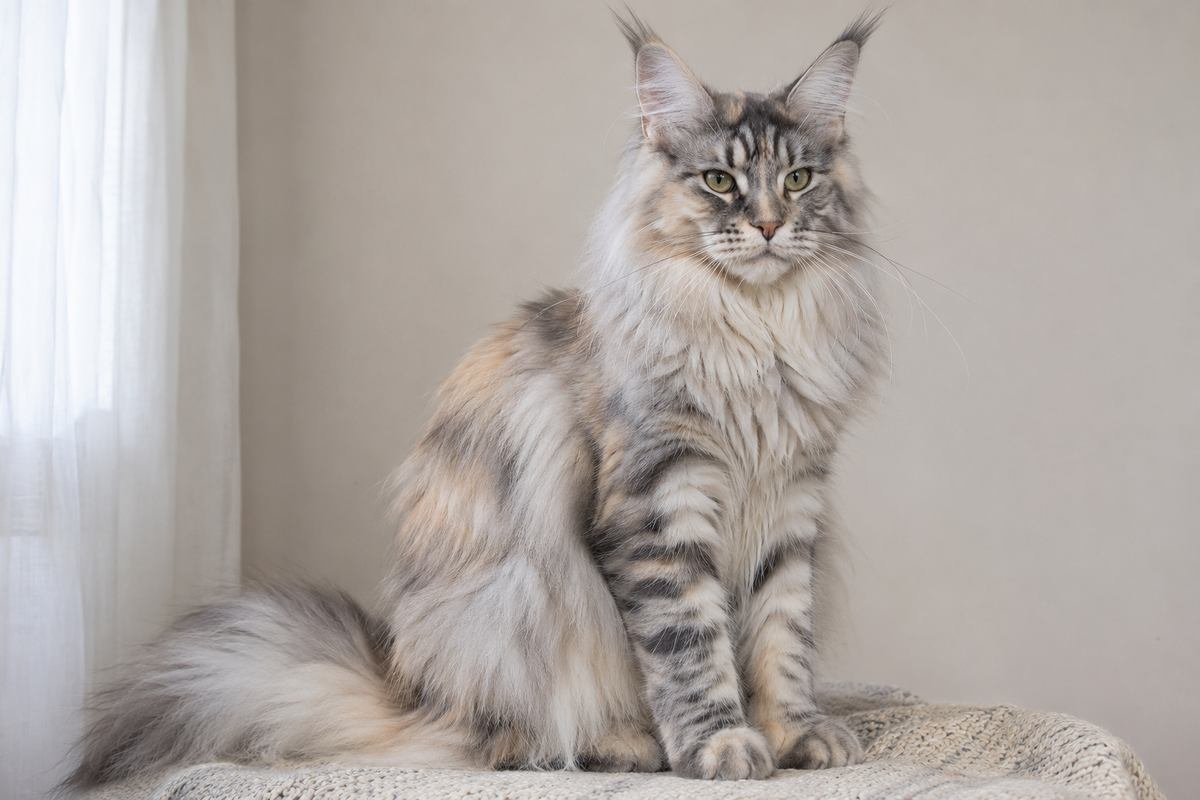
The dilute version confuses people most. A blue patched tabby is soft grey-blue with cream instead of black and red, and from across a room it can pass for a dilute tortie or even a pale silver. Up close, the bluish stripes on the legs and the M on the forehead settle it.
“Tortoiseshell-Tabbie that’s what a Torbie is. It’s a colouring type. Tends to be just females.”
– r/mainecoons, November 2021 (17 upvotes)
That comment answered a post whose title asked whether a torbie Maine Coon’s coloring was “unique or normal for maine coons.” Both halves of the answer hold: the coat is unusual to look at and ordinary to the breed standard.
Why a Maine Coon Torbie Is Almost Always Female
Maine Coon torbie cats are nearly always female because the gene that makes fur orange sits on the X chromosome, and a cat needs two X chromosomes to carry an orange copy and a black copy at once. Kyushu University’s 2025 release on the orange gene puts it plainly: calicos and tortoiseshells “are nearly always female.”
A torbie is a tortoiseshell with the tabby pattern switched on, so the same rule applies. In the words of the Kyushu University release, “one X chromosome in each cell is randomly switched off” early in development. Cells where the orange X stays active grow red fur, cells where the black X stays active grow black or brown tabby fur, and the patchwork follows the way those cells spread, which is why two torbie littermates can be patched quite differently.
The CFA breed page backs this up in a quieter way. It carries a long list of award-winning Maine Coons with each cat’s color and sex. Counted on 5 November 2026, the list held 429 entries: 210 male, 106 neuter, 75 female and 38 spay. Sixty entries had “patched” in the color name. All 60 were female or spay. The count includes cats listed in more than one season, covers show winners from 2017-18 to 2025-26 only, and says nothing about how common torbies are in pet litters. It does show that across nearly a decade of top show cats, not one patched tabby on that list was a male.
Male torbies can exist in the same way male torties do, usually through an extra X chromosome. The odds and the health and fertility problems that come with it are set out on the tortoiseshell page, and nothing about them changes for a tabby-patterned coat.
Does a Torbie Coat Mean the Cat Is a Maine Coon?
No. A torbie coat is a color pattern found in many breeds and in ordinary long-haired and short-haired house cats, so it says nothing about breed on its own. A cat is a Maine Coon torbie only when she is a Maine Coon first, which papers or a breeder’s records establish.
Plenty of large, fluffy rescue torbies get called Maine Coons on looks alone. Size, ear tufts, a ringed tail and big paws are worth looking at, and the checklist in how to tell if your cat is a Maine Coon mix walks through them. None of them are proof, and the torbie coat adds no evidence either way.
If you are buying a kitten sold as a Maine Coon torbie, ask what color the registration will list. A breeder who registers with CFA should be able to say “brown patched tabby” or “silver patched tabby and white.” A vague answer is worth a follow-up question before any deposit.
Torbie Kittens and Coat Changes
Kitten photos are a weak guide to the adult coat, and owners know it. A January 2025 post in r/mainecoons came from a family choosing a new kitten after losing a cat:
“One caught my eye, but I was hoping to see some “grown up” cats that have the same coloring”
– r/mainecoons, January 2025 (136 upvotes)
Asking the breeder for photos of the mother and of adult cats from earlier litters with the same color code is the most direct way to see where a kitten’s coat is heading.
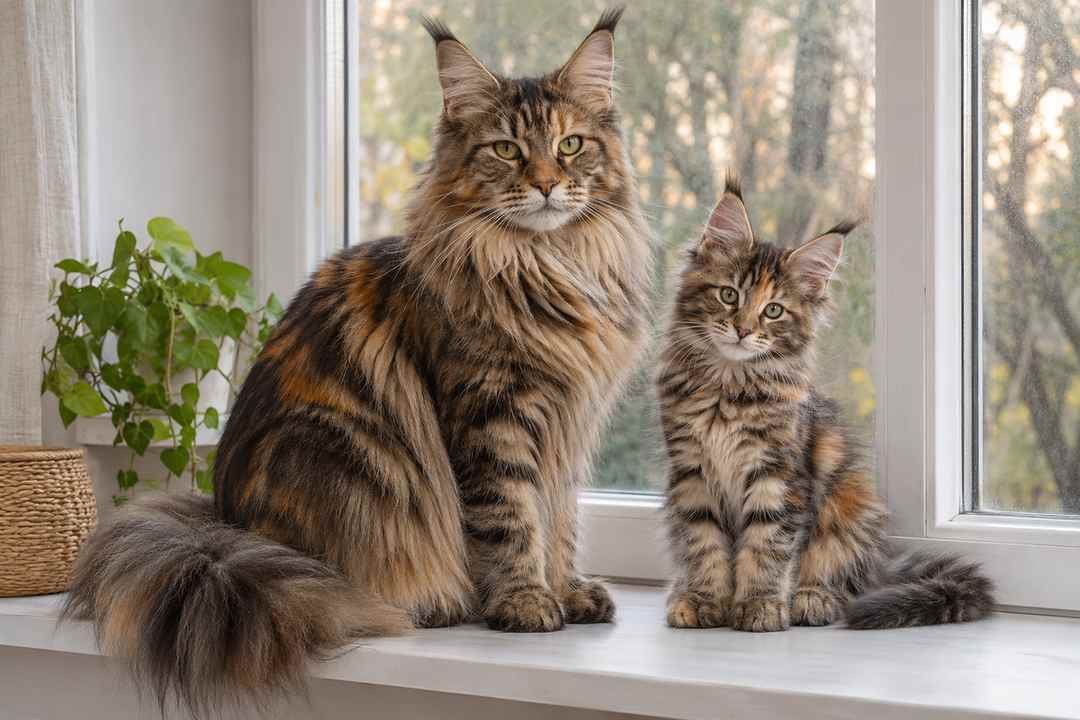
For the silver classes, CFA’s wording sets the target: a “pale, clear silver” ground under the markings. How the full color settles in any single kitten is not something the standard predicts.
FAQ
Are Maine Coon torbies rare?
Maine Coon torbies are not a rare color in the breed standard: CFA gives brown, silver, blue and blue-silver patched tabbies their own classes. They are limited mainly by sex, since nearly all are female. No registry publishes how many Maine Coon kittens are born torbie each year.
What is the most common Maine Coon color?
Brown tabby is the color most linked with the breed. CFA’s own history article calls the brown tabby the color that “occurs most commonly in nature,” though no registry publishes a full color count. The full list of accepted colors is on the Maine Coon colors page.
What is the difference between a torbie and a calico Maine Coon?
A torbie Maine Coon has tabby stripes inside her patches and little or no white; a calico Maine Coon is white on the underparts with clean, unstriped blocks of black and red. A torbie with a white bib, belly and four paws is a patched tabby and white, and the calico page sets out the white-coat classes in full.
On a registration slip, the color line settles it: tortoiseshell, calico, or one of the patched tabby classes CFA lists.