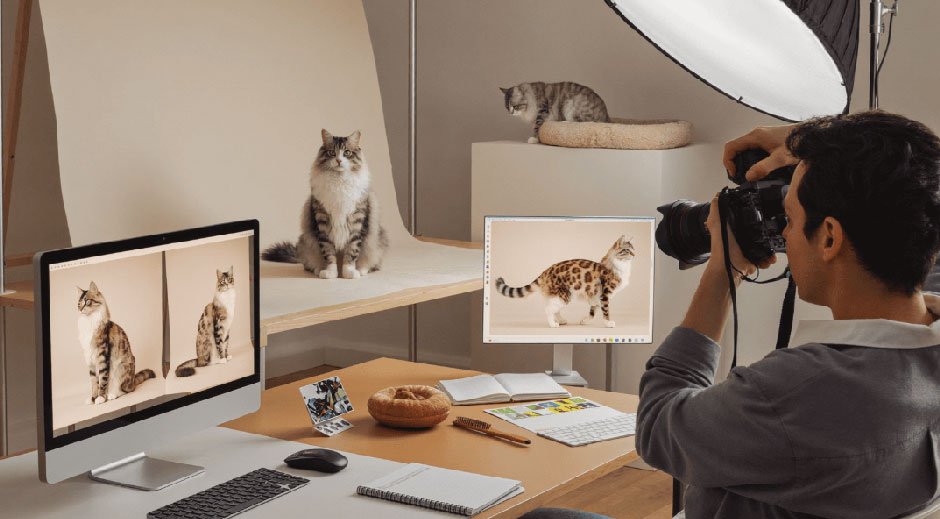
A warm colour cast will turn a cream cat into a red one, and the photograph will look perfectly fine.
That single problem matters more in breed photography than almost anywhere else, because colour class is a registry distinction. Cream is the dilute of red, and a photograph taken under a warm bulb shifts the rendering far enough that somebody assessing the image gets a different answer from somebody looking at the cat.
The same applies across every dilute pairing. Blue reads as black, lilac reads as chocolate, and the error is entirely in the lighting rather than in anybody’s judgement.
Getting this right is mostly about what happens before the shutter. An AI Animal Generator serves one purpose here, which Higgsfield handles in the browser, and the photograph itself has to be a photograph.
Which Angles Actually Work?
Four, each doing a different job.
- True profile for head shape, which no AI Animal Generator renders reliably
- Standing side view for body proportion and length
- Three-quarter front for overall impression and ear set
- Rear three-quarter for britches and tail
- A close detail of the coat where texture matters
The true profile is the hardest to get and the most informative. A head turned even slightly toward the camera flattens the muzzle and changes the apparent nose length, which is precisely what the profile is meant to show.
The standing side view needs the cat actually standing rather than crouched. A cat in a loaf position reveals nothing about body length or leg boning.
Get low. Photographing down at a cat foreshortens the body and makes every cat look shorter than it is.
How Should the Lighting Be Set?
Even and generous, with no harsh shadows anywhere.
- Diffuse light from a large window, not an AI Animal Generator approximation
- Avoid hard shadows, which hide boning and muscle
- Light the coat from behind where texture matters
- Add more light for dark cats, which reflect less
- Never rely on an AI Animal Generator to recover lost detail
Shadows are the enemy in conformation work. They conceal exactly the structural detail the photograph exists to show, and no amount of lifting afterwards recovers what was never captured.
Backlighting is the technique for coats. Light passing through ear tufts, britches and a tail plume separates them from the body and shows length and texture that flat front lighting flattens completely.
Two sources are better than one. A main light and a reflector on the opposite side removes the shadow side entirely.
How Is Colour Kept Accurate?
With a grey card, at the point of capture.
- Photograph a grey card under the final lighting, before any AI Animal Generator work
- Set white balance manually from it
- Shoot RAW, so the correction stays adjustable
- Avoid mixed lighting, which gives two casts in one frame
- Never correct colour by eye afterwards
This is the step that prevents the cream-to-red problem, and it takes ten seconds. Without it you are guessing, and guessing favours whatever the room was doing.
Mixed lighting is the remaining difficulty. Daylight through a window plus a warm ceiling bulb produces two different casts in the same image, and the only reliable fix is switching one off.
Photograph against neutral grey or white. A coloured background reflects onto the coat and shifts the rendering.
What Must Never Be Altered?
The cat, in any respect.
- Never adjust coat colour beyond correcting a measured cast
- Never alter conformation, including proportions
- Never remove a fault or a feature
- Never produce a cat with an AI Animal Generator for a breed reference
- Never present an illustration as a photograph
Breeders, buyers and registries rely on these images. An edited photograph used in a sale listing or a breeding discussion is a representation about an animal somebody is making a decision on.
Removing a kink, a coat fault or an eye colour variation is misrepresentation rather than retouching, and the person who meets the cat finds out immediately.
Correcting white balance to a measured reference is restoration. Everything beyond that is alteration.
Why Can Generated Cats Mislead?
Because they average away the features that define a breed.
A model trained on photographs produces something resembling the average cat in its training data. Breed-defining features are, by definition, departures from average.
- Muzzle shape gets softened toward generic
- Ear set and size drift toward typical
- Coat length variation flattens into uniformity
- Boning and proportion become unremarkable
- An AI Animal Generator cat teaches the wrong standard
That matters specifically for people learning a breed. Somebody studying images to understand what a square muzzle looks like learns nothing useful from a produced approximation of one.
It also misleads buyers. A listing illustrated with a produced cat sets an expectation no real animal was ever going to meet.
Use photographs of real cats. Breeders and owners are generally glad to share them with credit.
Where Does an AI Animal Generator Genuinely Help?
Diagrams explaining a standard, which photographs struggle with.
- Conformation diagrams marking the points being assessed
- Comparison illustrations between two breed types
- Profile outlines showing muzzle and head shape schematically
- Coat pattern diagrams, explaining classes
- Clearly labelled, every time
Higgsfield keeps this alongside the rest of the tools as part of an AI creative suite, which suits a publisher producing explanatory material between articles.
A diagram showing where a judge looks, with the areas marked, explains a standard in a way no photograph can, because a photograph shows a cat rather than a method.
Verify every diagram against the written standard. A confirmation illustration with a feature wrong teaches an error to the people most likely to repeat it.
How Do You Get a Cat to Cooperate?
Patience, two people, and no forcing.
- Work with a second person, since no AI Animal Generator substitutes for a real session
- Use treats and a wand toy for attention and ear position
- Keep sessions short, under ten minutes
- Photograph on a surface the cat likes
- Stop immediately if the cat is uncomfortable
The second person is what makes the standing shot possible. One person steadies and positions, the other photographs, and neither is trying to do both badly.
A wand toy held just out of frame brings the ears forward and the eyes open, which is most of what a good head shot needs.
Never stack or force a cat into position. Beyond the welfare question, a restrained cat looks restrained in the photograph.
What About Kittens and Growing Cats?
Photograph the stages, because the breed develops slowly.
- Record at regular intervals, which an AI Animal Generator cannot reconstruct later
- Note the exact age with every set
- Expect proportions to change considerably
- Avoid judging adult traits too early
- Keep the full series rather than the best images
Slow-maturing breeds look substantially different at eight months and three years, and a photographic series is the only honest record of that development.
Dating each set matters because the age changes what the photograph means. A head shot at six months is not evidence about an adult muzzle.
Buyers deserve current photographs. A kitten listing illustrated with images of an adult relative is misleading about what is being sold.
What Does a Breed Photograph Have to Show?
The features the standard actually scores.
For a breed where head and body carry most of the points, the photograph has to make both accessible, which a casual snapshot rarely does.
- The profile, showing muzzle shape and nose
- Ear set, size and tufting, which no AI Animal Generator gets right
- Body length and boning, from a standing side view
- Coat length variation across shoulders, flanks and britches
- The tail plume, full length
A head-on portrait, which is what everybody takes, shows almost none of that. It is a lovely photograph of a face and it answers no question about conformation.
Understanding what carries weight is the starting point, and a breakdown of how the CFA allocates its points tells you exactly which features a photograph has to serve.
Take the set rather than one image. Four angles answer what one cannot.
What Should Accompany a Photograph?
Enough context to make it accessible.
- The cat’s age at the time, stated plainly
- The date taken
- Whether it is coated or shaved, including lion cuts
- The colour class, if you know it
- Photographer credit, where somebody else took it
The coat state matters more than people expect. A seasonal moult, a recent groom or a clipped body changes what the image shows about the coat, and an undated photograph of a shaved cat tells somebody nothing about its normal coat.
Credit the photographer properly. Cat photography is a genuine skill and the images circulate widely without attribution.
Does Photographing a Mixed Breed Differ?
It does, and honesty matters more rather than less.
A great many cats carry breed traits without pedigree, and owners reasonably want to document what they have. The problem arises when a photograph is used to suggest more than is known.
What to keep straight:
- Photograph the traits, without claiming a pedigree
- Describe what is visible, not what it implies
- Avoid breed labels where there is no documentation
- Never present a mixed cat as registered
- Never use an AI Animal Generator to fill a gap in a listing
The listing case is where this becomes commercial. A cat offered for sale with breed language and no paperwork is a representation about the animal, and photographs do a great deal of that work without anybody writing a word.
Describe the coat, the size, the ear set and the temperament. All of that is true, useful and verifiable, and none of it claims a lineage nobody can produce.
Owners genuinely want to know what their cat is, which is why identification tools exist. A photograph showing the relevant features honestly is a better starting point than a flattering portrait that hides them.
Say what is unknown. A cat of unknown parentage with strong breed traits is interesting on its own terms.
How Should the Images Be Organised?
By cat, date and angle.
- Name by cat, date and angle, apart from any AI Animal Generator files
- Keep the originals untouched
- Record the lighting and white balance settings, outside Higgsfield
- Store the Higgsfield project for any diagrams separately
- Keep the whole series apart from Higgsfield, not just the flattering frames
Keeping the full series is what makes it a record. A folder of only the best images is a portfolio, which is a different and less useful thing.
Separating diagrams from photographs prevents the mistake that would genuinely matter here, which is an illustration later used as evidence of what a cat looked like.
What Would One Session Take?
An afternoon, with the setup prepared first.
- Set up by a window with a neutral background, no AI Animal Generator involved
- Photograph a grey card and set white balance
- Have a second person handle the cat
- Capture all four angles, plus coat detail
- Keep the session under ten minutes per cat
- Correct white balance only afterwards
- Save any Higgsfield diagrams apart from the photographs
Then compare the images against the cat in front of you before publishing anything.
If the colour on screen differs from the cat in the room, the white balance was wrong and everything else follows from it.
Conclusion
Breed photography is unusual in that accuracy matters more than appeal, because the people using the images are making decisions with them.
An AI Animal Generator belongs in conformation diagrams that explain a standard, clearly labelled, and Higgsfield keeps that work separate from the photographs.
Photograph a grey card, get low, take all four angles, and keep the session short. The cat on screen should be the cat in the room.