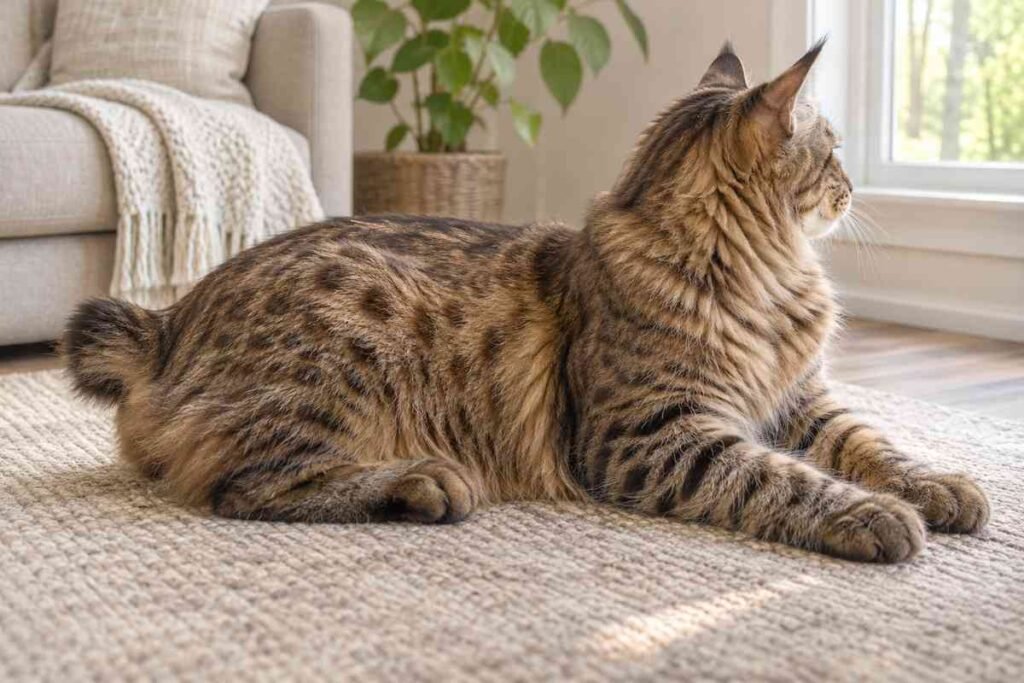
A Pixie Bob Maine Coon mix (usually written Pixie-Bob) is a cat said to have one Pixie-Bob parent and one Maine Coon parent, and in most homes that claim cannot be proven. Without papers on both parents, the label rests on looks. The two traits people lean on most, extra toes and a short tail, show up in both lineages and in plain domestic cats.
Below: what each parent’s standard says, which traits settle nothing, what size to expect, and how to handle a cat whose parents are unknown.
What is a Pixie-Bob Maine Coon mix?
One parent is a Pixie-Bob, the other a Maine Coon. Neither breed standard describes a cross, so the cat has no breed of its own on paper, only a description. The pairing appeals because both parents are large and sturdy, and both can carry extra toes.
The Pixie-Bob is the newer line by far. According to a cats.com Pixie-Bob profile, The International Cat Association (TICA) accepted it for exhibition in 1993, as a new breed in 1996 and for championship in 1998. The Maine Coon is older and far better documented.
A kitten sold as this cross usually has no registry behind it.
Can you tell if a cat is a Pixie-Bob Maine Coon mix?
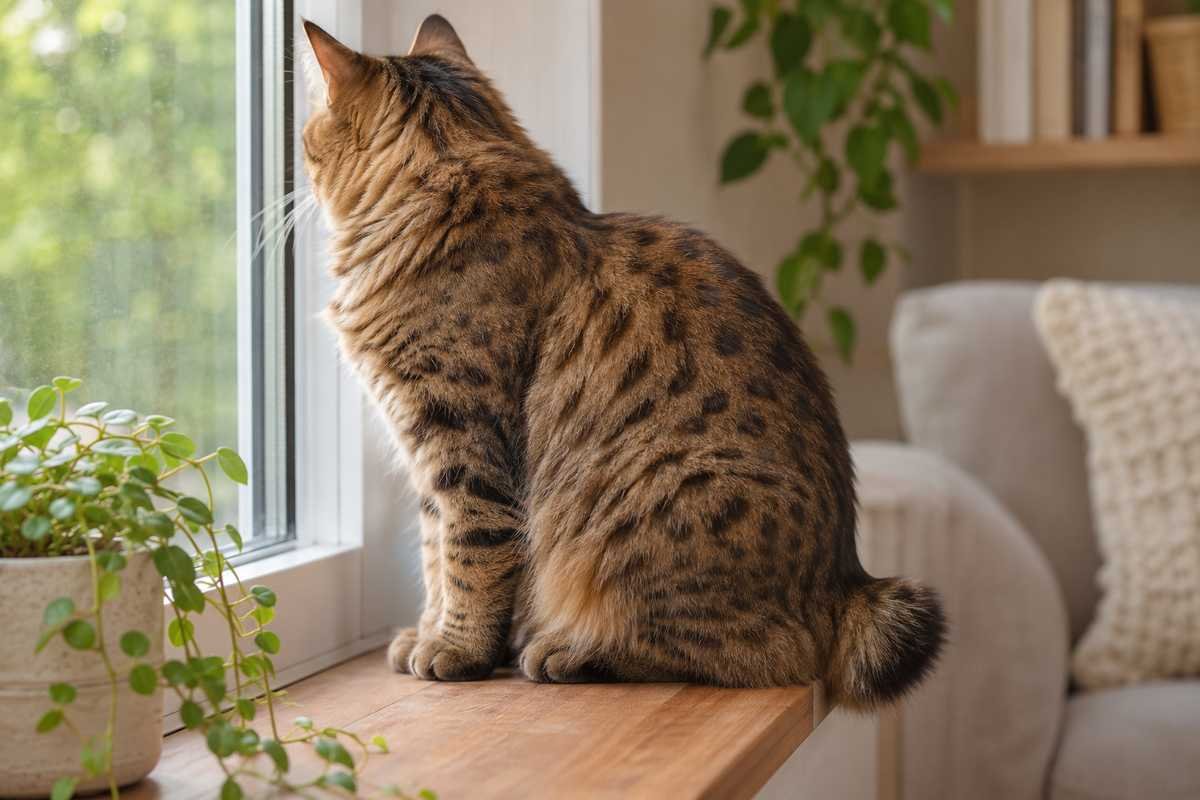
Not reliably from appearance. Cats of unknown parentage can look like either breed, and no coat, ear or toe feature belongs to just one of them. Firm evidence means a pedigree for both parents, or meeting both parents in person.
Cat forums are blunt about this. When a Maine Coon-mix photo was posted to r/catbreeds, the answers were consistent:
“This is just a cat. Unless there’s a pedigree, every cat is just a cat.”
– r/catbreeds, November 2026 (11 upvotes)
A thread in r/tabby asked whether a spotted rescue kitten might be part Pixie-Bob. One reply pointed to rarity as the practical problem:
“Pixie-bobs are a rare breed with very few breeders, and the chance of finding a Pixie-bob kitten in a rescue is virtually non-existent.”
– r/tabby, October 2026 (6 upvotes)
A shelter listing that says “Pixie-Bob Maine Coon mix” is a guess unless papers back it up. The same gap exists in any record that lists a breed: the site’s Seattle pet licence data shows how many cats carry a Maine Coon label in one city, and a label in a record is not a documented pedigree. For the general checklist, the guide on how to tell if your cat is a Maine Coon mix covers what a vet or a DNA kit can and cannot answer.
What do the two breed standards say?
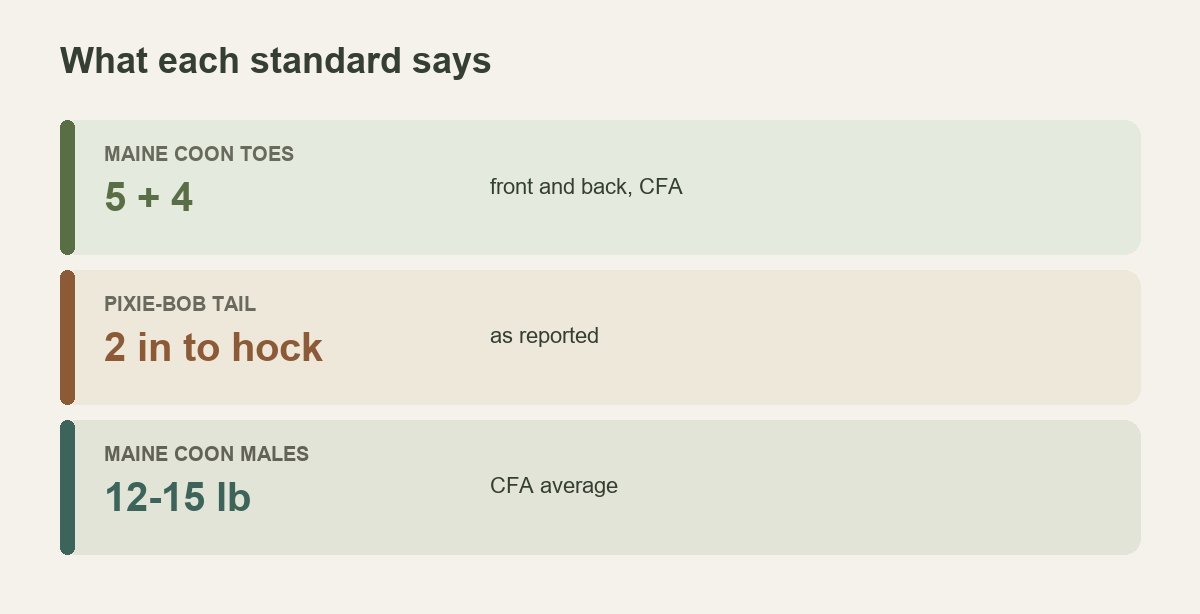
The Maine Coon standard is published by the Cat Fanciers’ Association (CFA), and it is specific. The CFA Maine Coon standard calls for five toes in front and four behind and a long tail that tapers, and it disqualifies a kinked or abnormal tail. Pixie-Bob traits, as reported by cats.com, run the other way on tail length.
| Trait | Maine Coon (CFA) | Pixie-Bob (as reported) |
|---|---|---|
| Tail | Long and tapering | About 2 inches up to hock length (cats.com) |
| Toes | Five front, four back | Extra toes common, not required (Parade Pets) |
| Adult weight | Males 12 to 15 lb, females 9 to 12 lb on average | 8 to 18 lb overall (cats.com) |
Tail
Maine Coons carry long, tapering tails. Pixie-Bobs are the short-tailed parent, with the cats.com profile reporting a minimum of about 2 inches and a maximum at hock length. A mix can land anywhere between, even at full length, so tail alone says little about who contributed what.
Toes
Both breeds have extra toes. A polydactyl cat founded the Pixie-Bob line, and extra toes are reported as common in the breed but not required. Maine Coon polydactyly is old and arose independently, so a cat with extra toes cannot be assigned to either parent. The background is on the site’s page about the polydactyl Maine Coon.
Coat and build
Both breeds are heavy-boned. Maine Coons wear a long, shaggy coat with a ruff, while Pixie-Bobs come in short and long coats. One commenter in the r/tabby thread noted that the Pixie-Bob standard allows only tabby coloring with no white, apart from a white chin. Such a rule describes the breed and predicts little about a cross.
How big does a Pixie Bob Maine Coon mix get?
Expect a large cat, probably in the low-to-mid teens of pounds for a male, but that is an inference from the parents, not a measured figure. CFA material reports Maine Coon males averaging 12 to 15 pounds and females 9 to 12, with some males reaching 20 or more.
Pixie-Bob weights vary by source. Cats.com gives a broad 8 to 18 pounds, whereas a Parade Pets piece reports roughly 12 to 17 pounds for males and 9 to 13 for females. A cross of two large parents should land inside those ranges, with wide individual variation.
Maturity matters too. Maine Coons mature slowly, reaching full size at up to three years per the CFA, and a mix may follow suit, so a one-year-old weight is not the final number. The site’s Maine Coon growth chart shows the pure-breed pattern for comparison.
Do extra toes or a short tail prove a Pixie-Bob parent?
No. Extra toes occur in Maine Coons on their own, so they do not point to a Pixie-Bob. A short or bobbed tail is more suggestive, but short tails also turn up in other breeds and in random-bred cats. The site’s page on the American Bobtail Maine Coon mix covers one such look-alike.
Within the Pixie-Bob breed, a bobbed tail is reported as the more common outcome, though long tails occur too. A short tail on a cat with Maine Coon-like size and coat is a clue, not a conclusion.
Is the bobcat story true?
Legend gives the Pixie-Bob a wild bobcat ancestor, yet the breed is registered as domestic. Wikipedia’s Pixie-bob entry reports a 1996 DNA test that found no wild genes, while noting that the underlying data are not public.
The CFA makes the same point from the Maine Coon side. Its breed article says domestic cats cannot breed with bobcats or raccoons because they belong to different genera. So whatever a seller says, a Pixie-Bob Maine Coon mix is not part wild cat. Spotted coats, tufted ears and short tails give the wild look, and domestic cats can have all three. The myth gets its own treatment in the Maine Coon bobcat mix guide.
What are the temperament and care needs of a Pixie-Bob Maine Coon mix?
Temperament in a cross follows the individual cat, so no parent guarantees a personality. The CFA calls the Maine Coon a gentle, loyal breed that gets along with children and dogs and talks in trills and chirps. For the Pixie-Bob side, cats.com describes a friendly, sweet-natured cat with a dog-like streak, fond of fetch and leash walking.
Lifespan is similarly an estimate: cats.com gives 13 to 16 years for Pixie-Bobs, and a mix has no breed figure of its own. Care is ordinary for a large, thick-coated cat. Cats.com suggests brushing once or twice a week for Pixie-Bobs and warns that big cats that grow lazy are prone to obesity, so exercise and portion control matter.
What should owners do with a cat of unknown parentage?
Work up an evidence ladder, from strongest proof to weakest, and stop at the first rung that gives an answer you can trust. Most owners will end up at the DNA rung.
- Papers for both parents, from a registry such as TICA or the CFA, are the only proof of a mix.
- Meeting both parents in person is the next best, since size, tail and coat can then be compared directly.
- A DNA kit adds a data point, though a result is a statistical estimate and not a pedigree, so read any breed percentage with that limit in mind.
- Looks alone, including toes and tail, come last because both lineages share them.
Whatever the answer, plan for a large domestic cat sized for the bigger parent. Feed for a growing frame, keep its weight in a healthy range, and ask a vet which screenings suit a cat with possible Maine Coon ancestry, such as a heart check. Personality will matter more than the label.
One Comment