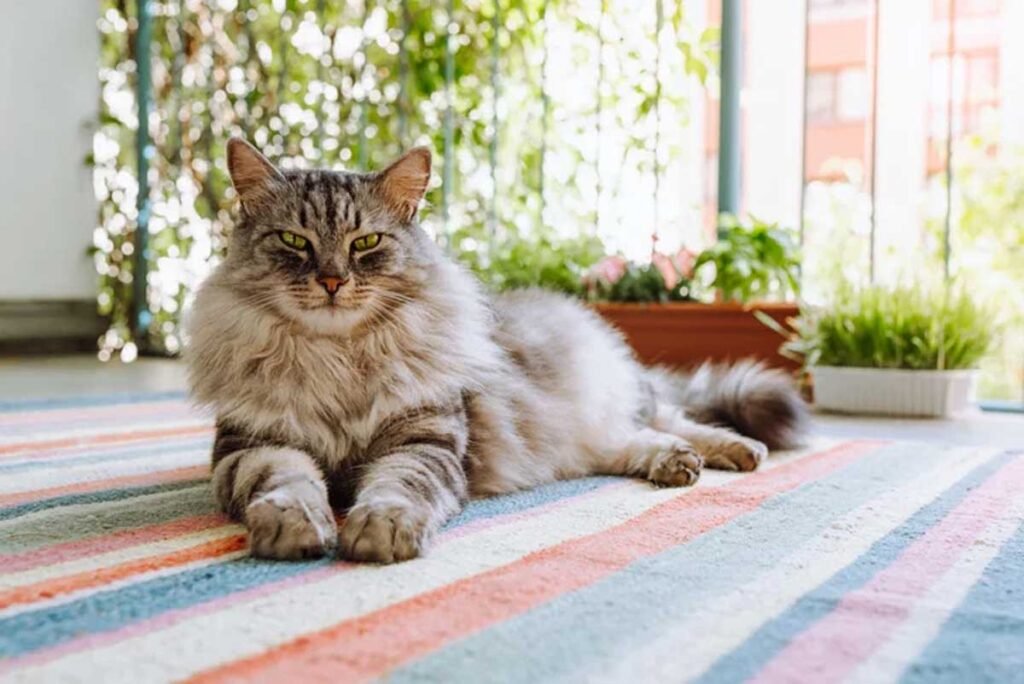
Without papers on at least one parent, you cannot confirm your cat is a Maine Coon mix. Every trait checklist online, including the one below, tells you how closely your cat resembles the breed, and resemblance is not ancestry. That distinction is the whole answer, and it is the part almost nobody says out loud.
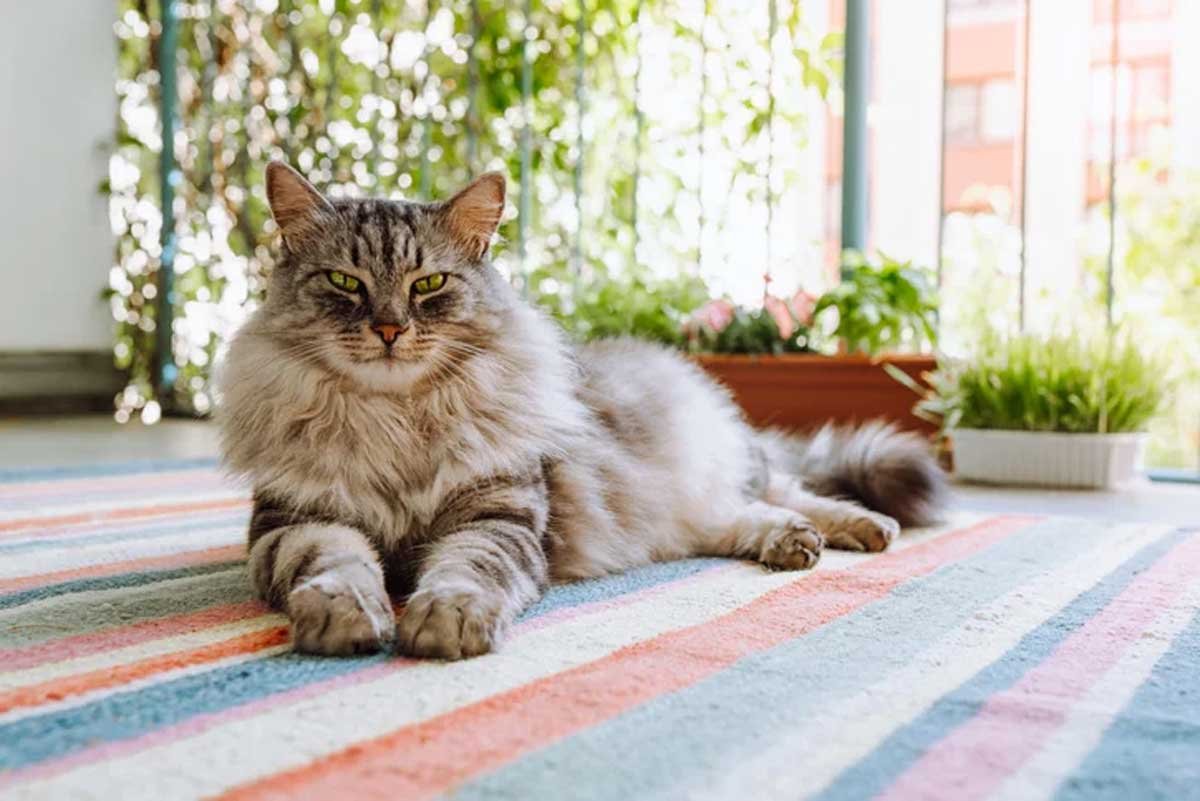
This is not pedantry about paperwork. It comes from where the breed came from, and once you see that, the ear tufts stop looking like evidence.
Why the Checklist Cannot Prove It
The Maine Coon was selectively bred from one of the oldest landraces in North America: ordinary working farm cats in New England, shaped by winters rather than by breeders. Fanciers later drew a pedigree around a population that already existed and already looked like that.
Which means the traits are not exclusive. A big semi-longhaired cat with tufted ears and a shaggy coat is what unmanaged cats in cold climates drift toward, with or without a registered Maine Coon anywhere in the family. Your neighbourhood tomcat may share ancestry with the founding population without a single pedigree cat in his line.
So when a shelter cat ticks eight boxes on a breed checklist, the honest reading is that he is a domestic longhair who looks the part. The people who answer identification threads every day land in the same place.
“There’s no way to definitively say yes your cat has Maine coon ancestry because it could also just be traits that were passed from a DLH that happened to LOOK like a Maine coon.”
– r/IDMyCat, September 2025 (29 upvotes)
What Each Clue Is Actually Worth
The clues available to you sit on a ladder of reliability, running from registration papers at the top down to coat and ear tufts at the bottom, and most owners spend all their attention on the bottom rung.
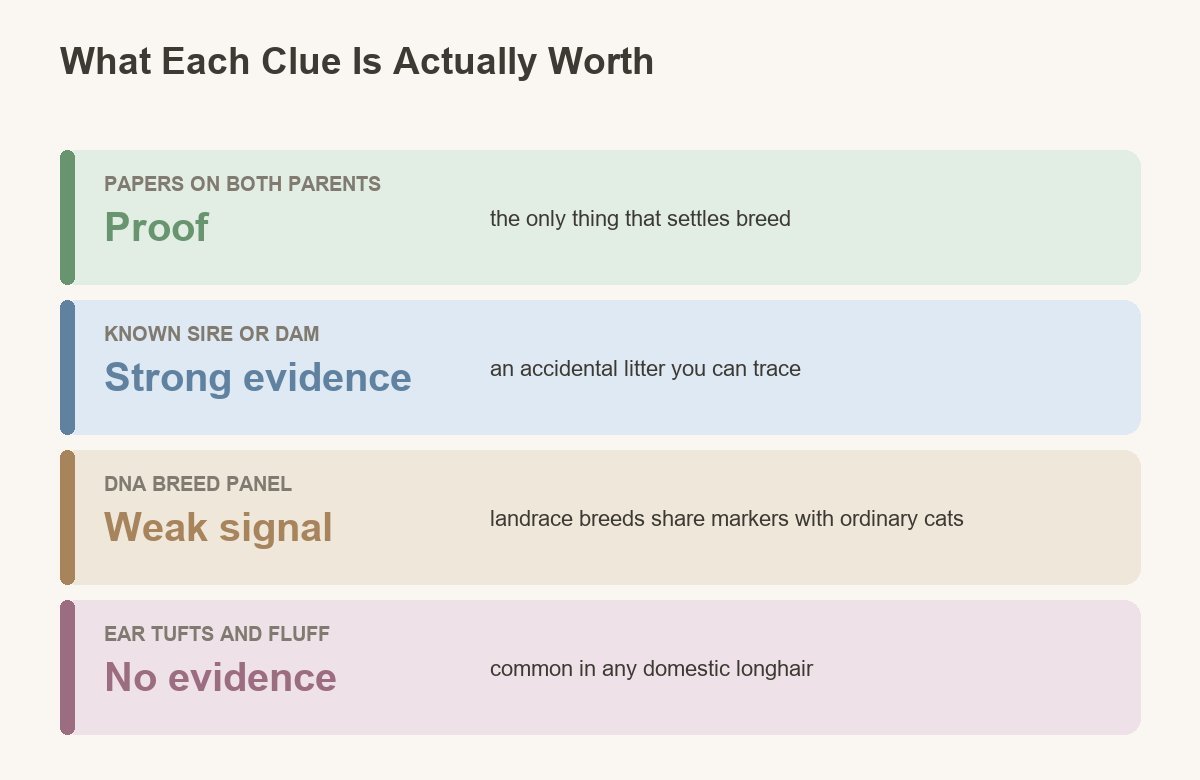
Registration papers on both parents settle it, and nothing else does. A known sire or dam is the next best thing: an accidental litter from a neighbour’s registered queen is a real, traceable claim, and it is how most genuine mixes come about.
A DNA panel sits lower than people expect, for a specific reason covered in the next section. Physical traits sit at the bottom, which does not make them worthless. They tell you what kind of cat you have and what care he needs, which is usually the thing that actually matters.
The Trait Checklist, Used Properly
Work through the structural features rather than the fluffy ones. Coat volume is the least informative thing on a cat and the first thing everyone looks at.
- Body shape. A long rectangular body, not a compact or cobby one. Maine Coon type reads as a cat built like a brick laid lengthwise.
- Boning. Heavy legs and substantial paws. Pick the cat up: type shows in density, not in size alone.
- Muzzle. A square muzzle with a visible break where it meets the cheek, rather than a rounded or wedge-shaped face.
- Ears. Large, set high and wide, and tall relative to the head. Tufts inside the ears are common in any longhair; the ear size and placement carry the signal.
- Tail. As long as the body and carried like a plume. This is one of the more discriminating single traits.
- Growth pattern. Still filling out at three or four years old rather than finishing at eighteen months.
Score honestly and the picture usually resolves. A cat with the tail, the muzzle break, and the boning has real type. A cat with tufty ears, a big fluffy coat, and a round face has a lovely coat.
Do Cat DNA Tests Answer This?
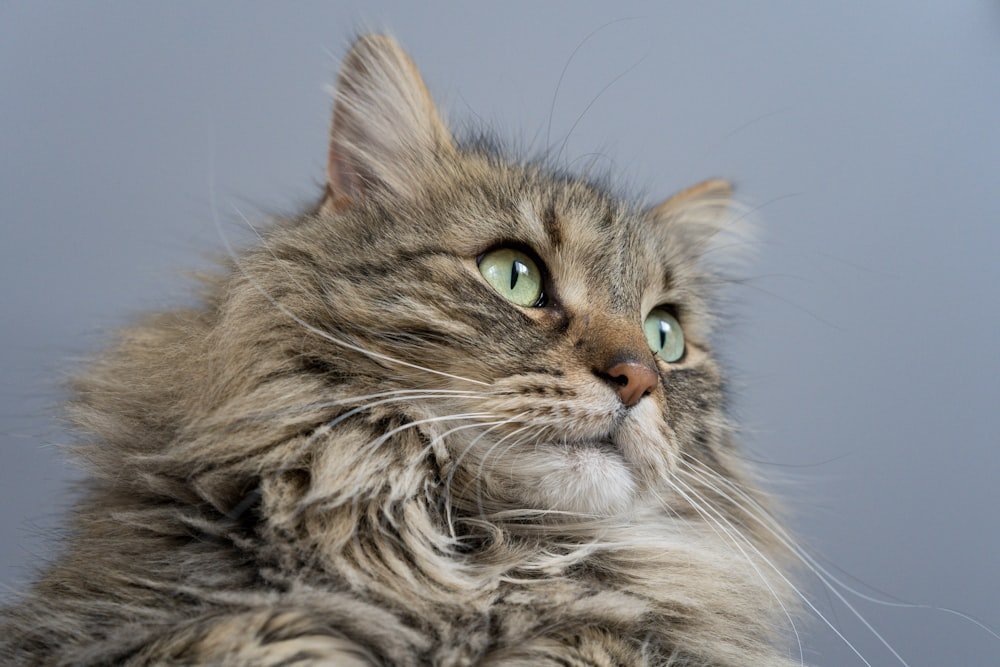
Cat breed panels are far weaker than the dog equivalents most people are thinking of, and the reason is structural rather than a flaw in any particular product. Dog breeds have been genetically isolated for long enough to leave distinctive markers. Cat breeds are mostly recent, and several of the popular ones were drawn from regional landrace populations that ordinary cats in the same region still belong to.
The Maine Coon is exactly that case. A panel comparing your cat against Maine Coon reference markers is comparing him against a population his ancestors may have been part of anyway, so a partial match is genuinely ambiguous rather than a soft yes.
What these tests do well is worth having: they screen for the HCM and spinal muscular atrophy variants that matter for a cat with Maine Coon ancestry, and they flag blood type before a surgery. Buy one for the health panel and treat the breed percentages as trivia.
Cats Most Often Mistaken for Maine Coons
Four candidates cover nearly every case. The domestic longhair is by far the most common answer and simply means a random-bred cat with long fur, no ancestry claim attached. Norwegian Forest Cats share the size and the winter coat but carry a straight profile and a triangular face, while Siberians are rounder in the head with a shorter, denser body.
The fourth is a genuine mix with a different breed entirely. If your cat’s markings or build point somewhere specific, our guides to the common Maine Coon mixes break down what each cross tends to look like, including the Norwegian Forest cross, the Bengal cross, and the Ragdoll cross.
One caution that applies to all of them: a mix inherits unpredictably, so a Maine Coon crossed with anything can produce a litter where one kitten reads pure and another reads plain.
What to Do With the Answer
If you are buying, it matters entirely, and papers are the only currency. Registered parents, health testing on both, and a breeder who shows you the paperwork before you ask are what separate a pedigree kitten from a fluffy kitten with a pedigree price.
If the cat is already yours, it changes almost nothing. Feed and groom the cat in front of you: a heavy-coated cat needs combing two or three times a week regardless of ancestry, and a large-framed cat benefits from staying lean whatever his paperwork says. Ask the vet to listen to his heart at annual visits if he has real Maine Coon type, because HCM is worth catching early in any cat built like that.
The cat does not know what the answer is, and nothing about him changes when you find out.
FAQ
What cat is most often mistaken for a Maine Coon?
The domestic longhair is mistaken for a Maine Coon more than any other cat, because long fur, ear tufts, and a full ruff appear in random-bred cats with no pedigree ancestry. Norwegian Forest Cats and Siberians account for most of the remaining cases.
What would a Maine Coon mix look like?
A Maine Coon mix usually shows partial breed type: a long body or a plumed tail alongside a rounder face or lighter boning than a purebred. Littermates from one cross often differ sharply, because mixed inheritance does not blend traits evenly.
How can you tell if a cat is really a purebred Maine Coon?
Registration papers from CFA, TICA, or an equivalent registry are the only proof of a purebred Maine Coon. Appearance, size, and DNA breed percentages cannot establish pedigree status, and no reputable breeder sells a purebred kitten without documentation.
What cat breeds make a Maine Coon?
No breeds were crossed to create the Maine Coon. It descends from working farm cats in New England that developed their size and coat naturally, and breeders later formalised that existing landrace population into a registered breed.
3 Comments