Maine Coon cats are renowned for their impressive size and gradual development, making a maine coon cat growth chart an essential tool for owners. These gentle giants follow a unique growth pattern that differs significantly from other domestic cat breeds. Understanding your Maine Coon’s development through a comprehensive maine coon cat growth chart helps ensure proper nutrition, health monitoring, and realistic expectations throughout their extended maturation period.
Curious when all this growing finally ends? See our complete timeline of when Maine Coons stop growing.
Maine Coons grow slowly, reaching their full size between 3-5 years old, which is considerably longer than most domestic cats who reach maturity by their first birthday. This extended development timeline makes tracking growth through a maine coon cat growth chart particularly valuable for identifying potential health concerns or nutritional deficiencies early in their development.
Understanding Maine Coon Development Stages
Birth to Three Months: Rapid Initial Growth
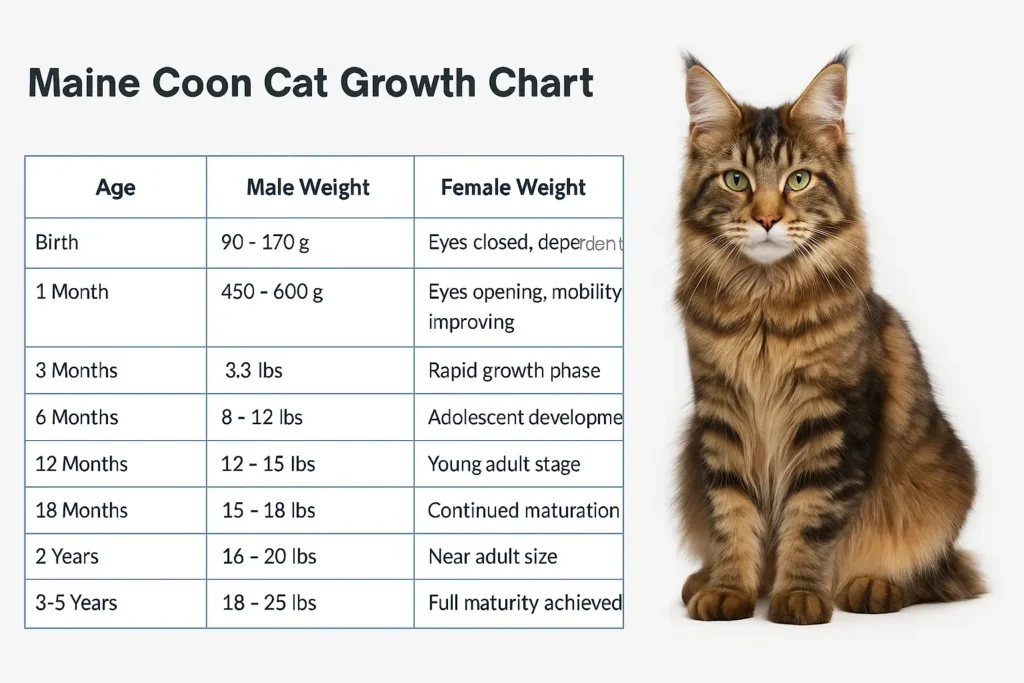
The first phase documented in any maine coon cat growth chart shows remarkable development during the initial months. Newborns typically weigh between 90-170 grams at birth. By the end of the first month, their weight increases to around 450-600 grams. This represents nearly a five-fold increase in body weight within just thirty days.
During this critical period, A male Maine Coon should weigh around 3 lbs at three months. The maine coon cat growth chart during this stage reflects the most dramatic weight gains your kitten will experience. Female kittens typically weigh slightly less, ranging between 2.5-2.8 pounds at the three-month milestone.
Three to Twelve Months: Sustained Growth Period
The maine coon cat growth chart from three to twelve months demonstrates continued rapid development. The first year is the fastest growth phase, with steady muscle development afterward. During this period, owners will notice significant changes in their cat’s physical structure, including leg length, body mass, and overall proportions.
By the end of its first year, it can weigh almost 15 pounds for male Maine Coons, while females typically reach 10-12 pounds. This substantial weight gain requires careful attention to nutrition and regular veterinary check-ups to ensure healthy development patterns align with standard maine coon cat growth chart expectations.
Adult Maine Coon Size Specifications
Male Maine Coon Growth Chart
Adult male Maine Coons represent the larger end of the maine coon cat growth chart spectrum. Males typically weigh between 20-25 lbs at full maturity, though some exceptional individuals may exceed these ranges. A male Maine Coon adult cat weighs between 15 and 25 pounds, with height measurements averaging 10-16 inches and lengths spanning 19-32 inches.
The maine coon cat growth chart for males shows continued development well into their third year, with some cats adding muscle mass and bulk until age five. This extended maturation period distinguishes Maine Coons from other domestic breeds and emphasizes the importance of long-term growth monitoring.
Female Maine Coon Growth Chart
Female Maine Coons follow a more conservative maine coon cat growth chart pattern. Females are generally smaller, averaging 10-15 lbs at full size. Most adult queens settle between 10 and 15 pounds, yet the normal span runs from 8 right up to 18 pounds, indicating significant individual variation within the breed.
The maine coon cat growth chart for females typically shows peak weight achievement between ages 2-3 years, with minimal additional growth afterward. However, some females may continue filling out until age four, particularly in terms of coat density and muscle definition.
Monthly Maine Coon Growth Chart Breakdown
| Age | Male Weight | Female Weight | Development Notes |
|---|---|---|---|
| Birth | 90 – 170 g | 90 – 150 g | Eyes closed, dependent |
| 1 Month | 450 – 600 g | 400 – 550 g | Eyes opening, mobility improving |
| 3 Months | ~3 lbs | 2.5 – 2.8 lbs | Rapid growth phase |
| 6 Months | 8 – 12 lbs | 6 – 9 lbs | Adolescent development |
| 12 Months | 12 – 15 lbs | 8 – 12 lbs | Young adult stage |
| 18 Months | 15 – 18 lbs | 10 – 13 lbs | Continued maturation |
| 2 Years | 16 – 20 lbs | 11 – 14 lbs | Near adult size |
| 3–5 Years | 18 – 25 lbs | 12 – 15 lbs | Full maturity achieved |
What Owners Actually Report at 3, 6, 12 and 24 Months
The chart above is the tidy version. The figures below are what Maine Coon owners posted in five r/mainecoons and r/MaineCoon weight threads across 2025 and 2026, converted to pounds where people posted in kilograms. The spread is much wider than any chart admits, and that width is the point.
| Age | Males, as reported | Females, as reported | What owners noted alongside |
|---|---|---|---|
| 3 months | ~3–4 lb (reference range) | ~2.5–3 lb (reference range) | Owner posts are rare this young; weight talk starts around 5 months |
| 6 months | 8.5–15 lb | ~7.7 lb in the few female reports | Littermates 4 lb apart at the same age was common |
| 12 months | 18–19 lb | 7.7–8.6 lb | The sex gap is at its widest here |
| 24 months+ | 18–20 lb typical, 30 lb reported once | 12.8–17.5 lb | Several owners said filling out continued past year four |
Two warnings before you measure your own cat against this. These are self-selected posts, so people with strikingly large cats are more motivated to reply than people with average ones, which pushes the top of every range upward. And home scales, vet scales, and estimates all sit in the same column here.
What the numbers do show reliably is the size of the gap between siblings. One owner in an r/mainecoons thread described a female at 3.5 kg and her brother at 5.5 kg at the same six months of age, a difference of roughly 4 lb between two kittens from one litter.
Read the reference chart as the middle of a wide band, not a target your cat is failing to hit.
Factors Influencing Maine Coon Growth Patterns
Genetic Contributions
Heredity plays a crucial role in determining where individual cats fall on the maine coon cat growth chart. Cats from larger breeding lines typically produce offspring that exceed average size expectations, while those from more moderate bloodlines may fall toward the lower end of standard maine coon cat growth chart ranges.
Quality breeding programs focus on maintaining healthy growth patterns rather than simply maximizing size. Reputable breeders provide maine coon cat growth chart data from previous litters to help new owners understand their kitten’s potential development trajectory.
Nutritional Requirements
Proper nutrition directly impacts how closely your cat follows an ideal maine coon cat growth chart. Kittens need more calories than adult cats since they’re growing constantly. High-quality kitten food should be provided until at least 12-15 months of age, with gradual transitioning to adult formulations.
The extended growth period shown in maine coon cat growth chart data necessitates sustained nutritional support beyond what other breeds require. Premium protein sources, appropriate fat levels, and essential vitamins support optimal development patterns outlined in comprehensive maine coon cat growth chart guidelines.
Health Monitoring Through Growth Charts
Regular weight monitoring using a maine coon cat growth chart helps identify potential health issues before they become serious problems. Sudden changes in growth velocity, whether accelerated or stunted, may indicate underlying conditions requiring veterinary attention.
Monthly weigh-ins during the first year, followed by quarterly assessments until maturity, provide valuable data points for comparison against standard maine coon cat growth chart benchmarks. Always weigh her on the same scale each time so you can spot real change, not scale error.
Regional Variations in Growth Patterns
Maine Coon cats from different geographic regions may show slight variations from standardized maine coon cat growth chart expectations. Climate, breeding practices, and genetic diversity within regional populations can influence final adult sizes and growth timelines.
European Maine Coons occasionally exceed North American maine coon cat growth chart standards, while cats from certain breeding programs may mature slightly earlier or later than typical timelines suggest. Understanding these variations helps owners set realistic expectations based on their cat’s specific background.
When to Consult Veterinary Professionals
While maine coon cat growth chart guidelines provide excellent reference points, individual cats may deviate from expected patterns for various reasons. Consultation with veterinary professionals becomes necessary when growth deviates significantly from maine coon cat growth chart norms.
Warning signs include failure to gain weight for extended periods, excessive weight gain suggesting obesity rather than healthy growth, or developmental delays in physical milestones. Early intervention guided by maine coon cat growth chart comparisons often prevents minor issues from becoming major health concerns.
Creating Your Personal Maine Coon Growth Chart
Developing a customized maine coon cat growth chart for your specific cat provides valuable insights into their individual development pattern. Record monthly weights, measurements, and developmental milestones alongside standard maine coon cat growth chart benchmarks for comparison.
Photography documentation complements numerical data in your personal maine coon cat growth chart, helping visualize changes in body proportions, coat development, and overall physical maturation. This comprehensive approach to tracking growth provides veterinarians with detailed information during routine examinations.
For additional guidance on Maine Coon care and development, Mainecoon Guides offers extensive resources for owners throughout their cat’s growth journey.
Is My Maine Coon Too Small?
A Maine Coon sitting below the chart is usually normal, not stunted. Size in this breed is driven by parentage more than by feeding, and a cat who is lean, active, eating well, and gaining steadily is developing correctly even when a chart says otherwise. The figure that matters is the trend on your own cat, not the gap to an average.
Smaller Can Be the Healthier Outcome
Owners tend to discover this at the vet rather than online.
“My girlies are 12 and 14 lbs. I used to think they were tiny until the vet told me they’re just a healthy weight for their age, and that they’ll have less joint problems because of it.”
– r/mainecoons, June 2026 (681 upvotes on the thread)
That trade-off is real. Extreme size carries a heavier load on hips and heart, and some buyers deliberately choose breeders who do not select for maximum size. A 12 lb Maine Coon is still a large cat by any other breed’s standard.
Females Are Meant to Be Lighter
Female Maine Coons commonly settle between about 12 and 17 lb, while males in the same threads reported 18 lb and up. Owners comparing a girl against a male-heavy chart routinely conclude something is wrong when nothing is. If your female is under 12 lb and holding steady with good muscle tone, she is small, not unwell.
If You Took Home the Runt
A runt who eats, drinks, plays, and gains weight steadily is on a slower curve rather than a failing one, and many never catch their littermates in size without that costing them anything. What warrants a vet visit is not smallness by itself but smallness with a symptom: weight loss or a stalled scale over several weeks, poor appetite, lethargy, a pot-bellied look, or diarrhoea. Parasite screening and a calorie check are where a vet will usually start.
Lean Until Four Is Normal
Maine Coons build frame first and fill it in afterwards, which is why an eighteen-month-old can look gangly and underweight while being entirely on track.
“On average can take up to 5 years for them to stop growing. Most of their growth is the first year, though. But I also have sisters where one is about double in size.”
– r/mainecoons, June 2026 (12 upvotes)
The same pattern shows up whenever someone posts a lanky adolescent and asks whether they are underfeeding.
“He’ll likely stay lean for a couple years, even while eating a ton. He’s a fine-looking kitty.”
– r/mainecoons, October 2025 (18 upvotes)
Weigh monthly, write it down, and judge the line rather than the single number. A cat gaining steadily on her own curve is the only growth chart that applies to her.
Conclusion
Understanding and utilizing a maine coon cat growth chart proves invaluable for Maine Coon owners committed to supporting their pet’s healthy development. These magnificent cats follow unique growth patterns requiring extended patience and consistent monitoring to ensure optimal outcomes. Regular tracking against established maine coon cat growth chart standards helps identify potential issues early while celebrating the remarkable transformation from tiny kitten to majestic adult cat.
The maine coon cat growth chart serves as more than just numbers on paper it represents a roadmap for providing appropriate care throughout your cat’s extended maturation period. By following established maine coon cat growth chart guidelines while remaining attentive to individual variations, owners can ensure their Maine Coon reaches their full genetic potential in terms of size, health, and development.
Whether you’re a first-time Maine Coon owner or an experienced enthusiast, maintaining awareness of maine coon cat growth chart expectations helps you provide the best possible care for these remarkable felines. Have you considered how your Maine Coon’s individual growth pattern compares to standard maine coon cat growth chart expectations?
One Comment