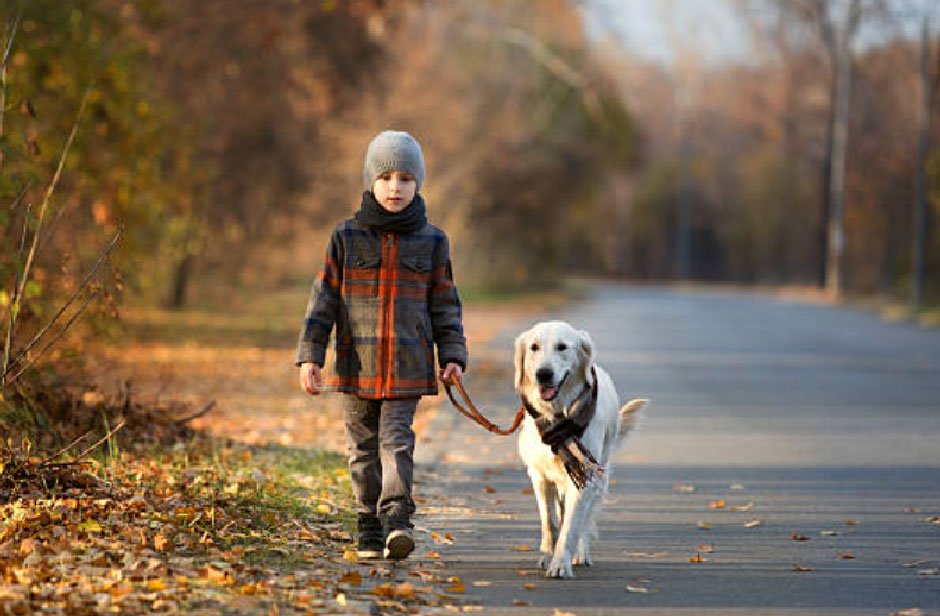
There’s a moment in most dog-owning households when a kid asks to take the dog around the block alone. It usually arrives around the same time they’re asking for more freedom everywhere else, and it’s a reasonable request. A daily walk is one of the most concrete responsibilities a child can own, and dogs benefit from the extra exercise. The trick is making sure the first solo walks are set up so both the kid and the dog come home without a scare.
Readiness for this job has less to do with a birthday than with a handful of skills that can be checked off one at a time. A child needs to handle traffic, control the specific dog on the end of the leash, know what to do when another dog shows up, and reach an adult quickly. Each of those can be practiced well before the first solo outing. Here’s how to work through them in a practical order.
Start With Street Smarts
Before a child’s ready to manage a dog near traffic, they need to manage themselves near traffic. The AAP’s pedestrian safety guidance for families notes that most children aren’t ready to cross a street alone until they’re at least 10 years old, and some need longer. That benchmark matters even more with a dog in tow, since a lunging dog can pull a kid’s attention away from cars at exactly the wrong moment. If a child can’t yet cross the street consistently and safely on their own, they’re not ready to do it while holding a leash.
The same guidance flags a few habits worth drilling: crossing at corners or crosswalks, making eye contact with drivers, and watching driveways where cars back out. It also points out that sunrise and sunset are tricky for drivers because of the shifting light, which is worth knowing since plenty of dog walks happen right after school or right before dinner in the darker months. A few weeks of walking the route together, with the child narrating what they’re checking at each crossing, turns those rules into habits. Parents also get a clear read on whether the kid’s actually ready instead of guessing.
Match the Dog to the Walker
A 10-year-old who weighs 75 pounds and a 90-pound Labrador with a squirrel habit aren’t an even match, no matter how well the kid knows the rules. A practical test is whether the child can hold the dog in place when it spots something exciting, like a cat, a jogger, or another dog across the street. If the dog pulls hard enough to drag the child even a step, solo walks should wait until leash training catches up. A front-clip harness or head halter can help, but equipment doesn’t replace a dog that reliably walks without pulling.
Temperament counts as much as size. Dogs that react to other dogs, chase bikes, or panic at loud noises need an adult on the leash, because a kid won’t have the strength or the split-second judgment to manage a sudden lunge. Older dogs bring different considerations, since a senior dog that tires halfway through a loop can leave a child stuck far from home with a dog that won’t move. Kids walking an aging dog should learn the early signs of mild arthritis in dogs, such as stiffness that eases after a few minutes or hesitation on stairs, so they can shorten the route and tell an adult what they noticed.
Plan a Route That Sets Them Up to Succeed
The first solo route should be boring on purpose. A short loop on familiar streets with sidewalks, light traffic, low speed limits, and as few crossings as possible gives a child room to focus on the dog. It’s smart to avoid routes that pass yards with fence-running dogs, parks where off-leash dogs are common, or construction zones. Agreeing on the exact route in advance also means a parent knows where to look if a check-in doesn’t come through.
Timing matters too. Drivers have an easier time spotting a small pedestrian and a dark-coated dog in full daylight, and a reflective leash or vest helps on overcast afternoons. In summer, walks should happen early or late enough that the pavement won’t burn paw pads, and pressing the back of a hand to the asphalt for a few seconds is an easy check kids can do themselves. Kids should also carry waste bags, plus a water bottle and a collapsible bowl on warm days, since cleaning up and caring for the dog are part of the job.
What to Do When a Loose Dog Approaches
Unleashed dogs are the scenario parents worry about most, and with reason. AVMA’s dog bite prevention guidance notes that millions of people in the U.S. are bitten by dogs each year and that about half of bite victims are children. Kids walking a dog of their own face a specific version of that risk, since a loose dog may be more interested in the leashed dog than in them. Rehearsing a plan at home makes it far more likely the child will follow it when their heart’s pounding.
The core rules are simple to teach. Kids shouldn’t run, because dogs naturally chase, and they should stay calm, avoid staring at the approaching dog, and back away slowly once it loses interest. A child should never step between two dogs that are squaring off or reach in to separate them, since hands near a scuffle are easy targets. If the child gets knocked down, they should curl into a ball and cover their face and neck with their hands.
Some families also decide in advance when the child should let go of the leash. Releasing a small dog during a fight carries its own risks, but a child’s safety comes first, and making that call ahead of time spares them from deciding under stress. Afterward, the child’s job is to get somewhere safe and call home immediately, which raises the question of how they’ll reach anyone at all.
A Way to Call an Adult in an Emergency
Nearly every scenario in this checklist ends the same way when something goes wrong: the child needs to reach an adult fast. A loose dog that bites, a family dog that slips its collar and bolts toward traffic, or a dog that collapses from the heat a mile from home aren’t situations a kid should handle alone. Shouting for a neighbor isn’t a plan, and a child can’t run home while holding onto an injured or frightened dog. Kids walking solo need a phone they can use to call a parent, a backup adult, or 911 within seconds.
That makes the phone question as important as the leash question, and the priority should be reliability when it counts. Plenty of families start kids out with a safer phone that handles calls and texts to family but leaves out the internet browser, social media, and games, so it works as a direct line to parents when something goes wrong. That matters on a walk, since the AAP warns against texting, scrolling, or wearing earbuds while walking, and a phone with nothing to scroll stays in a pocket until it’s needed. Pair it with a family rule that calls from home always get answered, and the device works in both directions: the child can call for help, and a parent can reach them the moment a check-in runs late.
In an emergency, the most useful thing a child can tell an adult is exactly where they are. Kids should practice naming the cross streets or landmarks at each turn of their route, so a parent or a 911 dispatcher can find them quickly. A short check-in routine reinforces the habit, with a text when the child leaves, one at the halfway point, and one when they’re back. If a check-in doesn’t arrive, the parent calls right away instead of waiting.
Teach Kids When the Dog Needs Help
Kids also need to recognize when the problem is the dog itself. Heavy panting that won’t settle, stumbling or collapse, a sudden refusal to put weight on a leg, or a dog that’s gulped something from the gutter are all reasons to stop the walk and call an adult. Reviewing the signs a dog needs emergency vet care together, especially overheating after exercise and eating something toxic, gives a child a short mental checklist instead of a vague sense that something’s off. The rule should be easy to remember: if they’re not sure, they call.
It helps to write the essentials on a card the child carries or saves in their contacts, including a parent’s number, a backup adult, and the family vet. Kids don’t need to make medical decisions on a sidewalk, but they do need to describe what happened clearly. Practicing that at home, with a parent playing the person on the other end of the call, makes the real thing a lot less frightening.
Build Up in Stages
The smoothest transitions happen gradually. Start with walks where the child holds the leash and makes every decision while a parent walks alongside without stepping in. Next, the parent trails half a block behind, then waits at home while the child does a short, familiar loop with check-ins. Only after several weeks of uneventful walks should the route get longer or the timing get trickier.
Each stage gives parents something concrete to evaluate. Did the child stop at every crossing without prompting? Did the dog stay manageable when another dog passed? Did the check-ins come through on time, every time? When the answers are consistently yes, the next step is earned rather than simply handed over, and kids tend to take earned freedom more seriously.
A Responsibility Worth Getting Right
Handing over the leash is a real vote of confidence, and kids feel it. With the groundwork done, solo dog walks build independence, routine, and a stronger bond with the family dog, while parents know exactly what their child will do if something goes wrong. The preparation takes a few weeks, but it covers the situations that actually cause trouble: traffic, a dog that’s too strong, a loose dog, a medical emergency, and a missed check-in. Get those right, and the daily walk becomes one of the best jobs a kid can have.