Rare cat breeds get ranked by looks far more often than by records, which is why the lists disagree. The Cat Fanciers’ Association registers and exhibits over 40 pedigreed breeds, and it treats low registration numbers as the clearest sign that a breed is rare.
There is no worldwide census of domestic cats. Every claim about the rarest breed is therefore a claim about one registry’s records, and two breeds called rare can mean very different things: a centuries-old breed with a shrinking gene pool, or a newer breed whose recognition process has not finished.
What makes a cat breed rare in a registry
CFA’s own writing on the subject is blunt about the first measure. In a September 2025 article on rare and unusual breeds, CFA allbreed judge emeritus Patricia Jacobberger says small registration numbers are a clear indication that only a few cats are bred and only a few breeders work with them.
That makes rarity a record-keeping fact rather than a judgement about how strange a cat looks. Four measures carry most of the weight:
- Registration count: kittens registered per year with a body such as CFA, the number CFA calls its clearest signal.
- Status class: where a breed sits in the recognition process, from a newer class through to full championship competition.
- Breeder base: how many catteries breed the cat at all, which decides how long a waiting list runs.
- Geographic spread: whether the breed exists outside its country of origin, or hardly does.
Wild cats stay out of this list. The sand cat and the Pallas’s cat are separate species, not domestic breeds, and neither is a household pet in most places; a video of one is not evidence about rare cat breeds. The same rule applies to the hybrids sold as domestic cats, which bring wild ancestry into a registry that measures registered kittens.
A breed can score low on one measure and high on another. That is why no single ranked list of rare cat breeds exists, and why size causes its own confusion: the biggest breeds are covered in our guide to big cat breeds, and a large cat is not a scarce one.
The rare cat breeds CFA registers least often, and its newer classes
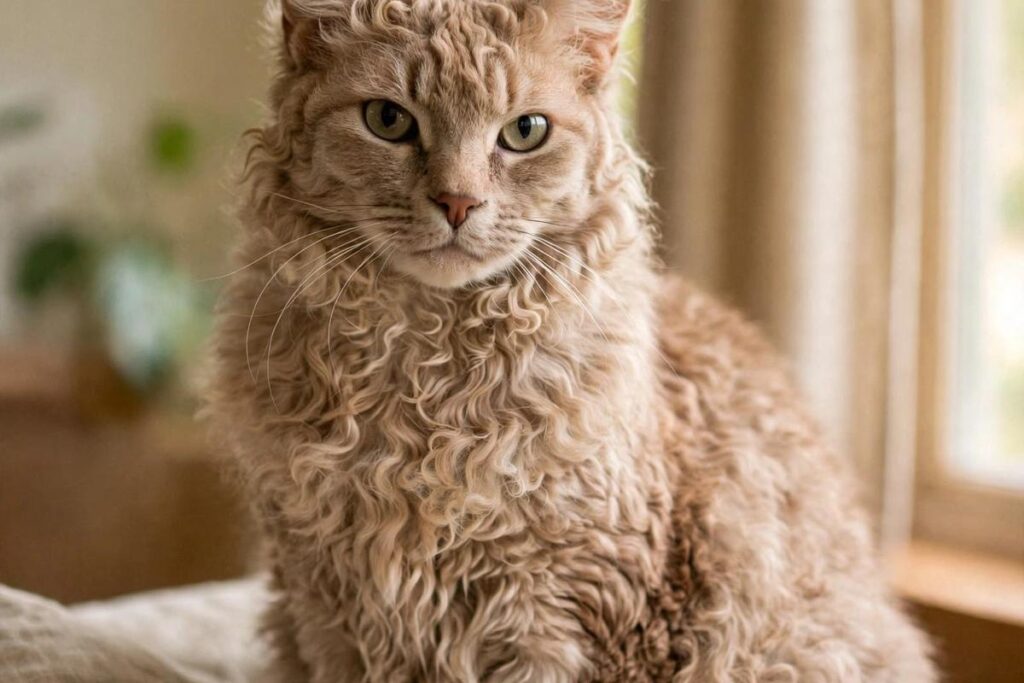
The closest thing to an official answer is short. CFA’s article names five breeds as its least frequently registered: the American Bobtail, the American Wirehair, the LaPerm, the Khao Manee and the Turkish Van.
Origins, weights and status come from CFA’s breed descriptions. Ranges differ between the sexes where CFA gives them.
| Breed | Origin | Coat and eyes | CFA standing | Adult weight |
|---|---|---|---|---|
| American Bobtail | United States, Arizona, late 1960s | Longhair or shorthair, naturally bobbed tail | Registered breed, among CFA’s five least registered | Males 12-16 lb, females 7-11 lb |
| American Wirehair | United States, upstate New York | Wiry crimped coat, each hair bent or hooked | Registered breed, among CFA’s five least registered | Males up to 12 lb, females 8-12 lb |
| LaPerm | United States, Oregon | Curly coat, ringlets or corkscrews | Registered breed, among CFA’s five least registered | Males 7-12 lb, females 6-9 lb |
| Khao Manee | Thailand | Always pure white, short close-lying coat, often odd-eyed | Miscellaneous class, accepted for registration in 2018 | 6-10 lb |
| Turkish Van | Lake Van region, Turkey | Longhair with no undercoat, colour on head and tail only | Registered breed, among CFA’s five least registered | Males 10-20 lb, females 7-12 lb |
What the five share is a small founder population. Four of them trace to a handful of cats found within the last century, and the fifth, the Turkish Van, has been bred in a narrow pattern for far longer, which keeps its numbers low for a different reason.
Read the status column before the weights. A breed can be registered and shown for decades and still be scarce, while a breed in a newer class is scarce partly because the process is unfinished.
The Khao Manee carries both halves at once. Thai royalty kept the cats, they appear as a good-luck cat in the Tamra Maeo, the Thai book of cat poems, and the breed stayed inside Thailand until 1999. CFA accepted it for registration in 2018 and, in the 2025 description, still shows it in the Miscellaneous class, the stage below full championship competition.
That class changes what a buyer is dealing with. A breed with few breeders and a short show record runs waiting lists measured in months, and a kitten can be registered while its class is still below championship. The American Bobtail, the American Wirehair and the LaPerm came from farm-born mutations, one in Arizona, one in upstate New York and one in Oregon, while the Khao Manee and the Turkish Van are old breeds from Thailand and eastern Turkey.
Old breeds that stay uncommon
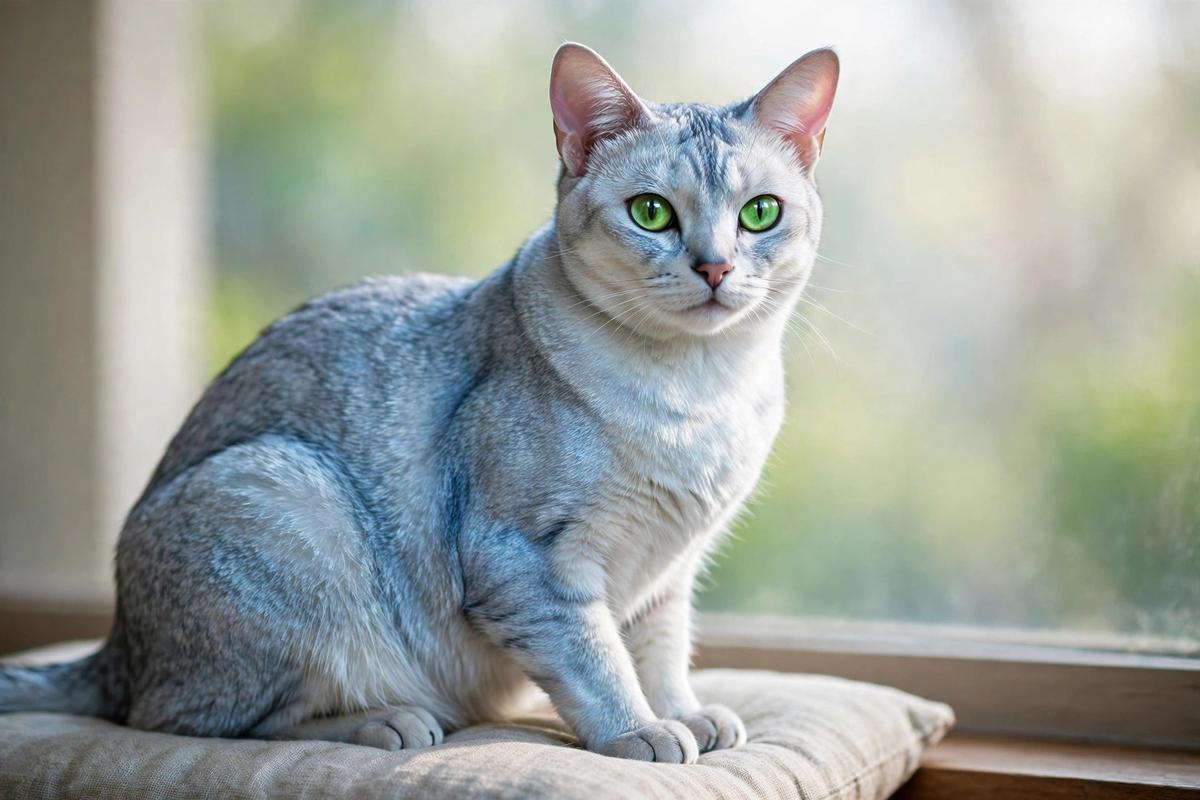
The Korat argues against equating old with common. CFA’s breed profile dates its documentation to Thailand in the 1300s, with the earliest record in the Cat-Book of Poems, or Smud Khoi of Cats, produced during the Ayudhya period between 1350 and 1767.
That book illustrates 17 good-luck cats of Thailand, of which the Korat is the best known. The cats were traditionally given as gifts to brides, and Jean Johnson imported the first two into the United States in 1959. CFA describes the breed as a silver-tipped blue coat that shimmers in sunlight, with luminous green eyes.
Owners describe the breed as talkative in a specific way: CFA notes that Korats are expressive and skilled at communicating with their people, a trait breeders mention as often as the coat.
Centuries of history have not produced large numbers. A breed can be documented for 700 years and still depend on a handful of catteries, which is why a long pedigree and a common cat are separate claims.
Rare colours are not rare breeds
A calico cat is not a breed, and a male calico is not a rare breed. He is an ordinary cat with an unusual chromosome set. Orange colour sits on the X chromosome, and a 2025 study in Current Biology traced the tortoiseshell and calico pattern to a deletion at the X-linked ARHGAP36 locus.
A cat needs two copies of the orange variant, one on each X, to show the patched pattern, so nearly every calico is female. A male calico has to carry an extra X. The rarity is in the chromosomes, not in a breed registry.
Search interest in a rare three-colour cat usually lands on the same answer. Three colours require both the orange variant and a second patterning gene, and the combination shows up in females far more often than in males, so the rare three-colour cat people are looking for is almost always a male calico or tortoiseshell.
Sellers lean on the gap between colour and breed. A kitten advertised as rare because of its markings may be a domestic shorthair with no registration behind it, and the label costs nothing to print.
“What breed is she? I got her as a gift from one of my uncles when I was in seventh grade. He told me she was a rare breed. 😭”
– r/IndianCats, 646 upvotes
The same confusion surrounds Maine Coon colours, where a scarce pattern is a colour question rather than a breed question. The calico Maine Coon page separates the two.
Nothing in the record supports a single most-unique cat. The look that draws the label most often is the odd-eyed white of the Khao Manee, one blue eye and one amber, yellow or green, followed by the tight curls of the LaPerm.
Where the Maine Coon fits
The Maine Coon is the mirror image of a rare breed. CFA’s breed profile calls it perhaps the most popular breed born in America and the largest of all pedigreed cats, with mature males reaching at least 20 pounds and growth taking up to three years.
Popularity does not make every colour common. Judges assess colour against the breed standard, and some patterns appear far less often than the classic brown tabby. Our page on Maine Coon colours sets out what the standard allows.
If a Maine Coon search brought you here looking for something scarce, the answer is that the breed is not rare, and that a colour is not a breed.
Before you buy a breed that is called rare
Ask for the registration number before the price. A CFA-registered kitten’s number ties the cat to a recorded sire and dam, and the association publishes the breed pages and standards that the number can be checked against.
Ask which class the breed is in. A Miscellaneous-class breed is shown in a different ring from a championship breed, and a breeder who cannot name the class is not following the process that makes the papers mean something.
Expect a waiting list. The breeds with the smallest registration numbers cannot supply kittens on demand, and a breeder with a genuinely rare breed available this week invites a question about where the kitten came from.
Price follows those checks rather than leading them. Waiting-list length, colour and show lines move a figure up or down, and none of those factors tells you whether the breed is rare. A single number would be wrong for most catteries within a season, so none is given.
Health testing is the last item to ask about, and the questions differ by breed. Ask for the tests the breed’s parent club recommends instead of a general assurance that the cat is healthy. Weights and lifespan lines here come from CFA’s breed descriptions.
CFA’s breed pages are public, so the check costs one registration number and a few minutes of reading.