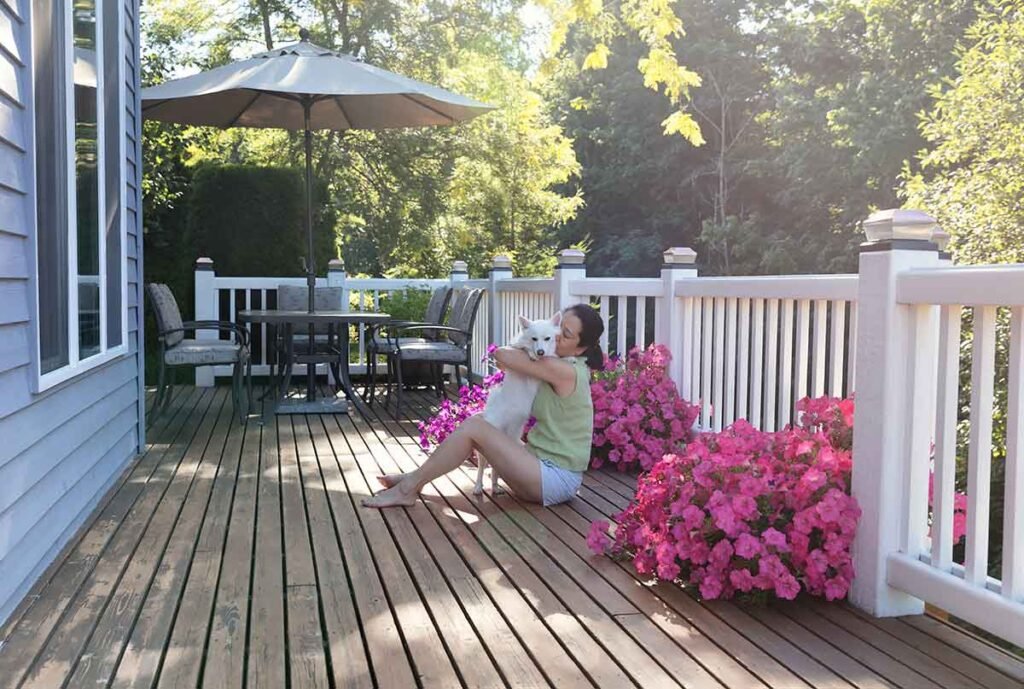
If you share your home with a dog that bolts off the back door at full speed every morning, you already know the truth: a deck takes a beating that has nothing to do with foot traffic. Nails dig in on the turns. A 90-pound shepherd does not “walk” down stairs, he launches. Whatever surface you build is going to live with claws, accidents, shedding, summer heat, and the occasional chewing phase.
Choosing the right material upfront makes the difference between a deck that ages gracefully and one that looks worn out in a few seasons. Below are five materials worth considering if you own pets, ranked by how they handle real animal wear, with honest notes on where each one falls short. There’s a comparison table further down and a FAQ at the end covering the questions that come up most often.
First, a word on what “pet-friendly” actually means, because the phrase gets thrown around loosely. It really comes down to four things: scratch resistance, how the surface handles heat under paws, how easy it is to clean up urine and mud, and whether the gaps between boards are small enough that small claws and toes don’t catch. A material can win on one of those and lose badly on another. Composite shrugs off scratches but can get hot. Wood stays cooler but scratches if you look at it wrong. So the “best” choice depends a lot on the specific animal you live with.
1. Capped Composite Decking
This is the one most decking pros recommend first for dog owners, and it’s a common starting point when homeowners ask a builder to spec out a deck for a house full of pets. The cap is a hard polymer shell bonded over the composite core, and that shell does the heavy lifting against claws.
Scratch resistance is the headline. A medium or large dog can run, brake, and pivot on capped composite for years without leaving the kind of gouges you’d see on softwood. Cleanup is just as good. Urine doesn’t soak in, mud hoses off, and there’s no staining or sealing every season.
Where it bites back: heat. A dark-colored capped board in direct afternoon sun can get hot enough that a dog won’t want to stand on it, and in extreme cases hot enough to be uncomfortable on paw pads. If a yard gets brutal western sun, a lighter color dodges most of that problem.
Lifespan with pets runs roughly 25 to 30 years, and the cap holds its look the whole time whether the household has a chihuahua or a Great Dane. Animal size barely moves the number here, which is a big part of the appeal.
2. PVC (Cellular) Decking
PVC is the lightest of the synthetic options and the best at handling moisture, which matters more than people think when pets are involved. Anyone who has cleaned up after a dog that wasn’t fully house-trained, or who lives with an older animal having accidents, will appreciate what a non-porous surface saves you.
It scratches a little more easily than the hardest capped composites, so a determined large breed can leave faint marks over time. Nothing dramatic, but worth knowing. The flip side is that PVC tends to run cooler than dark composite and weighs less, which makes it a good pick for elevated or rooftop decks.
Lifespan lands around 25 to 30 years with pets of any size. Cats are essentially a non-issue on PVC. Big dogs are fine too, though it’s smart to keep an eye on heavily used pivot points near the door.
3. Hardwood (Ipe and Other Tropical Hardwoods)
For homeowners who want real wood and have animals, hardwood is the way to go, not cedar or pine. Ipe in particular is dense enough that a dog’s claws don’t sink in the way they do with softwood. It’s genuinely tough, and it looks like nothing else.
Two honest drawbacks. First, it needs maintenance. Keeping that rich color means oiling it periodically, and a deck that sees constant paw traffic shows wear faster between treatments. Let it weather to gray and you skip the oiling, but the surface still takes scratches, they’re just harder to see. Second, cost and installation. Hardwood is heavy, hard to cut, and pricier than most composites.
Lifespan is excellent, 30 to 40 years or more with maintenance, and large dogs don’t shorten that much because the wood is so dense. Small pets have essentially no effect on it. The wear you’ll notice is cosmetic, not structural.
4. Aluminum Decking
Aluminum doesn’t come to mind for most backyards, but for certain pet situations it’s quietly brilliant. It will not scratch, will not rot, will not splinter, and claws do absolutely nothing to it. Cleanup is the easiest of anything on this list because the surface is completely sealed.
The catch is the same as composite, only more so: heat. Bare aluminum in full sun gets hot. Most aluminum decking now comes with a textured powder-coated finish that helps, and a shaded or covered deck removes the issue entirely, but a dark aluminum deck in a sun-blasted yard is not where a dog will want to lounge at 3 p.m. in July.
Lifespan is the longest here, 30 or more years and effectively immune to animal wear of any size. If scratch-proofing is the single biggest concern, this is the material that delivers it.
5. Pressure-Treated Wood
Pressure-treated lumber earns a spot because it’s the budget reality for a lot of households, and a pet-friendly deck shouldn’t require taking out a loan. It’s the most affordable option by a wide margin and easy to repair, since swapping a single chewed or gouged board costs a few dollars.
Be clear-eyed about the tradeoffs, though. It’s soft. A large active dog will scratch it, and over the years those scratches add up. It’s porous, so urine and accidents need prompt cleanup or you’ll get staining and odor. And it demands regular sealing to fight rot, which matters more on a deck that’s constantly getting wet from paws, drool, and water bowls.
Lifespan with a big dog is realistically 10 to 15 years before it looks rough, sometimes less if maintenance slips. With cats or small dogs you’ll get more, closer to 15 to 20, because the wear is so much gentler. If budget is the deciding factor, it’s a fine starting point, just plan on more upkeep than any synthetic.
Comparison Table
| Material | Scratch Resistance | Heat Underfoot | Cleanup (urine/mud) | Lifespan: Large Dog | Lifespan: Cat / Small Dog | Relative Cost |
| Capped Composite | Excellent | Warm (worse in dark colors) | Excellent | 25–30 yrs | 25–30 yrs | High |
| PVC | Very Good | Moderate | Excellent | 25–30 yrs | 25–30 yrs | High |
| Hardwood (Ipe) | Very Good | Cool | Good (needs prompt cleanup) | 30–40 yrs | 35–40+ yrs | High |
| Aluminum | Outstanding | Hot in sun (finish helps) | Excellent | 30+ yrs | 30+ yrs | Medium–High |
| Pressure-Treated Wood | Fair | Cool | Fair (porous) | 10–15 yrs | 15–20 yrs | Low |
A pattern jumps out once it’s laid side by side: the synthetics barely care how big your dog is, while wood lifespans swing hard based on the animal. That’s the single most useful thing to understand when choosing. For a large, high-energy breed, the gap between capped composite and pressure-treated pine is measured in decades, not years.
How Pet Size and Type Actually Change the Math
The size question matters more than almost any other factor, so here’s the short version of how it tends to play out.
Large, active dogs are the real test. The damage isn’t random scratching, it’s concentrated. The three feet of decking right outside the door and the top two stair treads take the brunt of it, because that’s where the bracing, braking, and pivoting happen. On softwood those spots wear out first. On capped composite, PVC, and aluminum they hold up the same as the rest of the deck. That’s the whole reason big-dog households are usually steered toward a hard-capped surface.
Cats and small dogs are gentle by comparison. Their claws are sharp but they’re not generating the force a big dog does on a hard stop, so even softer materials hold up reasonably well. A home with a cat and a couple of small dogs has more freedom to choose on looks and budget rather than pure durability.
One detail that’s easy to overlook: gap width. Small claws and toes can catch in wide board gaps, and tiny kittens or small breeds occasionally get a nail stuck. Tighter spacing or a hidden-fastener system that keeps gaps consistent solves this, and it’s worth raising with whoever builds the deck before the boards go down. Experienced builders such as the team at Wolf Spirit Deck in Naperville, IL plan for this kind of detail, because the right gap and the right board height around stairs make a bigger difference for pets than most homeowners expect.
Frequently Asked Questions
What is the best decking material for dogs? For most dog owners, capped composite is the strongest all-around choice. It resists claw scratches, cleans up easily after accidents, and lasts 25 to 30 years regardless of a dog’s size. If a yard gets intense afternoon sun, picking a lighter color keeps the surface cooler underfoot, or PVC is worth a look since it tends to run cooler.
Will a dog’s nails scratch composite decking? Capped composite is built to resist exactly this. The polymer cap on the surface stands up to claws far better than softwood. A large, active dog won’t gouge it the way it would scratch pressure-treated pine. Uncapped or older-generation composite is more vulnerable, so if scratch resistance is the priority, it’s worth confirming the boards are capped.
Does composite or aluminum decking get too hot for paws? Both can get hot in direct sun, and dark colors get the hottest. Aluminum and dark composite are the two to watch. Lighter colors, a shaded or covered deck, or choosing PVC or hardwood all help keep the surface cooler. If a deck bakes in the afternoon, surface temperature is worth factoring into the color choice from the start.
How long will a wood deck last with a large dog? A pressure-treated wood deck with a big, active dog realistically lasts 10 to 15 years before it looks worn, sometimes less if sealing falls behind. Dense hardwoods like ipe do far better, lasting 30 years or more because the wood is too hard for claws to dig into easily. With cats or small dogs, even pressure-treated wood stretches to 15 to 20 years.
Is wood or composite better for a home with both cats and dogs? If the dogs are large and active, composite or PVC wins on durability and easy cleanup. If the pets are cats and small dogs, there’s more room to choose wood for the look and lower upfront cost, since lighter animals don’t wear a deck down nearly as fast. Either way, keeping board gaps tight stops small claws from catching.
Are wider board gaps a problem for small pets? They can be. Small claws and toes occasionally get caught in wide gaps, especially with kittens and toy breeds. A hidden-fastener system, or simply specifying tighter, consistent spacing, fixes it. It’s smart to mention pets to the deck builder before installation so the gaps and stair treads are sized with them in mind.
The Bottom Line
There’s no single right answer, but there are clear patterns. For a big dog and a build-once-and-forget-about-it approach, capped composite or PVC is the move. For real wood that survives animals, it pays to spend on a dense hardwood like ipe rather than cheap softwood. If scratch-proofing is everything, aluminum is unbeatable. And if budget rules the decision, pressure-treated wood works, it just means more maintenance and replacing it sooner.
The most important step is matching the material to the actual animals in the home, not to a generic recommendation. A household with two cats has completely different needs than one with a pair of energetic labs. Homeowners weighing these tradeoffs often find it helps to talk through their specific pets with a local builder. Companies like Wolf Spirit Deck, which serves Homer Glen and the surrounding area, can walk through board choice, gap spacing, and stair design with a particular dog or cat in mind. Get that match right and the deck will outlast a lot of other things in the yard.