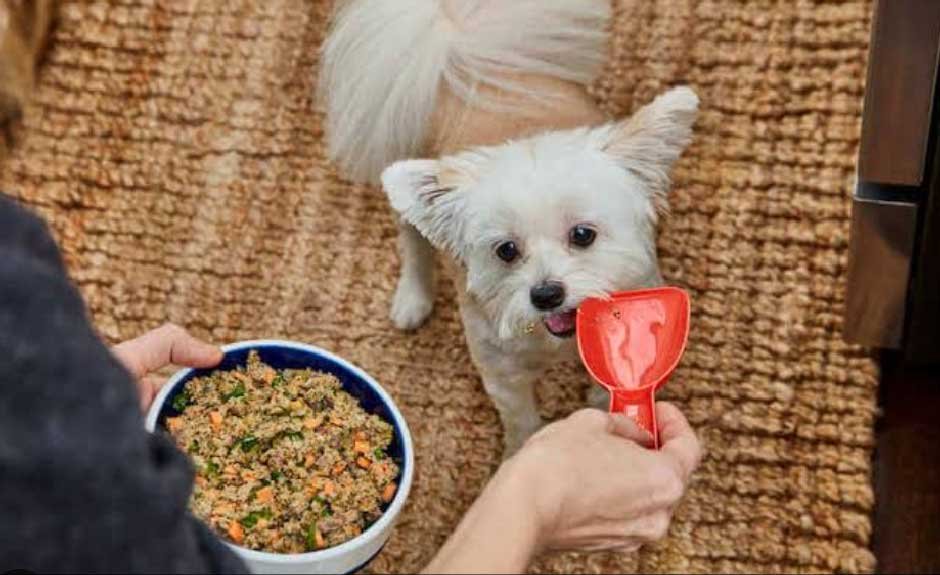
Puppies need roughly 5-6% of their expected adult body weight in food per day, split across 3-4 meals depending on age. For a puppy expected to weigh 50 pounds at maturity, that means about 2.5-3 pounds of food daily. But the real answer is messier than a single formula because caloric density varies wildly between brands, and breed size changes everything about feeding math.
Ask ten puppy owners how they figure out portions and you’ll hear ten different answers. The feeding chart on the bag? Vague. Online calculators? Often built for adult dogs. Your vet? They’ll say “watch the body condition” which sounds wise but doesn’t help when you’re standing in the kitchen at 6 a.m. holding a scoop.
This guide walks through the numbers, the nuances, and the real-world methods that actually work.
Puppy Feeding Chart by Weight & Age
The most referenced starting point is a weight-and-age table that maps a puppy’s expected adult size to daily food portions. Below is a consolidated feeding chart based on data from Purina, Pawlicy, and veterinary nutrition guidelines.
| Expected Adult Weight | 1.5-3 Months | 4-5 Months | 6-8 Months | 9-11 Months | 1-2 Years |
|---|---|---|---|---|---|
| 3-12 lbs | ½ to 1 cup | ⅔ to 1⅓ cups | ½ to 1½ cups | Feed as Adult | Feed as Adult |
| 13-20 lbs | ½ to 1¼ cups | 1⅝ to 2 cups | ¾ to 1⅓ cups | ½ to 1½ cups | Feed as Adult |
| 21-50 lbs | ½ to 1½ cups | 1½ to 2¾ cups | 1⅝ to 2⅓ cups | 2 to 3 cups | 2 to 4¼ cups |
| 51-75 lbs | ⅙ to 2⅓ cups | 1½ to 4 cups | 1½ to 3¾ cups | 2½ to 4¾ cups | 2⅙ to 6¼ cups |
| 76-100 lbs | 1 to 2⅔ cups | 2⅝ to 3¾ cups | 2⅝ to 6⅓ cups | 3⅝ to 7 cups | 5⅙ to 11 cups |
| 101+ lbs | 2⅔ cups + ⅓ cup per 10 lbs over 100 | 3¾ cups + ⅓ cup per 10 lbs over 100 | 6⅓ cups + ⅓ cup per 10 lbs over 100 | 7 cups + ⅓ cup per 10 lbs over 100 | 11 cups + ⅓ cup per 10 lbs over 100 |
These numbers assume a standard dry kibble with roughly 350-400 calories per cup. The PetMD calorie table offers a more precise approach: a 10-pound puppy needs approximately 649 calories per day, while a 30-pound puppy requires around 1,487 calories. Individual needs can vary up to 50% in either direction based on activity level and metabolism, so treat charts as starting points, not scripture.
How Feeding Frequency Changes as Puppies Grow
The amount of food matters, but so does how you split it across the day. Puppies have small stomachs and unstable blood sugar. They cannot handle the twice-a-day schedule that works for adult dogs.
Newborns nurse every 2-3 hours. Once weaned onto solid food around 6-8 weeks, most puppies need four meals a day until roughly 12 weeks old. From 3-6 months, drop to three meals. After six months, two meals per day are sufficient for most breeds. Tiny and toy breeds may need three meals longer because their blood sugar crashes faster between feedings.
Free-choice feeding, where food sits out all day, makes it hard to track intake and house-train consistently. Time-restricted meals, where you put the bowl down for 15-20 minutes then remove it, give you far better control over both appetite and bathroom timing.
Breed Size Matters: Small vs Large Breed Feeding Needs
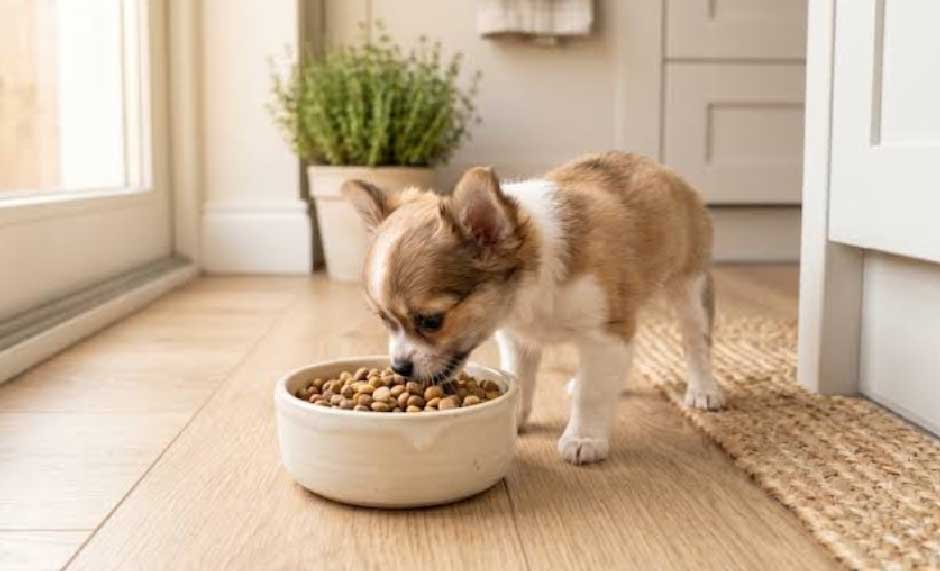
The puppy feeding conversation changes completely depending on whether you’re holding a Chihuahua or a Great Dane. Small breeds reach adult size fast, often by 9-10 months. Their food needs peak early and then level off. Large and giant breeds keep growing for 18-24 months, which means they need sustained nutritional support through a longer window.
Large breed puppies also face a risk small breeds don’t: growing too fast. Rapid growth in large breeds can stress developing joints and contribute to hip dysplasia and other orthopedic problems. For this reason, large breed puppy formulas intentionally moderate calorie density and calcium levels. A Labrador puppy on standard puppy food might pack on weight too quickly; the same pup on a large breed formula gets the same nutrients spread over fewer calories per cup.
Small breeds have the opposite challenge. Their tiny stomachs hold less volume, so their food needs to be more calorie-dense to compensate. Toy breed formulas typically pack 400-500 calories per cup versus 350-400 for standard puppy food.
Why the Kibble Bag Label Isn’t Enough
“Feed 2-3 cups per day.” That range on the side of the bag sounds straightforward until you realize it spans a 50% difference and leaves you guessing where your puppy falls. For a 40-pound target weight, the difference between 2 and 3 cups is roughly 350-400 calories, enough to turn a lean puppy into a chunky one over the course of a month.
Many bags base their recommendations on estimated adult weight, a number that requires a crystal ball when you have a mixed breed puppy. A kitchen scale helps enormously here. One cup of kibble can weigh anywhere from 3.5 to 5 ounces depending on the brand and kibble size. Measuring by weight in grams rather than by volume in cups eliminates the ambiguity.
This confusion is not unique to new owners. On r/puppy101, one owner with a 5-month-old lab mix summed up the universal experience:
“The bag says ‘2-3 cups’ which is about as helpful as ‘feed some food.’ Turns out I was overfeeding by like 30%.”
— r/puppy101, 18 upvotes, 28 comments (2025), source
Another owner in the same thread described using a digital kitchen scale to weigh portions after discovering that “depending on who scoops, we could be giving anywhere from 10 to 14 ounces. 10 ounces they lose weight, 14 ounces they gain.” That 4-ounce swing per day, sustained over weeks, produces two very different puppies from the same bag of food.
How to Tell If You’re Feeding the Right Amount
Charts and calculators eventually hit a wall because every puppy is an individual. The most reliable gauge is body condition scoring, a hands-on assessment vets use to judge whether an animal is underweight, ideal, or overweight.
For a puppy at ideal weight, you should be able to feel the ribs easily under a thin layer of fat but not see them prominently. Looking down from above, the waist should tuck in behind the ribcage. From the side, the belly should slope upward toward the hind legs. If the ribs disappear under padding and the waistline vanishes, cut back slightly. If the ribs and hip bones protrude sharply, increase portions.
Monthly weigh-ins provide the other half of the feedback loop. Puppies should gain weight steadily but not explosively. A sudden jump in growth rate might mean you’re overfeeding. A plateau might signal it’s time to increase portions or check for health issues. Veterinary nutritionists at Banfield Pet Hospital recommend weighing your puppy at the same time of day, ideally before the morning meal, to get consistent readings.
Common Puppy Feeding Mistakes That Throw Off Portions
The three most common mistakes that sabotage puppy portions are forgetting to count training treats, switching foods without recalculating calories, and assuming every puppy of the same breed needs the same amount. Each of these can silently add or subtract hundreds of calories per week.
Forgetting to count training treats. If you’re doing 10-15 short training sessions a day, those tiny liver bits add up. Treats should account for no more than 10% of a puppy’s daily calorie intake. For a 20-pound puppy eating 800 calories per day, that’s an 80-calorie treat budget. A single large Milk-Bone is about 125 calories, meaning one treat blows the entire budget.
Switching foods without adjusting portions. Different brands have different caloric densities. Moving from one kibble to another without recalculating can lead to accidental underfeeding or overfeeding. Always check the kcal per cup on the new bag and adjust.
Assuming all puppies of the same breed need the same amount. Littermates raised in different homes with different activity levels can require noticeably different food volumes. A puppy that spends its days running in a yard needs more fuel than one that mostly naps in an apartment.
Frequently Asked Questions
How many calories should puppies eat?
A puppy’s daily calorie needs range from roughly 125 calories for a 1-pound puppy to over 2,000 calories for a 50-pound puppy. The most accurate formula multiplies the puppy’s weight in kilograms raised to the 0.75 power by a factor of 130-200, depending on age and activity level. As a simpler rule, growing puppies need about twice the calories per pound of body weight compared to adult dogs of the same breed.
Can puppies eat adult dog food?
Puppies should not eat adult dog food as their primary diet. Adult formulas lack the protein, fat, calcium, and phosphorus levels that growing bodies require. Feeding adult food to a puppy can lead to developmental orthopedic disease, particularly in large breeds. The one exception: a healthy adult dog can occasionally eat a meal of puppy food without harm, but the reverse is not true for growing puppies.
How long should my puppy eat puppy food?
Feed puppy food until your dog reaches roughly 80% of their expected adult size. Small breeds reach this milestone around 9-10 months, medium breeds around 12 months, large breeds around 14-18 months, and giant breeds may need puppy food for up to 24 months. Switching too early deprives growing bones and joints of key nutrients. Switching too late is less dangerous but can contribute to unnecessary weight gain since puppy formulas are calorie-dense.
Should I feed wet food, dry food, or both?
Either format works fine as long as the food meets AAFCO standards for growth. Dry kibble is more calorie-dense per volume and better for dental health. Wet food has higher moisture content, which can help puppies who don’t drink enough water. Many owners mix both, adjusting the kibble portion down to account for the wet food’s calories. A common starting ratio is 75% dry to 25% wet by calorie contribution.
What if my puppy acts starved all the time?
Many puppies act perpetually hungry, especially during growth spurts. This behavior alone does not mean you should increase portions. Labradors and Beagles are genetically predisposed to food obsession and will overeat if allowed.
Check body condition first. If the puppy is at a healthy weight and the vet confirms growth is on track, the begging is behavioral, not a sign of genuine hunger. Puzzle feeders and slow-feed bowls can stretch mealtime duration and provide mental stimulation that reduces food fixation.
The Simplest Method That Actually Works
Start with the feeding chart on the bag, pick the mid-range amount for your puppy’s estimated adult weight, and weigh portions with a kitchen scale instead of scooping by eye. Weigh your puppy once a week. If weight gain tracks steadily and body condition looks right, change nothing. If the puppy trends too lean, add 10% more food and reassess in two weeks. If too heavy, cut 10% and reassess.
It is not precise. It will never be precise. But it is repeatable, adjustable, and based on the actual animal in front of you rather than a generic formula. That is what the best vets mean when they say “watch the body condition.” The chart gets you in the ballpark. The scale and your hands do the rest.