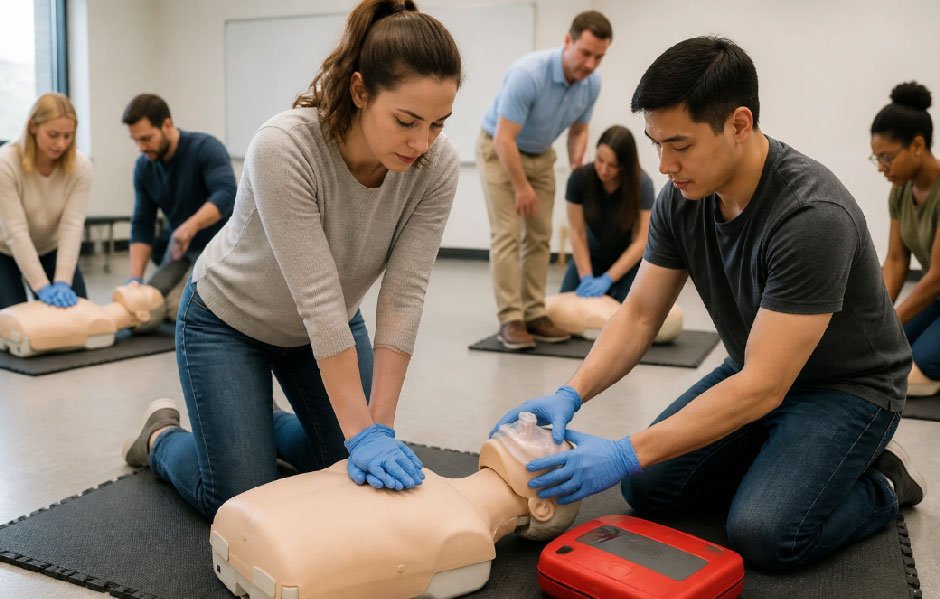
If you share your home with a cat, you already know the drill. You research the best food, book the vet visits, cat-proof the windows, and lie awake worrying over a single skipped meal. Devoted pet owners pour real love into keeping their animals safe. So here’s a gentle question worth sitting with: if a person in your home collapsed, would you know what to do? Taking a First Aid training in Calgary gives you that same protective instinct, aimed at the people you love most. The care already lives in you. This is about pointing it at a human emergency.
The mindset that makes you a great cat parent is the same one that makes a great first responder. Let’s explore why.
Why Do Pet Owners Make Natural Caregivers?
Think about what being a devoted pet owner actually requires. You notice small changes in behaviour. You stay calm when your cat is distressed. You act quickly when something seems wrong. You’ve trained yourself to pay attention.
Those are the exact instincts first aid builds on. Attentiveness, composure under pressure, and the willingness to step in rather than hope someone else handles it.
The difference is simply knowledge. You’ve learned your cat’s warning signs over years of living together. Human first aid gives you the same kind of knowledge for people, condensed into one approachable course.
You already have the heart for it. This just adds the know-how.
What Human Emergencies Should You Be Ready For?
Just as you’d want to recognize when your cat is in trouble, it helps to know the common human emergencies that strike without warning at home:
- Cardiac arrest, when the heart suddenly stops and the person collapses
- Choking, which can happen at any meal, to adults and children alike
- Serious bleeding from a kitchen accident or a fall
- Severe allergic reactions, which can escalate within minutes
- Burns and scalds, common wherever there’s a stove and a kettle
None of these announce themselves. They arrive in the middle of an ordinary evening. The people trained to handle them aren’t superheroes. They’re regular folks who took an afternoon to learn.
What Exactly Is Hands-Only CPR?
If there’s one skill worth carrying for life, this is it, and it’s simpler than most people expect.
When an adult collapses and isn’t breathing normally, hands-only CPR can keep blood moving to their brain until help arrives. You push hard and fast in the centre of the chest, about 100 to 120 times a minute, letting the chest rise fully between each push. No rescue breaths needed for untrained bystanders.
That’s the whole core of it. Trained rescuers go further, learning the 30 compressions to 2 breaths rhythm and the gentler techniques for children and infants, but the hands-only version is something anyone can do today.
Why does it matter so much? Because speed is everything. In Canada, around 60,000 cardiac arrests happen outside hospitals each year, and only about 1 in 10 people survive. Immediate CPR paired with an AED can double those odds.
What’s an AED, and Could You Use One?
You’ve probably walked past an AED a hundred times without noticing. They hang in community centres, malls, offices, and rec facilities across Calgary.
An AED, or automated external defibrillator, is a device that can restart a heart’s normal rhythm. Here’s the reassuring part: it talks you through every step. You turn it on, place the pads as the pictures show, and it tells you exactly what to do, even when to push the button.
You don’t need to memorize anything. You just need to know these machines exist, that you’re allowed to use one, and that doing so can be the difference between life and loss. A short course removes the hesitation that costs precious seconds.
How Do You Handle Choking?
Choking is one of the most frightening emergencies to witness, and one of the most treatable when you know the steps.
For a conscious adult or child who can’t breathe, speak, or cough, back blows between the shoulder blades followed by abdominal thrusts can dislodge the blockage. The technique shifts for infants, using gentler back blows and chest thrusts suited to their small size.
The key is acting without freezing. A trained person moves in while others stand stunned. That’s the gift of practice: your hands remember the steps when your mind is racing.
Why Does Having a Trained Person at Home Matter?
Here’s a truth worth sitting with. Most serious emergencies happen at home, surrounded by the people we love, not in some public place full of strangers.
That means the person most likely to save your partner, your child, or your parent is you. Not a passing paramedic. You.
When even one person in a household is trained, the whole home becomes safer. You become the calm centre when everything else is chaos. You know where the nearest AED is. You know the rhythm of compressions. You know not to wait and wonder.
Think of it as insurance you hope to never use, bought with a single short course. Learning through Coast2Coast First Aid is an easy way to bring that protection into your home.
Isn’t Learning First Aid a Big Commitment?
Not anymore. Modern training respects your time.
Many courses now use blended learning. You complete the theory online, at your own pace, maybe with a cat curled on your lap. Then you attend one short in-person session to practise the physical skills with an instructor. No long, draining classroom days.
It’s the kind of thing you can slot into a busy week without upending your schedule. And once it’s done, the knowledge stays with you, refreshed with a quick renewal every three years.
What’s the Real Reason to Learn?
You already know how to love something enough to protect it. Every vet bill, every careful choice, every worried glance proves it.
First aid simply widens that circle. It takes the fierce, attentive care you give your cat and gives you the power to use it for a person in their worst moment. That’s not a burden. It’s a privilege.
So the next time you catch yourself fussing over your pet’s wellbeing, let it be a nudge. The people in your home deserve a caregiver who’s ready too. And readiness is just one short course away.
How Do You Handle Bleeding and Burns?
Beyond the dramatic emergencies, everyday injuries happen constantly, and knowing the right response keeps small accidents from becoming serious ones.
For serious bleeding, the first and most important step is firm, direct pressure on the wound with a clean cloth or dressing. Keep pressing. Resist the urge to peek every few seconds, because lifting the pressure lets the bleeding start again. This simple action buys time until help arrives.
For burns and scalds, cool running water for several minutes is the correct first move, not ice, not butter, and not the kitchen remedies that often cause more harm. Cover the area loosely afterward and know the signs that a burn is serious enough to need medical attention.
These aren’t complicated skills, but doing them correctly in a stressful moment takes a little practice. That’s exactly what a hands-on course gives you: the chance to try the motions before you ever need them for real.
Why Does Calm Matter as Much as Technique?
Ask anyone who’s been through a real emergency and they’ll tell you the same thing. The hardest part isn’t the technique. It’s staying composed enough to use it.
This is where pet owners have a quiet advantage. You’ve already practised staying calm when an animal you love is hurt or frightened. You know how to push past your own panic to help a creature that depends on you.
First aid training strengthens that same calm and points it at human emergencies. By rehearsing the steps in a safe setting, you build the kind of muscle memory that takes over when your mind goes blank. You stop thinking “what do I do?” and start simply doing it.
That composure is contagious, too. When you’re steady, the people around you steady themselves. Children stop panicking. Bystanders start helping. Your calm becomes the anchor that holds a frightening moment together, long enough for the outcome to change.
If you’re looking for first aid and CPR training near Capitol Hill Crescent NW and 16th Avenue, the SAIT and Confederation Park area, or surrounding areas, you may reach out to Coast2Coast First Aid Inc. in that area.
Frequently Asked Questions
Q: Is this course about first aid for pets or for people?
A: This is human first aid training. While pet owners often have wonderful caregiving instincts, the course teaches you to help people in emergencies like cardiac arrest, choking, and bleeding. For animal medical concerns, your veterinarian is always the right resource.
Q: Do I need any experience to take a first aid course?
A: None at all. Courses are built for complete beginners and walk you through every skill step by step. If you can follow simple instructions and are willing to help, you can learn first aid and CPR.
Q: How does an AED work if I’ve never used one?
A: An AED guides you through the entire process with clear voice prompts and pictures. It tells you where to place the pads and when to deliver a shock. You don’t need to memorize anything, and a short course helps you feel confident using one.
Q: How long does certification last?
A: Standard first aid and CPR certifications are generally valid for three years. A quick refresher course keeps your skills sharp, since hands-on abilities fade over time without practice.
Q: Can I really learn CPR online?
A: With blended learning, you complete the theory portion online at your own pace, then attend one short in-person session to practise the physical skills. This hands-on practice is essential for building the muscle memory CPR requires.