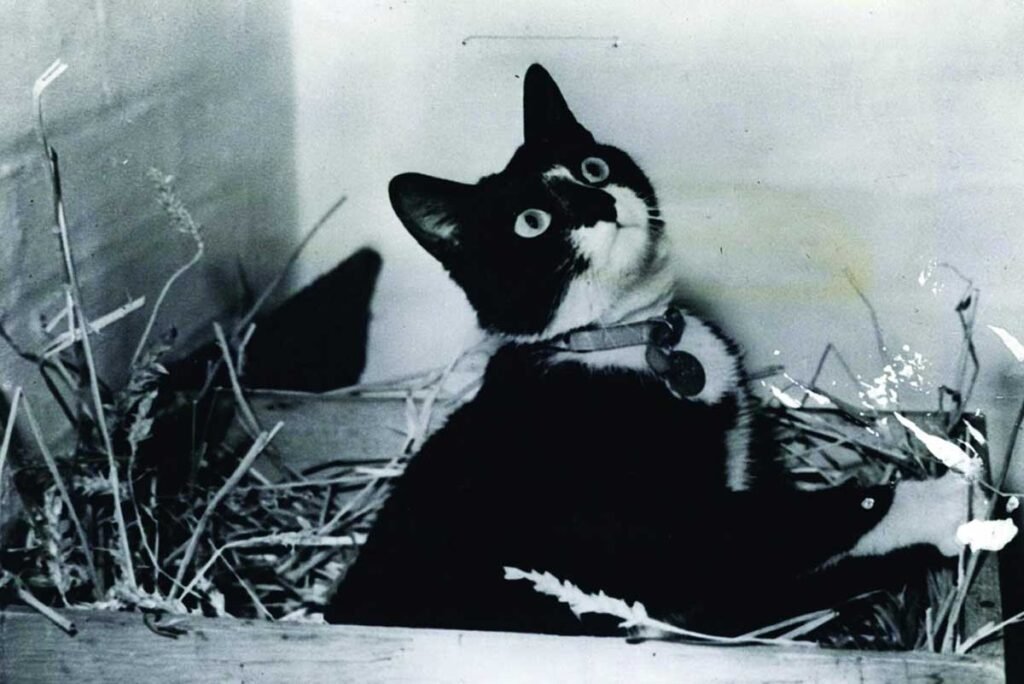
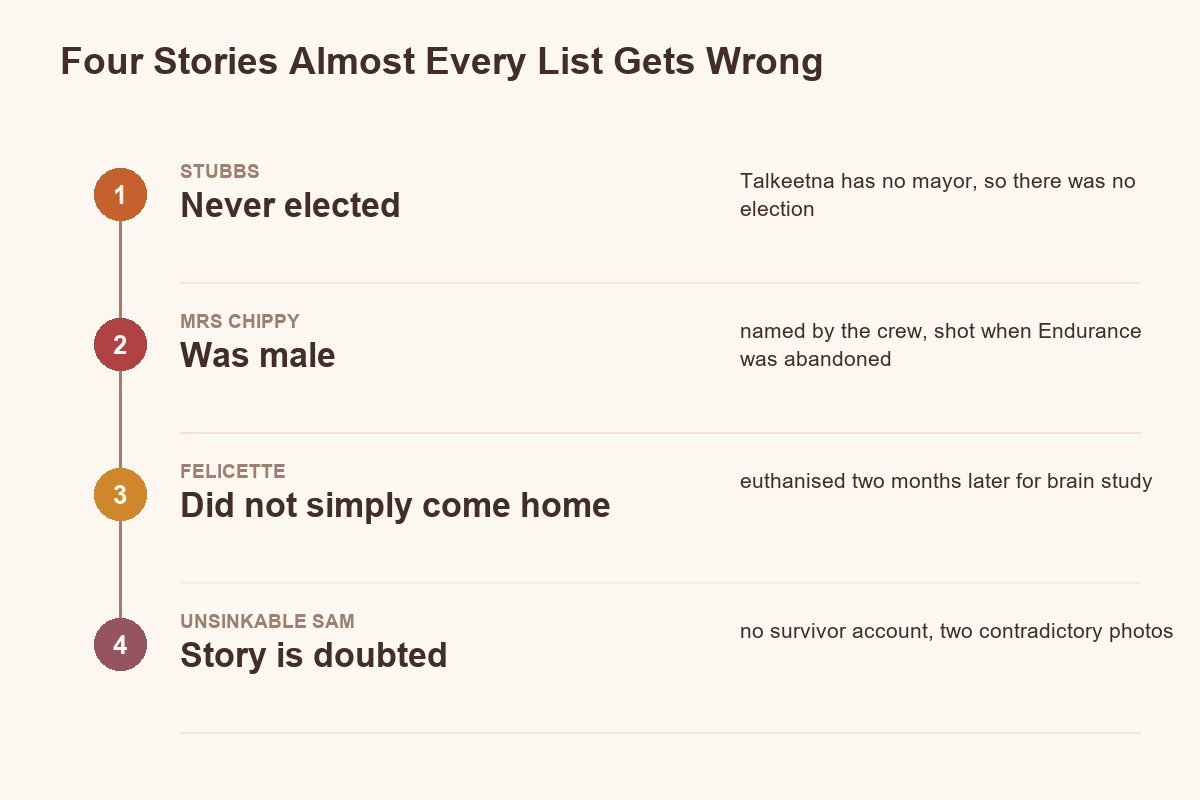
The most repeated facts about famous cats in history are frequently the ones that fall apart first. A cat mayor who was never elected. A ship’s cat named Mrs who was male. A space cat whose story ends two months later than the version you were told.
The cats below are real and their records are documented. What follows is the documented version, which is stranger and sadder than the tidy one.
The Ship’s Cats
Cats went to sea for centuries as working animals, hired to protect stores and rigging from rats, and a few of them ended up with service records better than some of the sailors.
Simon of HMS Amethyst is the one whose honours are beyond dispute. Wounded by shellfire on the Yangtze in 1949, he kept killing rats through the ship’s ordeal and remains the only cat ever awarded the PDSA’s Dickin Medal, the animal equivalent of the Victoria Cross.
Unsinkable Sam is the famous one, and the shaky one. The story has a single cat surviving the sinking of the Bismarck, then HMS Cossack, then HMS Ark Royal, which would make him the luckiest animal of the Second World War. The record notes the doubt plainly: there is no survivor account placing him aboard the Bismarck, and two contradictory photographs exist. A story that good deserves better evidence than it has.
Mrs Chippy Was a Tom, and the Story Ends Badly
Mrs Chippy sailed with Shackleton’s Imperial Trans-Antarctic Expedition in 1914 as the carpenter’s cat, belonging to Harry McNish. The name came from the crew, who assumed the cat was female and never bothered to change it after learning otherwise. He was a mackerel tabby tom.
When the Endurance was crushed and the party took to the ice on 29 October 1915, Mrs Chippy was shot along with several of the dogs. Shackleton’s reasoning was recorded at the time: the expedition could not maintain animals that could not pull.
McNish never forgave him. The carpenter died destitute in Wellington in 1930 and was buried in an unmarked grave; the New Zealand Antarctic Society placed a headstone there in 1959, and a bronze of Mrs Chippy was later added to it. That is the part of the story worth carrying, and it is the part the listicles cut.
Félicette, the Only Cat in Space
France launched Félicette on 18 October 1963 through its aerospace medicine research centre, CERMA, with electrodes implanted in her skull to transmit neural activity during the flight. The capsule came down by parachute and was recovered thirteen minutes after ignition. She survived.
Two months later she was euthanised so her brain could be examined by necropsy.
Most accounts stop at the recovery, and the omission matters, because the reason she flew at all was to produce that brain tissue. There is a second detail that survives in almost every retelling: the press named her Félix, after the cartoon, and CERMA adjusted it to the feminine Félicette afterwards. She was designated C 341 until the moment she became famous.
The Cat Mayor Who Was Never Elected
Stubbs held the title of honorary mayor of Talkeetna, Alaska from July 1997 until his death in 2017, and ran his affairs from Nagley’s General Store. The story attached to him says voters ran a write-in campaign because they disliked the human candidates.
NPR pointed out the flaw: Talkeetna has no real mayor, so there was no election to write into. The town is unincorporated. Stubbs was a tourist attraction with a title the community enjoyed giving him, which is a perfectly good story without the invented ballot.
The Record Holders and the Poets’ Cats
Creme Puff of Austin, Texas lived from 1967 to 2005, just over 38 years, and remains the longest-lived cat verified by Guinness World Records. She belonged to Jake Perry, whose household produced more than one extraordinarily old cat, which is the sort of detail that invites questions no one has answered.
Further back, Pangur Bán belonged to an Irish monk who wrote a poem comparing his own scholarly hunting to the cat’s hunting of mice, and the verse survives from around the ninth century. Crimean Tom was found alive in the ruins of Sevastopol after the siege and is credited with leading British troops to buried food stores.
Neither of those needs correcting. They were written down close to the events by people who were there, which is precisely why they have not drifted.
Why These Stories Drift
The pattern is consistent once you see it. The corrections always run the same direction: a cat gets an office it never held, a tragedy gets trimmed off the end, an unverifiable coincidence gets stated as record. Nobody is lying. Each retelling just drops the caveat that made the previous version accurate.
If you want to check one of these yourself, the test is simple. Ask who wrote it down at the time, and whether anyone who was present ever confirmed it. Simon has a medal citation and a ship’s log. Unsinkable Sam has a photograph nobody can reconcile.
Cats turn up just as often in invented form. Our companion pieces cover the famous cartoon cats and what animators get right about real feline behaviour, and cats in famous paintings, where a cat on a bed was rarely just a cat.
FAQ
Who is the most famous cat in history?
Among famous cats in history, Félicette has the strongest claim as the only cat ever launched into space, flown by France in October 1963. Simon of HMS Amethyst is the most decorated, holding the only Dickin Medal awarded to a cat.
Did the space cat survive?
Félicette survived the flight itself and was recovered by parachute thirteen minutes after launch. She was euthanised two months later so that scientists could examine her brain, which is the part most retellings leave out.
What is the oldest cat ever recorded?
Creme Puff of Austin, Texas reached just over 38 years before her death in 2005 and remains the Guinness World Records holder. Modern verified ages rarely approach thirty, so the record stands well clear of the field.
Was there really a cat mayor?
Stubbs was honorary mayor of Talkeetna, Alaska for twenty years, but he was never elected, because the town is unincorporated and has no mayoral office. The write-in campaign described in most accounts could not have taken place.