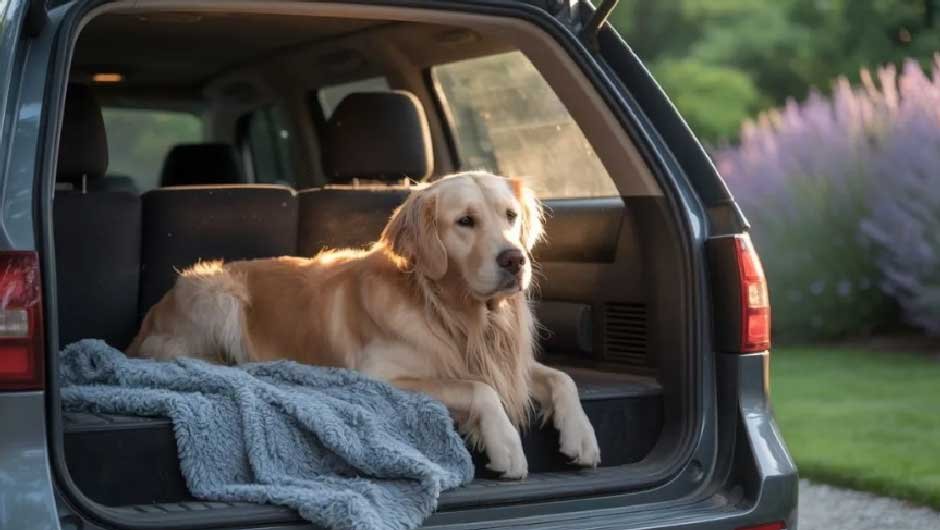
Most owners discover their dog’s car anxiety the worst possible way: on the drive to the vet, with traffic backing up and a panting, drooling animal in the back seat. By then, training is off the table and the only question is how to make the next 20 minutes survivable. A calm dog in the car comes from three layers working together: an emergency response for active panic, a gradual 4- to 6-week desensitization plan, and the right calming aid for the dog’s anxiety level. What follows is the in-ride playbook for the bad days, a realistic week-by-week training timeline, a side-by-side medication comparison, and the common mistakes that quietly make car anxiety worse.
What to Do Right Now If Your Dog Is Panicking in the Car
If your dog is panicking mid-drive, pull over safely within the next two minutes, cut the cabin temperature, and stop talking in your high-pitched soothing voice. The fastest way to calm a dog in the car immediately is to remove escalating stimuli, not to add more reassurance. Crisis-mode petting often reads to the dog as confirmation that something is wrong.
Once you are parked, run through this five-step sequence:
- Pull over to a safe shoulder or lot. Never try to soothe a panicked dog from the driver’s seat. A loose, terrified dog is a moving hazard.
- Drop the cabin temperature and crack two windows. Heat stacks anxiety fast. Most stress-panting dogs ride 5-8 degrees hotter than the cabin reading.
- Speak quietly or stay silent. Skip phrases like “it’s okay, baby.” Dogs read tone more than words, and frantic reassurance signals danger.
- Offer a scent anchor. A worn t-shirt, the dog’s blanket, or a piece of bedding from home gives the nervous system something familiar to latch onto.
- Try slow, long strokes along the chest or back-of-neck, not the top of the head. Head-petting feels confrontational to a stressed dog.
If the dog settles within five minutes, you can usually continue. If panting becomes labored, gums turn pale or brick red, or the dog collapses, that is a vet emergency: heatstroke and vasovagal episodes both present this way. The difference between a 30-second pause and a five-minute one is often whether the dog ever rides willingly again. According to the ASPCA, prolonged car stress can imprint as a phobia after a single bad ride, especially in dogs under two years old.
“Advice on how to calm dog in car? She shakes the entire ride, drools, sometimes vomits. We’ve tried treats, toys, nothing works mid-drive.”
This is the most common pattern on dog-advice subreddits: owners trying mid-drive fixes when the only viable mid-drive fix is to stop driving.
Spot the Early Anxiety Signals Before They Escalate
If you want to calm down a dog in the car, you first have to recognize when the dog is asking for help. Car anxiety almost never starts with vomiting. It starts with subtle stress signals 10 to 30 minutes earlier, and most owners miss them. A dog’s anxiety follows a three-tier escalation: early signs (lip licking, yawning, looking away), moderate signs (panting, whining, pacing), and crisis signs (vomiting, escape attempts, frozen posture). Catching the early tier is the single most useful skill a dog owner can build.
| Tier | What You’ll See | What to Do |
|---|---|---|
| Subtle (early) | Lip licking, yawning, head turned away, tight closed mouth, sudden stillness | Pause the activity. Don’t drive yet. Sit with the dog for 5 minutes. |
| Moderate | Heavy panting in a cool car, whining, pacing, drooling, tail tucked, low body posture | Step the training back two stages. End the session on a quiet positive note. |
| Crisis | Vomiting, frantic escape attempts, frozen statue posture, defecation, trembling that does not stop | Pull over. End the trip if possible. Schedule a vet behaviorist consult. |
Two dogs in the same car can show the same drooling: one needs an anti-emetic, the other needs a behaviorist. The fast diagnostic question is whether the drooling and nausea improve when the car stops. True motion sickness eases within 5 to 10 minutes of being still. Pure anxiety often takes 20-40 minutes to fade, even on solid ground. The American Veterinary Medical Association notes that early-tier stress signals are routinely overlooked by owners, which is why most car phobias deepen over months of “they were doing fine.”
The 6-Week Desensitization Plan That Actually Works
Your goal for the next six weeks is to never give your dog a single bad ride, even if that means not driving anywhere with them at all. A realistic desensitization plan moves in five stages over six weeks, with daily 10-minute sessions and never any pressure to move faster than the dog allows. The principle is counter-conditioning: pair the car with something the dog already loves until the car itself becomes the cue for that good thing. Forcing a fearful dog into longer rides “to get used to it” is the fastest way to make car anxiety permanent.
| Phase | Daily Activity | Duration | Success Marker |
|---|---|---|---|
| Week 1-2 | Walk near the parked car. Feed meals 6-10 feet from it, working closer day by day. | 5-10 min/day | Dog approaches the car without tension |
| Week 3 | Sit inside with the dog, engine off, doors open. Treat, praise, leave. | 10 min/day | Dog jumps in willingly |
| Week 4 | Engine on, doors closed, parked. Still no driving. Treat, praise, leave. | 10-15 min/day | Dog relaxes during engine sound |
| Week 5 | Driveway loops and 60-second drives ending at a fun destination (yard, park). | 2-5 min/day | Tail neutral or wagging on arrival |
| Week 6+ | 10-20 minute trips to enjoyable places: park, beach, dog-friendly cafe. | 3-4 trips/week | Settles within 2 minutes of starting to drive |
Why Counter-Conditioning Beats Forced Exposure
Forced exposure (also called flooding) works in some training contexts but routinely backfires with car anxiety. The dog learns the car is inescapable, not that it is safe. Counter-conditioning swaps that lesson: the car predicts the best part of the day. AKC trainer Stephanie Gibeault, CPDT, frames it as teaching the dog to volunteer rather than tolerate. Volunteering is what gets you a road-trip dog years later.
How to Handle a Setback
A single bad ride can knock a dog back two phases. When that happens, do not push forward; restart at a stage where the dog was last visibly relaxed and rebuild from there. Setbacks are part of the timeline, not a sign the plan is failing.
“My husband and I accidentally cured our pupper’s car anxiety. We stopped driving anywhere for a month and just fed him dinner in the parked car every night. By week three he was jumping in on his own.”
The thread is one of the most-upvoted car-anxiety success stories on Reddit, and it lines up exactly with what the staircase method predicts: slow, daily, no driving for weeks, food paired with the car. A Reddit thread with 148 upvotes documented one couple’s accidental win, and the variable they isolated was patience. Everything else was already in their kitchen.
Where Should Your Dog Sit, and How Should the Car Be Set Up?
Most dogs ride safest in the back seat with a crash-tested harness anchored to the seat belt, or in the cargo area of an SUV behind a barrier. The front seat is never appropriate: a deployed airbag can kill a dog under 80 pounds, and the visual stimulation overwhelms anxious dogs within minutes.
- Small to medium dogs: Back seat, crash-tested harness clipped to a seat-belt anchor. Crate strapped down on the floor if the dog is calmer in a crate.
- Large dogs: Cargo area of an SUV or wagon, behind a sturdy barrier. More containment, less sway.
- Crate users: Position the crate forward-facing, not sideways. Side-facing motion triggers vestibular nausea in most dogs.
- Never: Front seat, lap of a passenger, loose in the cargo bed of a pickup, head out the window at speed.
The Center for Pet Safety runs the only independent crash-testing program for pet travel gear in the United States. As of their 2023 testing cycle, only a small fraction of marketed dog harnesses passed at highway-speed forces. The CPS-certified list is short and worth checking before buying based on marketing alone.
Calming Aids Compared: Pheromones, Supplements, and Prescription Meds
If your dog needs more than training to calm down in the car, you have three layers to choose from, and the right one depends on how severe the anxiety actually is. The best calming aid for dogs in the car depends entirely on anxiety severity: pheromones and L-theanine work for mild stress, prescription trazodone or gabapentin is the standard for moderate-to-severe cases, and Cerenia handles motion-sickness vomiting separately from anxiety itself. Pick by severity, not by popularity. Most owner mistakes start with assuming Benadryl is a calming option, which it isn’t.
| Aid | Type | Onset | Vet Rx? | Best For | Key Notes |
|---|---|---|---|---|---|
| ADAPTIL collar or spray | Synthetic pheromone | 30-60 min | No | Mild anxiety, daily use | Safe long-term; effect builds over weeks |
| L-theanine / Zylkene | OTC supplement | 30-90 min | No | Mild-to-moderate, daily use | Most effective when given daily for 2-4 weeks |
| CBD (broad-spectrum) | OTC supplement | 30-60 min | No | Mild anxiety | Quality varies widely; choose USDA-certified brands |
| Benadryl (diphenhydramine) | OTC antihistamine | 30 min | Confirm dose with vet | Mild sedation only, NOT anxiety | Risky and largely ineffective for true anxiety |
| Trazodone | Prescription | 1-2 hours | Yes | Moderate-to-severe anxiety | Veterinary behaviorist first choice for car rides |
| Gabapentin | Prescription | 1-2 hours | Yes | Anxiety with reactivity or pain | Often paired with trazodone for severe cases |
| Cerenia (maropitant) | Prescription | 1-2 hours | Yes | Motion-sickness vomiting | 24-hour effect; treats nausea, not anxiety |
Many owners reach for Benadryl because their vet did not return the call in time, and the dog still rides in fear, just quieter. The American College of Veterinary Behaviorists lists trazodone as a first-line option for situational anxiety in dogs, partly because it has a short half-life and can be dosed only on travel days. Talk to your vet about a single-trip prescription before any planned road trip rather than a daily medication you may not need.
Long Road Trips (4+ Hours): The Break and Hydration Cadence
For trips over four hours, plan a 10- to 15-minute walk and water break every two hours, feed three to four hours before departure rather than just before, and book pet-friendly accommodation if the trip will run overnight. Long-trip anxiety is more about cumulative fatigue and dehydration than the duration itself.
- Pre-trip (night before and morning of): Long exercise session the day before. Feed a normal meal 3-4 hours before departure. Skip the just-before-leaving meal completely.
- Every 2 hours on the road: 10-15 minute leashed walk. Offer water in a collapsible bowl. Do not force drinking.
- Hot weather: Never leave the dog in a closed car alone. Above 75°F, internal car temperature can reach lethal levels in under 15 minutes, per AVMA hot-car warnings.
- Overnight stops: Book pet-friendly hotels ahead. Bring scent items (bed, blanket, an unwashed t-shirt) for the room. Walk the perimeter before going inside.
“How to keep dog calm on a long car ride? We’re driving 8 hours next weekend and she’s never done more than 20 minutes.”
Going from 20 minutes to 8 hours in one jump is exactly the scenario where a single-day trazodone prescription, planned with the vet a week in advance, earns its cost. The dog rides through the hardest stretch sedated enough to break the panic-loop, and the next long trip starts from a calmer baseline.
Five Mistakes That Make Car Anxiety Worse
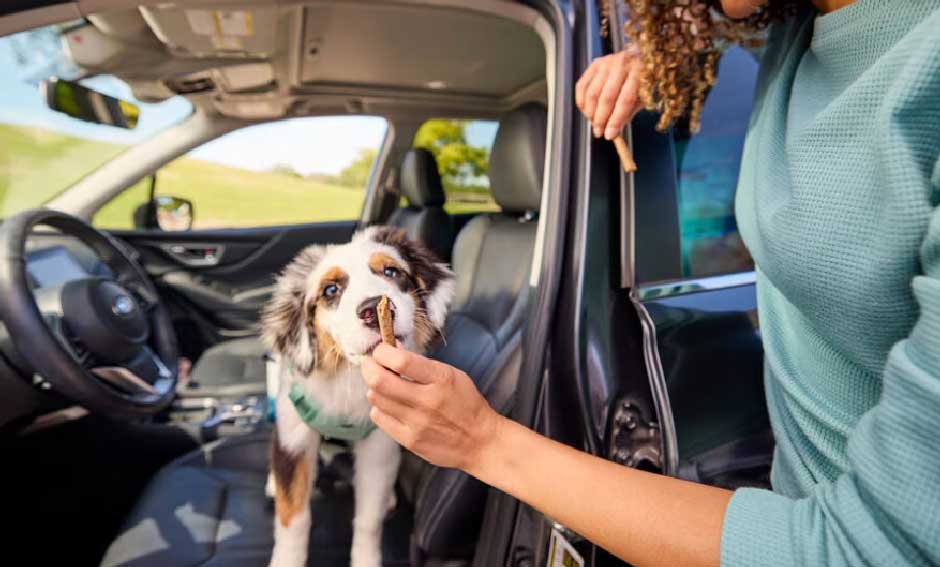
You can do almost everything in this guide correctly and still set your dog back if you fall into one of the patterns most owners do not realize they’re repeating. The five most common owner mistakes that quietly worsen car anxiety are: starting with a long vet trip, feeding right before driving, putting the dog in the front seat, soothing in a high-pitched voice, and dropping training the moment the dog seems “okay.” Each one teaches the dog something the owner did not intend. Owners do not see a training mistake. They see a dog that “just hates the car.”
- Starting big. The first car ride should not be a 2-hour vet trip. A rescue dog’s first ride home is often the first imprint, and it sticks.
- Feeding right before. Food in a moving stomach plus anxiety creates a vomit-anxiety loop that is hard to break. Feed 3-4 hours before departure.
- Front-seat placement. Airbags can kill a small or medium dog on deployment. The view from the front also over-stimulates anxious dogs.
- High-pitched soothing. “It’s okay, sweet baby, you’re fine” sounds reassuring to humans and alarming to dogs. Stay quiet or use a low, neutral tone.
- Stopping training too early. Anxiety compounds quietly. A dog who “seems okay” for short trips often falls apart on the first long one if training stopped at week three.
One CPDT-certified trainer in a 2022 interview estimated that roughly 70 percent of the car-anxious dogs in her practice were rescues whose first car ride was a vet visit on adoption day. The first imprint matters more than any single training session that follows.
Frequently Asked Questions
How long does it take to train a dog to be calm in the car?
Most dogs respond within 4 to 6 weeks of daily 10-minute sessions, though severely anxious rescue dogs may need 3 to 4 months. Consistency matters more than session length. Five short daily sessions outperform one long weekend session every time.
Can I give my dog Benadryl for car anxiety?
Benadryl sedates the body but does not reduce anxiety, and most veterinary behaviorists advise against it for car rides. The dog stays scared, just immobilized. Trazodone or gabapentin, both prescription, work better for true anxiety and are routinely prescribed for situational car-ride use.
Why does my dog only get sick in the back seat?
Dogs experience motion sickness more intensely in the back seat, where visual cues conflict with inner-ear motion signals. Forward-facing crate placement and a clear sight line out the windshield reduce nausea for most dogs. Side-facing crates worsen the vestibular mismatch.
Are calming chews safe for daily use?
L-theanine, Zylkene, and most chamomile-based calming chews are safe for daily use in healthy adult dogs. Check with your vet first if your dog takes other medication or has liver or kidney issues. CBD chew quality varies widely; choose USDA-certified, third-party tested products.
Does music actually help calm down a dog in the car?
Yes. A 2017 study from the Scottish SPCA found that classical music and reggae reduced canine stress markers more than silence or other genres. Keep the volume low, aim for around 60 BPM, and use the same playlist on every ride so the music becomes its own calming cue.
Should I let my dog hang their head out the window?
No. Wind exposure can lodge debris in the eyes and ears, airborne pathogens hit dogs harder than humans, and a sudden swerve can throw an unrestrained dog out of the car. Crack the window an inch or two for airflow, but never let the head protrude at driving speed.
Putting It Together: How to Calm Down a Dog in the Car
The owners who figure out how to calm down a dog in the car never solve it with a single fix. They treat it as three parallel tracks: an emergency skill for bad days, a multi-week training plan that runs in the background of normal life, and a calming-aid backup chosen by anxiety severity rather than popularity. Owners do not see a behavioral problem. They see a stubborn dog. The dog who panics on a short vet drive at three years old can be the same dog napping through a six-hour interstate run at four. With the right combination, it really is that linear.